
Ask questions which are clear, concise and easy to understand.
Ask QuestionPosted by Shubham Soni 7 years ago
- 3 answers
Posted by Arpan Sinha 7 years ago
- 2 answers
Posted by Swati Tyagi 7 years ago
- 2 answers
Chētnà Pandey✌️ 7 years ago
Posted by Varun Yadav 7 years ago
- 1 answers
Posted by Gulshan Kumar 6 years, 6 months ago
- 1 answers
Sia ? 6 years, 6 months ago

Radius of the cone = 3.5 cm
{tex}\therefore {/tex} Radius of the hemisphere = 3.5 cm
Total height of the toy = 15.5 cm
{tex}\therefore {/tex} Height of the cone = 15.5 - 3.5 = 12 cm
Slant height of the cone = {tex}\sqrt {{{(3.5)}^2} + {{(12)}^2}} = \sqrt {12.25 + 144} {/tex}
{tex} = \sqrt {156.25} {/tex} = 12.5 cm
{tex}\therefore {/tex} Total surface area of the toy = Curved surface area of hemisphere + Curved surface area of cone
{tex} = 2\pi {r^2} + \pi rl = 2\pi {(3.5)^2} + \pi (3.5)(12.5){/tex}
{tex} = 24.5\pi + 43.75\pi = 68.25\pi = 68.25 \times \frac{{22}}{7}{/tex} = 214.5 cm2
Posted by Nitin Rai 7 years ago
- 1 answers
Posted by Pradumn Kumar Singh 7 years ago
- 5 answers
Priya Raj 7 years ago
Posted by Saloni Chaudhary 7 years ago
- 1 answers
S Sihag Ji 7 years ago
Posted by Rishabh Kumar Singh 6 years, 6 months ago
- 1 answers
Sia ? 6 years, 6 months ago
Given in the quadrilateral ABCD
{tex}\frac{AO}{BO}=\frac{CO}{DO}{/tex}
or, {tex}\frac { A O } { C O } = \frac { B O } { D O }{/tex} ...(i)
Draw EO {tex}\parallel{/tex} AB on
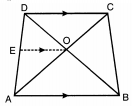
In {tex}\triangle A B D,{/tex} EO {tex}\parallel{/tex} AB (By construction)
{tex}\therefore {/tex} {tex}\frac { A E } { E D } = \frac { B O } { D O }{/tex} (By BPT)...(ii)
From (i) and (ii) we get
{tex}\frac{AO}{CO}=\frac{AE}{ED}{/tex}
Hence by converse of BPT in {tex}\triangle{/tex}ADC
{tex}EO\|CD{/tex}
But {tex}EO \|AB {/tex}
So {tex}AB\|CD {/tex}
Therefore ABCD is a trapezium
Posted by Hemanth Ganesh 6 years, 6 months ago
- 1 answers
Sia ? 6 years, 6 months ago
We know that the tangent segments from an external point to a circle are equal

{tex}\therefore{/tex} AP = AS ........(1)
BP = BQ .......(2)
CR = CQ .......(3)
DR = DS .......(4)
Adding (1), (2), (3) and (4), we get
(AP + BP) + (CR + DR) = (AS + BQ + CQ + DS)
{tex}\Rightarrow{/tex} AB + CD = (AS + DS) + (BQ + CQ)
{tex}\Rightarrow{/tex} AB + CD = AD + BC
Posted by Tamanna Soni 7 years ago
- 1 answers
Yaar 7 years ago
Posted by Manish Kumar 7 years ago
- 1 answers
Posted by Nonu Kansal 7 years ago
- 4 answers
Posted by Sanjana Dhakad 7 years ago
- 2 answers
Posted by Sunny Rudra Singh 7 years ago
- 0 answers
Posted by Shailly Rawat 7 years ago
- 1 answers
Posted by Reeja Ansari 7 years ago
- 1 answers
Posted by Akshansh Kakkar 7 years ago
- 1 answers
Yaar 7 years ago
Posted by Sairubashri T 7 years ago
- 3 answers
Posted by Jyoti Rawat 7 years ago
- 1 answers
Yaar 7 years ago
Posted by Amit Jaiswal 7 years ago
- 1 answers
Gaurav Seth 7 years ago
given n =11
middle term = (a1 + a11)/2 = 30
a1 + a11 = 60 .......... i
Sn = n/2(a1 + a11) ......... ii
= 11/2 (60) ... from i
= 11 x 30
= 330
Posted by Nitin Kumar? 7 years ago
- 5 answers
Ankit Tarar 7 years ago
Deepak R 7 years ago
Posted by Nitin Kumar? 7 years ago
- 6 answers
Posted by Tannu Pal 7 years ago
- 3 answers
Soumya Ranjan Mahapatra 7 years ago
Posted by Harshdeep Singh 7 years ago
- 1 answers
Gaurav Seth 7 years ago
Let 1st term of AP be 'a',
Let the common difference be 'd',
So,as per question, 7 x 7th term = 11 x 11th term
or, 7 [a+6d] = 11 [a+10d]
or, 7a+42d = 11a +110d
or, 4a + 68d = 0
or, a + 17d = 0 .......(1)
Now, 18th term = a+17d
or, t18 = 0 (from 1)
Posted by Shivani Burkul 7 years ago
- 6 answers
Harsh Katiyar 7 years ago
Harsh Katiyar 7 years ago
Posted by Satyam Roy 7 years ago
- 2 answers
Himanshi Sharma 7 years ago

myCBSEguide
Trusted by 1 Crore+ Students

Test Generator
Create papers online. It's FREE.

CUET Mock Tests
75,000+ questions to practice only on myCBSEguide app

Nitin Kumar? 7 years ago
2Thank You