
Ask questions which are clear, concise and easy to understand.
Ask QuestionPosted by Abdul Wajid Malik 6 years, 11 months ago
- 3 answers
Simar Simar 6 years, 11 months ago
Posted by Rakesh Rakesh 6 years, 6 months ago
- 1 answers
Sia ? 6 years, 6 months ago
Diameter of cylindrical pipe = 7 cm
∴ Radius of cylindrical pipe = {tex}\frac { 7 } { 2 }{/tex}cm = 3.5 cm
Volume of water flows in 1 min = 192.5 litres
Volume of water that flows per hour = {tex}( 192.50 \times 60 ){/tex}litres
{tex}= ( 192.50 \times 60 \times 1000 ) \mathrm { cm } ^ { 3 }{/tex} ........(I)
{tex}{/tex} {tex}{/tex}Let h cm be the length of the column of water that flows in one hour.
Clearly, water column forms a cylinder of radius 3.5 cm and length h cm.
{tex}\therefore{/tex} Volume of water that flows in one hour
= πr2 h
Volume of the cylinder of radius 3.5 cm and length h cm
{tex}= \left[ \frac { 22 } { 7 } \times ( 3.5 ) ^ { 2 } \times h \right] \mathrm { cm } ^ { 3 }{/tex} ...(ii)
From (i) and (ii), we have
πr2 h = 192.50 × 60 × 1000
{tex}\frac { 22 } { 7 } \times 3.5 \times 3.5 \times h = 192.50 \times 60 \times 1000{/tex}
{tex}\Rightarrow \quad h = \frac { 192.50 \times 60 \times 1000 \times 7 } { 22 \times 3.5 \times 3.5 } \mathrm { cm }{/tex} = 300000 cm = 3 km
Hence, the rate of flow of water is 3 km per hour.
Posted by Zoya Khan 6 years, 6 months ago
- 1 answers
Sia ? 6 years, 6 months ago
Let the coordinates of the third vertex be (x, y), Then
Coordinates of centroid of triangle are
{tex}\left( {\frac{{x + 1 + 3}}{3},\frac{{y + 2 + 5}}{3}} \right){/tex}
We have centroid is at origin (0, 0)
{tex}\therefore \frac{{x + 1 + 3}}{3} = 0{/tex} and {tex}\frac{{y + 2 + 5}}{3} = 0{/tex}
{tex}\Rightarrow{/tex} x + 4 = 0 {tex}\Rightarrow{/tex} y + 7 = 0
{tex}\Rightarrow{/tex} x = -4 {tex}\Rightarrow{/tex} y = -7
Hence, the coordinates of the third vertex are (-4, -7).
Posted by Ashwin Patel 6 years, 11 months ago
- 2 answers
Ashwin Patel 6 years, 11 months ago
Posted by Kamal Gupta 6 years, 11 months ago
- 2 answers
Nishant Dubey 6 years, 11 months ago
Gaurav Seth 6 years, 11 months ago
If nth term of an A.P = 2n+1
then, first term of A.P = 2(1)+1
= 2+1
= 3
then, second term = 2 (2) + 1
》4+1
》5
third term = 2 (3) +1
》6+1
》7
sum of terms = 3+5+7
sum of terms = 15
Posted by Anvika Rana 6 years, 11 months ago
- 3 answers
Anvika Rana 6 years, 11 months ago
Nishant Dubey 6 years, 11 months ago
Posted by Karan Verma 6 years, 11 months ago
- 0 answers
Posted by Amit Raj 6 years, 11 months ago
- 1 answers
Divya Garg 6 years, 11 months ago
Posted by Arshad Kamar 6 years, 11 months ago
- 1 answers
Posted by Juhi Kumari 6 years, 11 months ago
- 0 answers
Posted by S Sihag Ji 6 years, 11 months ago
- 1 answers
Abhishek Mishra 6 years, 11 months ago
Posted by Rohit Yadav 6 years, 11 months ago
- 1 answers
Saumya Saini 6 years, 11 months ago
Posted by Sheshnath Chauhan 6 years, 6 months ago
- 1 answers
Sia ? 6 years, 6 months ago
We know that tangent is always perpendicular to the radius at the point of contact.
So, ∠OAP = 90
We know that if 2 tangents are drawn from an external point, then they are equally inclined to the line segment joining the centre to that point.
So, ∠OPA = 12∠APB = 12{tex}\times{/tex}60° = 30°
According to the angle sum property of triangle-
In ∆AOP, ∠AOP + ∠OAP + ∠OPA = 180°
{tex}\Rightarrow{/tex} ∠AOP + 90° + 30° = 180°
{tex}\Rightarrow{/tex} ∠AOP = 60°
So, in triangle AOP
tan angle AOP = AP/ OA
{tex}\sqrt 3 = \frac{{AP}}{a}{/tex}
therefore, {tex}AP = \sqrt 3 a{/tex}
hence, proved
Posted by Shreya Gupta 6 years, 11 months ago
- 1 answers
Posted by Suhail Khan 6 years, 6 months ago
- 1 answers
Sia ? 6 years, 6 months ago
Given A(3, 0), B(6, 4) and C(-1, 3)
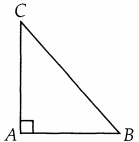
AB2 = (3 - 6)2 + (0 - 4)2 = 9 + 16 = 25
BC2 = (6 + 1)2 + (4 - 3)2 = 49 + 1 = 50
CA2 = (-1 - 3)2 + (3 - 0)2 = 16 + 9 = 25
AB2 = CA2 or, AB = CA
Triangle is isoceles
Also, 25 + 25 = 50
or, AB2 + CA2 = BC2
Since, pythagoras theorem is verified, therefore triangle is right-angled triangle.
Posted by Jitendra Dangra 6 years, 11 months ago
- 1 answers
Garima Bhardwaj 6 years, 11 months ago
Posted by Nandana Santhosh 6 years, 11 months ago
- 1 answers
Divya Garg 6 years, 11 months ago
Posted by Anjali Singh 5 years, 8 months ago
- 1 answers
Sia ? 6 years, 6 months ago
Given,
tan A = n tan B
{tex} \Rightarrow{/tex} tanB = {tex}\frac{1}{n}{/tex}tan A
{tex}\Rightarrow{/tex} cotB = {tex}\frac { n } { \tan A }{/tex}..........(1)
Also given,
sin A = m sin B
{tex}\Rightarrow{/tex} sin B = {tex}\frac{1}{m}{/tex}sin A
{tex}\Rightarrow{/tex} cosec B = {tex}\frac { m } { \sin A }{/tex}.....(2)
We know that, cosec2B - cot2B = 1, hence from (1) & (2) :-
{tex} \quad \frac { m ^ { 2 } } { \sin ^ { 2 } A } - \frac { n ^ { 2 } } { \tan ^ { 2 } A } = 1{/tex}
{tex}\Rightarrow \quad \frac { m ^ { 2 } } { \sin ^ { 2 } A } - \frac { n ^ { 2 } \cos ^ { 2 } A } { \sin ^ { 2 } A } = 1{/tex}
{tex}\Rightarrow \quad \frac { m ^ { 2 } - n ^ { 2 } \cos ^ { 2 } A } { \sin ^ { 2 } A } = 1{/tex}
{tex}\Rightarrow{/tex} m2 - n2cos2A = sin2A
{tex}\Rightarrow{/tex} m2 - n2cos2A = 1 - cos2A
{tex}\Rightarrow{/tex} m2 - 1 = n2cos2A - cos2A
{tex}\Rightarrow{/tex} m2 - 1 = (n2 - 1) cos2A
{tex}\Rightarrow \quad \frac { m ^ { 2 } - 1 } { n ^ { 2 } - 1 } ={/tex} cos2A
Posted by Naveen Kumar 6 years, 11 months ago
- 1 answers
Posted by Satyendra Kumar 6 years, 11 months ago
- 1 answers
Madhu Singh 6 years, 11 months ago
Posted by Puja Sahoo 6 years, 11 months ago
- 2 answers
Amira Roy❤❤ 6 years, 11 months ago

myCBSEguide
Trusted by 1 Crore+ Students

Test Generator
Create papers online. It's FREE.

CUET Mock Tests
75,000+ questions to practice only on myCBSEguide app
