
Ask questions which are clear, concise and easy to understand.
Ask QuestionPosted by Siddhant Shrivastava 7 years, 3 months ago
- 1 answers
Posted by Abhishek Chauhan 7 years, 3 months ago
- 0 answers
Posted by Shifana Fathima 7 years, 3 months ago
- 0 answers
Posted by Bhupinder Singh 6 years, 9 months ago
- 1 answers
Sia ? 6 years, 9 months ago
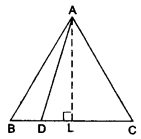
Given, {tex}\triangle ABC{/tex} in which {tex}AB = BC = CA{/tex} and D is a point on BC such that BD ={tex}\frac { 1 } { 3 }{/tex}BC.
Prove: 9AD2 = 7AB2.
Construction :Draw {tex}A L \perp B C{/tex}
Proof: In right triangles ALB and ALC, we have
{tex}AB = AC {/tex}(given)
{tex}AL = AL {/tex}(common)
{tex}\therefore \triangle A L B \cong \triangle A L C{/tex} [by RHS axiom]
So, {tex}BL = CL.{/tex}
Thus, BD ={tex}\frac { 1 } { 3 }{/tex}BC and BL ={tex}\frac { 1 } { 2 }{/tex}BC.
In {tex}\triangle ALB{/tex}, {tex}\angle A L B = 90 ^ { \circ }{/tex}
By using pythagoras theorem, we get
{tex}\therefore{/tex} AB2 = AL2 + BL2 ...(i)
In {tex}\triangle ALD{/tex}, {tex}\angle A L D = 90 ^ { \circ }{/tex}
By using pythagoras theorem, we get
{tex}\therefore{/tex} AD2 = AL2 + DL2
= AL2 + (BL - BD)2
= AL2 + BL2 + BD2 - {tex}2 B L \cdot B D{/tex}
= (AL2 + BL2) + BD2 - {tex}2 B L \cdot B D{/tex}
= AB2 + BD2 - {tex}2 B L \cdot B D{/tex} [using (i)]
{tex}= B C ^ { 2 } + \left( \frac { 1 } { 3 } B C \right) ^ { 2 } - 2 \left( \frac { 1 } { 2 } B C \right) \cdot \frac { 1 } { 3 } B C{/tex}
{tex}= B C ^ { 2 } + \frac { 1 } { 9 } B C ^ { 2 } - \frac { 1 } { 3 } B C ^ { 2 }{/tex}
{tex}= \frac { 7 } { 9 } B C ^ { 2 } = \frac { 7 } { 9 } A B ^ { 2 }{/tex} [{tex}\because{/tex} BC = AB]
Therefore, 9AD2 = 7AB2.
Posted by Sandeep Chaudhary 7 years, 3 months ago
- 3 answers
Guddu Guddu 7 years, 3 months ago
Posted by Shahid Hassan 7 years, 3 months ago
- 3 answers
Yogita Ingle 7 years, 3 months ago
x + y = 3
x = 3 - y........ (i)
4x - 3y = 26...... (ii)
Put (i) in (ii)
4(3 - y) - 3y = 26
12 - 4y - 3y = 26
-7y = 26 - 12
-7y = 14
y = -2
Y = -2 in (i)
x = 3 - (-2)
x = 3 + 2
x = 5
Guddu Guddu 7 years, 3 months ago
Posted by Janhvi Singh 7 years, 3 months ago
- 2 answers
Abc . 7 years, 3 months ago
Posted by Parag Dubey 7 years, 3 months ago
- 0 answers
Posted by Nonu Kansal 7 years, 3 months ago
- 4 answers
Ram Kushwah 7 years, 3 months ago
x2-1=3x
x2-3x-1=0
{tex}x = {3\pm \sqrt{9+4} \over 2}={3\pm\sqrt{13}\over 2}{/tex}
Prabhjeet Singh 7 years, 3 months ago
Posted by Nonu Kansal 7 years, 3 months ago
- 2 answers
Dhyanu Kumar 7 years, 3 months ago
Posted by Mohamed Jabrin 7 years, 3 months ago
- 3 answers
Dhyanu Kumar 7 years, 3 months ago
Yogita Ingle 7 years, 3 months ago
x = a , y = b
x - y = 2
a - b = 2....... (i)
x + y = 4
a + b = 4 ....... (ii)
Add (i) and (ii)
2a = 6
a = 6/2 = 3
But a = 3 in (ii)
3 + b = 4
b= 4 - 3
b = 1
So, a = 3 and b = 1
Posted by Zain C 6 years, 9 months ago
- 1 answers
Sia ? 6 years, 9 months ago
Since, any odd positive integer n is of the form 4m + 1 or 4m + 3.
if n = 4m + 1
n2 = (4m + 1)2
= 16m2 + 8m + 1
= 8(2m2 + m) + 1
So n2 = 8q + 1 ........... (i)) (where q = 2m2 + m is a positive integer)
If n = (4m + 3)
n2 = (4m + 3)2
= 16m2 + 24m + 9
= 8(2m2 + 3m + 1) + 1
So n2 = 8q + 1 ...... (ii) (where q = 2m2 + 3m + 1 is a positive integer)
From (i) and (ii) we conclude that the square of an odd positive integer is of the form 8q + 1, for some integer q.
Posted by Ram Swaroop 6 years, 9 months ago
- 1 answers
Sia ? 6 years, 9 months ago
Given points are collinear. Therefore
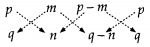
[p {tex}\times{/tex} n + m(q - n) + (p - m) q] - [m {tex}\times{/tex} q + (p - m) n + p (q - n)] = 0
{tex}\Rightarrow{/tex} (pn + qm - mn + pq - mq) - (mq + pn - mn + pq - pn) = 0
{tex}\Rightarrow{/tex} (pn + p q - mn) - (mq - mn + pq) = 0
{tex}\Rightarrow{/tex} pn - mq = 0
{tex}\Rightarrow{/tex} pn = qm
Posted by Aj Raghav 7 years, 3 months ago
- 1 answers
Posted by Student Entertainment 6 years, 9 months ago
- 1 answers
Sia ? 6 years, 9 months ago
5x2 - 6x - 2 = 0
Multiplying the above equation by 1/5
{tex} \Rightarrow {x^2} - \frac{6}{5}x - \frac{2}{5} = 0{/tex}
{tex}\Rightarrow x ^ { 2 } - \frac { 6 } { 5 } x + \left( \frac { 3 } { 5 } \right) ^ { 2 } - \left( \frac { 3 } { 5 } \right) ^ { 2 } - \frac { 2 } { 5 } = 0{/tex}
{tex}\Rightarrow \left( x - \frac { 3 } { 5 } \right) ^ { 2 } = \frac { 9 } { 25 } + \frac { 2 } { 5 }{/tex}
{tex}\Rightarrow \left( x - \frac { 3 } { 5 } \right) ^ { 2 } = \frac { 9 + 10 } { 25 }{/tex}
{tex}\Rightarrow \left( x - \frac { 3 } { 5 } \right) ^ { 2 } = \frac { 19 } { 25 }{/tex}
{tex}\Rightarrow x - \frac { 3 } { 5 } = \pm \frac { \sqrt { 19 } } { 5 }{/tex}
{tex}\Rightarrow x = \frac { 3 } { 5 } \pm \frac { \sqrt { 19 } } { 5 }{/tex}
{tex}\Rightarrow x = \frac { 3 + \sqrt { 19 } } { 5 } \text { or } x = \frac { 3 - \sqrt { 19 } } { 5 }{/tex}
Posted by Vivek Chaurasiya 7 years, 3 months ago
- 3 answers
Amresh Shukla 7 years, 3 months ago
Posted by Vineet Jain 7 years, 3 months ago
- 1 answers
Tanya Gupta 7 years, 3 months ago
Posted by Madhu Shree Madhu 7 years, 3 months ago
- 0 answers
Posted by Aj Raghav 7 years, 3 months ago
- 0 answers
Posted by Ashish Panday 7 years, 3 months ago
- 2 answers
Posted by Tanisha Tanisha 7 years, 3 months ago
- 2 answers
Neha Mishra 7 years, 3 months ago
Posted by Chandrika Sharma 7 years, 3 months ago
- 1 answers
Posted by Alok Raj 7 years, 3 months ago
- 1 answers
Posted by Anjaney Rauniyar 7 years, 3 months ago
- 4 answers

myCBSEguide
Trusted by 1 Crore+ Students

Test Generator
Create papers online. It's FREE.

CUET Mock Tests
75,000+ questions to practice only on myCBSEguide app
