
Ask questions which are clear, concise and easy to understand.
Ask QuestionPosted by Vishal Kumar 7 years, 2 months ago
- 1 answers
Posted by Jaya Saji 7 years, 2 months ago
- 2 answers
Satyam Suman 7 years, 2 months ago
Posted by Kunal Choudhary 7 years, 2 months ago
- 1 answers
Jashan Singh 7 years, 2 months ago
Posted by Aryan Thind 7 years, 2 months ago
- 1 answers
Puja Sahoo? 7 years, 2 months ago
Posted by Aryan Thind 7 years, 2 months ago
- 2 answers
Puja Sahoo? 7 years, 2 months ago
Posted by Vishal Kumar 7 years, 2 months ago
- 3 answers
Posted by Anshika & Aliens???? 7 years, 2 months ago
- 1 answers
Lavina Rajput ??? 7 years, 2 months ago
Posted by Divyanshu Rawat 7 years, 2 months ago
- 6 answers
Purvanshi Yadav 7 years, 2 months ago
Posted by Rekhansh Chaturvedi 7 years, 2 months ago
- 3 answers
Posted by Poonam Bais 7 years, 2 months ago
- 0 answers
Posted by Premangshu Das 7 years, 2 months ago
- 0 answers
Posted by Mandeep Singh 7 years, 2 months ago
- 1 answers
Amna Nasim 7 years, 2 months ago
Posted by Deveshi Nema 7 years, 2 months ago
- 1 answers
Posted by Sunil Sood 7 years, 2 months ago
- 2 answers
Posted by Vinuthna Hasthi 7 years, 2 months ago
- 1 answers
Posted by Harshita Patel 7 years, 2 months ago
- 3 answers
Ram Kushwah 7 years, 2 months ago
Mr Yuvraj ,
This is useless thing 2+2=5 is impossible,behave like a good student and do not waste your time.
May be somebody prove this by using 0\0=1,which is again wrong and useless.
Posted by Dinesh Somani 7 years, 2 months ago
- 1 answers
Gaurav Seth 7 years, 2 months ago
Q.If the areas of two similar triangles are equal, prove that they are congruent.
<hr />Solution:
Posted by Ashwani Kumar 6 years, 8 months ago
- 1 answers
Sia ? 6 years, 8 months ago
It is given that {tex} \alpha{/tex} and {tex} \beta{/tex} are the zeros of the polynomial {tex}f(x)=x^2-x-2{/tex}
Let,{tex}g(x)=k(x^2-Sx+P){/tex} be the required polynomial where 'S' is sum of zeroes and 'P' is product of zeroes.
Sum of zeroes of required polynomial (S)={tex}(2 \alpha+1)+(2 \beta+1)=2( \alpha+ \beta)+2=2 \times1+2=4{/tex}
Product of zeroes of required polynomial (P) = {tex}(2 \alpha+1) \times(2 \beta+1) = 4 \alpha \beta + 2 \alpha + 2 \beta + 1 = 4 \alpha \beta + 2 ( \alpha + \beta ) + 1{/tex}
{tex}=4 \times-2+2 \times1+1=-8+2+1=-5{/tex}
Hence, required polynomial g(x) is {tex}k(x^2-4x-5){/tex}, where k is any non-zero constant.
Posted by Samriddhi Shrivastava 7 years, 2 months ago
- 3 answers
Gaurav Seth 7 years, 2 months ago
We see that it is a quadratic polynomial.
so, splitting the middle term,
x²+100x-300000
x²+600x - 500x - 300000 =0
x(x+600) -500(x+600) = 0
(x-500)(x+600) = 0
X = 500 or X = -600
Yogita Ingle 7 years, 2 months ago
x2 + 100x - 300000 = 0
x2 + 600x - 500x - 300000 = 0
x(x + 600) - 500 (x + 600) = 0
(x + 600) (x - 500) = 0
x = -600 and x = 500
Posted by Alok Panwar 7 years, 2 months ago
- 0 answers
Posted by Virendra Singh Rajawat 7 years, 2 months ago
- 0 answers
Posted by Satyam Raj Raj 7 years, 2 months ago
- 2 answers
Ram Kushwah 7 years, 2 months ago
Let O(2a-1,7) is the center and A(-3,-1) is on the circumference then
OA=r=20/2=10
{tex}\begin{array}{l}OA^2=10^2=100\\or\;\;(2a-1+3)^2+(7+1)^2=100\\\;\;(2a+2)^2+64=100\\4a^2+8a+4+64=10\\4a^2+8a-32=0\\a^2+2a-8=0\\(a+4)(a-2)=0\\Hene\;a=-4\;and\;2\end{array}{/tex}
Posted by Sonakshi Goel 5 years, 11 months ago
- 7 answers
Augustya Singh 7 years, 2 months ago
Murari Barnwal 7 years, 2 months ago
Yogita Ingle 7 years, 2 months ago
sorry wrong solution added.
Correct solution is
x2 - 2kx - 6 = 0
x = 3
(3)2 - 2k(3) - 6 = 0
9 - 6k - 6 = 0
- 6k + 3 = 0
6k = 3
k = 3/6
k = 1/3
Yogita Ingle 7 years, 2 months ago
x2 - 2kx - 6 = 0
x = 3
(3)2 - 2k(3) - 6 = 0
9 - 6k - 6 = 0
2 - 6k = 0
6k = 2
k = 2/6
k = 1/3
Jiya Arora????? 7 years, 2 months ago
Posted by Spark Light 7 years, 2 months ago
- 2 answers
Gaurav Seth 7 years, 2 months ago
L.H.S
1-sinA/1+sinA
Rationalising the denominator
1-sinA (1-SinA) /1+sinA(1-SinA)
(1-SinA)²/ 1² -(Sin²A)
(1-SinA)²/ 1 -(Sin²A)
(1-SinA)² /Cos² A
[ 1 -Sin²A = cos²A]
(1-SinA/CosA)²
(1/CosA-SinA/CosA)²
(SecA-tanA)²
L.H S = R H.S
Posted by Sweta Nishad 6 years, 8 months ago
- 1 answers
Sia ? 6 years, 8 months ago
Given : {tex}\triangle \mathrm{ABC}{/tex} is right angle at B
To prove: {tex}A C^{2}=A B^{2}+B C^{2}{/tex}
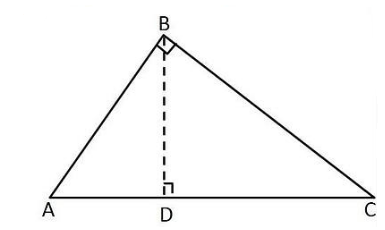
Construction: Draw {tex}B D \perp A C{/tex}
Proof:In {tex}\triangle{/tex}ABC and {tex}\triangle{/tex}ABD
{tex}\angle{/tex}ABC={tex}\angle{/tex}ADB=90
{tex}\angle{/tex}A is common
{tex}\angle{/tex}ABC{tex}\sim{/tex}{tex}\angle{/tex}ADB
{tex}\Rightarrow \frac{A D}{A B}=\frac{A B}{A C}{/tex}
{tex}\Rightarrow{/tex} AD. AC = AB2 ...(i)
Similarly {tex}\Delta \mathrm{BDC} \sim \Delta \mathrm{ABC}{/tex}
{tex}\Rightarrow \frac{C D}{B C}=\frac{B C}{A C}{/tex}
{tex}\Rightarrow{/tex} CD.AC = BC2 ...(ii)
Adding (i) and (ii)
AD.AC + CD. AC= AB2 + BC2
AC(AD + CD) = AB2 + BC2
AC {tex}\times{/tex} AC = AB2 + BC2
AC2 = AB2 + BC2
Hence Proved
Posted by Technical Shamim 7 years, 2 months ago
- 4 answers
Shreyanka Das 7 years, 2 months ago
Bhavya Choubey 7 years, 2 months ago
Posted by Akash Kumar 5 years, 11 months ago
- 0 answers
Posted by Sahil Bhati 7 years, 2 months ago
- 3 answers
Shreyanka Das 7 years, 2 months ago

myCBSEguide
Trusted by 1 Crore+ Students

Test Generator
Create papers online. It's FREE.

CUET Mock Tests
75,000+ questions to practice only on myCBSEguide app

Maths Lover **** √Π÷= 7 years, 2 months ago
1Thank You