
Ask questions which are clear, concise and easy to understand.
Ask QuestionPosted by Sweekriti Dilwaliya 7 years, 2 months ago
- 1 answers
Posted by Shivankit Patel 7 years, 2 months ago
- 4 answers
Chetna Pandey ? 7 years, 2 months ago
Posted by Anurag Sharma 7 years, 2 months ago
- 2 answers
Anushka ? 7 years, 2 months ago
Posted by Abhishek Anand 7 years, 2 months ago
- 3 answers
Ram Kushwah 7 years, 2 months ago
{tex}\begin{array}{l}\frac4{\mathrm x}+3\mathrm y=14\;\;-----(1)\\\frac3{\mathrm x}-4\mathrm y=23\;-----(2)\\\mathrm{Multiply}\;(1)\;\mathrm{by}\;3\;\mathrm{and}\;(2)\;\mathrm{by}\;(4)\;\mathrm{we}\;\mathrm{get}\\\frac{12}{\mathrm x}+9\mathrm y=42----(3)\\\frac{12}{\mathrm x}-16\mathrm y=92\;----(4)\\\mathrm{Subtracting}\;(4\;\mathrm{from}(3)\mathrm{we}\;\mathrm{get}\\0\;+25\mathrm y=42-92=-50\\\mathrm{So}\;\;\mathrm y=-50/25=-2\\\\\\\end{array}{/tex}
{tex}\begin{array}{l}\mathrm{puttig}\;\mathrm{value}\;\mathrm{of}\;\mathrm y\;\mathrm{in}\;(\;1)\;\mathrm{we}\;\mathrm{get}\\\;4/\mathrm x+3\mathrm y=14\;\\\;4/\mathrm x+3(-2)=14\\4/\mathrm x-6=14\;\\4/\mathrm x=20\;\;\;\mathrm{So}\;\mathrm x=5/20=1/4\;\;\;\mathrm{and}\;\mathrm y=\;-2\;\mathrm{ans}\\\\\\\end{array}{/tex}
Posted by Kishan Bisht Uttrakhandi 7 years, 2 months ago
- 0 answers
Posted by A K 6 years, 9 months ago
- 1 answers
Sia ? 6 years, 9 months ago
n3 - n = n (n2 - 1) = n (n - 1) (n + 1)
Whenever a number is divided by 3, the remainder obtained is either 0 or 1 or 2.
∴ n = 3p or 3p + 1 or 3p + 2, where p is some integer.
If n = 3p, then n is divisible by 3.
If n = 3p + 1, then n – 1 = 3p + 1 –1 = 3p is divisible by 3.
If n = 3p + 2, then n + 1 = 3p + 2 + 1 = 3p + 3 = 3(p + 1) is divisible by 3.
So, we can say that one of the numbers among n, n – 1 and n + 1 is always divisible by 3.
⇒ n (n – 1) (n + 1) is divisible by 3.
Similarly, whenever a number is divided by 2, the remainder obtained is 0 or 1.
∴ n = 2q or 2q + 1, where q is some integer.
If n = 2q, then n is divisible by 2.
If n = 2q + 1, then n – 1 = 2q + 1 – 1 = 2q is divisible by 2 and n + 1 = 2q + 1 + 1 = 2q + 2 = 2 (q + 1) is divisible by 2.
So, we can say that one of the numbers among n, n – 1 and n + 1 is always divisible by 2.
⇒ n (n – 1) (n + 1) is divisible by 2.
Since, n (n – 1) (n + 1) is divisible by 2 and 3.
∴ n (n-1) (n+1) = n3 - n is divisible by 6.( If a number is divisible by both 2 and 3 , then it is divisible by 6)
Posted by Sneha Mainwal 6 years, 9 months ago
- 1 answers
Sia ? 6 years, 9 months ago
Let APB be the tangent and take O as centre of the circle.
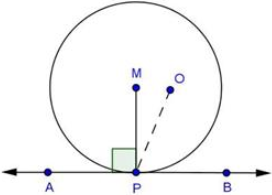
Let us suppose that MP{tex}\bot{/tex}AB does not pass through the centre.
Then,
{tex}\angle OPA = 90^\circ{/tex} [{tex}\because{/tex} Tangent is perpendicular to the radius of circle]
But {tex}\angle MPA = 90^\circ{/tex} [Given]
{tex}\therefore \angle OPA = \angle MPA{/tex}
This is only possible when point O and point M coincide with each other.
Hence, the perpendicular at the point of contact to the tangent to a circle passes through the centre of the circle.
Posted by Rita Gokani 7 years, 2 months ago
- 1 answers
Ram Kushwah 7 years, 2 months ago
volume of cuboid tank =4 x 3 x 2={tex}24 m^3=24000000 cm^3{/tex}
volume of overhead tank={tex}\mathrm{πr}^2\mathrm h=.3.14\times60\times60\times80=904320\;\mathrm{cm}^3{/tex}
{tex}\begin{array}{l}\mathrm{Water}\;\mathrm{left}\;\mathrm{in}\;\mathrm{the}\;\mathrm{cuboidal}\;\mathrm{tank}\\=24000000-904320\;=2309560\;\mathrm{cm}^3\\\end{array}{/tex}
so height of water in the cuboid tank
{tex}\begin{array}{l}=\frac{\mathrm{volume}}{\mathrm{area}}=\frac{2309560}{400\times300}=19.246\;\;\mathrm{cm}\\\end{array}{/tex}
Posted by Smrithi Sathyan 7 years, 2 months ago
- 1 answers
Anshika & Aliens???? 7 years, 2 months ago
Posted by Satya Narayan 7 years, 2 months ago
- 1 answers
Rupal ???? 7 years, 2 months ago
Posted by Sonu Kumar 7 years, 2 months ago
- 1 answers
Posted by Dhruv Sharma 7 years, 2 months ago
- 2 answers
Posted by Devraj Sahu 7 years, 2 months ago
- 0 answers
Posted by Ahere Kashinath 7 years, 2 months ago
- 0 answers
Posted by Pooja Debi 7 years, 2 months ago
- 2 answers
Posted by Pasang Chukla 7 years, 2 months ago
- 2 answers
Posted by Kala Devi 7 years, 2 months ago
- 1 answers
Gaurav Seth 7 years, 2 months ago
unique integers m and r satisfying
a = bm + r, 0 ≤ r < b.
Let b=3
Then r can be 0,1,2
Then By Euclid division lemma as
a can be 3m or 3m+1 or 3m+2.
Thus,every positive integer can be written in the form 3m+r,where r = (0,1,2)
Posted by Siddhartha Jain 7 years, 2 months ago
- 0 answers
Posted by Suhana Nadaf 7 years, 2 months ago
- 2 answers
Posted by Suhana Nadaf 7 years, 2 months ago
- 1 answers
Posted by Suhana Nadaf 7 years, 2 months ago
- 0 answers
Posted by Aman Chauhan 6 years, 9 months ago
- 1 answers
Sia ? 6 years, 9 months ago
L.H.S
= (1 + cotA + tanA) (sinA - cosA)
= sinA - cosA + cotA sinA - cotA cosA + sinA tanA - tanA cosA
{tex}= \sin A - \cos A + \frac{{\cos A}}{{\sin A}} \times \sin A - \cot A\cos A + \sin A\;\tan A - \frac{{\sin A}}{{\cos A}} \times \cos A{/tex}
= sinA - cosA + cosA - cotA cosA + sinA tanA - sinA
= sinA tanA - cotA cosA........(1)
Now taking ;
{tex}\quad \frac{{\sec A}}{{\cos e{c^2}A}} - \frac{{\cos ecA}}{{{{\sec }^2}A}}{/tex}
{tex} = \frac{{\frac{1}{{\cos A}}}}{{\frac{1}{{{{\sin }^2}A}}}} - \frac{{\frac{1}{{\sin A}}}}{{\frac{1}{{{{\cos }^2}A}}}}{/tex}
{tex} = \frac{{{{\sin }^2}A}}{{\cos A}} - \frac{{{{\cos }^2}A}}{{\sin A}}{/tex}
{tex} = \sin A \times \frac{{\sin A}}{{\cos A}} - \cos A \times \frac{{\cos A}}{{\sin A}}{/tex}
{tex} = \sin A \times \tan A - \cos A \times \cot A{/tex}.......(2)
From (1) & (2),
(1 + cotA + tanA) (sinA - cosA) = {tex}\frac { \sec A } { cosec ^ { 2 } A } - \frac { cosec A } { \sec ^ { 2 } A }{/tex} = sinA.tanA - cosA.cotA
Hence, Proved.
Posted by Sushant Thareja 7 years, 2 months ago
- 3 answers
Posted by Harsharn Kaur Sandhu 7 years, 2 months ago
- 3 answers
Posted by Kiran Verma 7 years, 2 months ago
- 0 answers
Posted by Jashan Singh 7 years, 2 months ago
- 3 answers
Vishu Joshi 7 years, 2 months ago

myCBSEguide
Trusted by 1 Crore+ Students

Test Generator
Create papers online. It's FREE.

CUET Mock Tests
75,000+ questions to practice only on myCBSEguide app

Shivam The Galaxy 5 years, 11 months ago
0Thank You