
Ask questions which are clear, concise and easy to understand.
Ask QuestionPosted by Arun Patel 5 years, 11 months ago
- 0 answers
Posted by L Amrutha 7 years, 2 months ago
- 1 answers
Posted by Rohit Prajapati 7 years, 2 months ago
- 3 answers
Yogita Ingle 7 years, 2 months ago
x2 + 11x - 60
= x2 + 15x - 4x - 60
= x ( x + 15) - 4 ( x +15)
= (x + 15) (x - 4)
Posted by Amulya Amuu 7 years, 2 months ago
- 1 answers
वैभव सिंह आर्य 5 years, 11 months ago
Posted by Yuvam Thakur 7 years, 2 months ago
- 2 answers
Kratika Nyati 7 years, 2 months ago
Posted by Vishal Sodhani 7 years, 2 months ago
- 1 answers
Deepanshi Tayal 7 years, 2 months ago
Posted by Rishabh Verma?? 6 years, 7 months ago
- 1 answers
Sia ? 6 years, 7 months ago
LHS = {tex}\frac { \tan \theta } { 1 - \cot \theta } + \frac { \cot \theta } { 1 - \tan \theta }{/tex}
{tex}= \frac { \frac { \sin \theta } { \cos \theta } } { 1 - \frac { \cos \theta } { \sin \theta } } + \frac { \frac { \cos \theta } { \sin \theta } } { 1 - \frac { \sin \theta } { \cos \theta } }{/tex} {tex}\left[ \because \tan \theta = \frac { \sin \theta } { \cos \theta } , \cot \theta = \frac { \cos \theta } { \sin \theta } \right]{/tex}
{tex}= \frac { \sin ^ { 2 } \theta } { \cos \theta ( \sin \theta - \cos \theta ) } + \frac { \cos ^ { 2 } \theta } { \sin \theta ( \cos \theta - \sin \theta ) }{/tex}
{tex}= \frac { \sin ^ { 2 } \theta } { \cos \theta ( \sin \theta - \cos \theta ) } - \frac { \cos ^ { 2 } \theta } { \sin \theta ( \sin \theta - \cos \theta ) }{/tex}
{tex}= \frac { \sin ^ { 3 } \theta - \cos ^ { 3 } \theta } { \sin \theta \cos \theta ( \sin \theta - \cos \theta ) }{/tex}
{tex}= \frac { ( \sin \theta - \cos \theta ) \left( \sin ^ { 2 } \theta + \cos ^ { 2 } \theta + \sin \theta \cos \theta \right) } { ( \sin \theta - \cos \theta ) \sin \theta \cos \theta }{/tex} [ a3 - b3 = (a - b)(a2 + ab + b2) ]
{tex}= \frac { 1 + \sin \theta \cos \theta } { \sin \theta \cos \theta }{/tex}
{tex}= \frac { 1 } { \sin \theta \cos \theta } + 1 = 1 + \sec \theta cosec \theta{/tex} = RHS
therefore, RHS = LHS
Posted by Puja Sahoo? 7 years, 2 months ago
- 5 answers
Puja Sahoo? 7 years, 2 months ago
Shivank Johari 7 years, 2 months ago
Posted by Shweta Rao ?? 7 years, 2 months ago
- 2 answers
Balbir Singh 7 years, 2 months ago
Posted by Aadi Raj 7 years, 2 months ago
- 3 answers
Posted by Isha Gandotra 7 years, 2 months ago
- 1 answers
Puja Sahoo? 7 years, 2 months ago
Posted by Gouri Naik 7 years, 2 months ago
- 1 answers
Posted by Amy James 7 years, 2 months ago
- 2 answers
Posted by Puja Sahoo? 6 years, 7 months ago
- 1 answers
Sia ? 6 years, 7 months ago
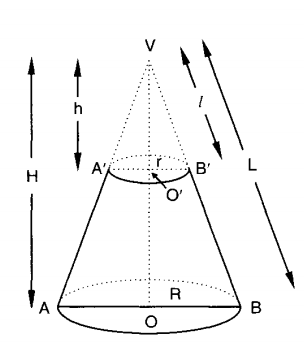
Assume that the ratio of the altitude of the bigger and smaller cone be l : L
Let R and r be the radii of the bigger and smaller cone respectively.
Let H and h be the height of the bigger and smaller cone respectively.
Clearly, {tex}\Delta V O ^ { \prime } A ^ { \prime } \sim \Delta V O A{/tex}
{tex}\therefore \quad \frac { V O ^ { \prime } } { V O } = \frac { O ^ { \prime } A ^ { \prime } } { O A } = \frac { V A ^ { \prime } } { V A } \Rightarrow \frac { h } { H } = \frac { r } { R } = \frac { l } { L }{/tex}
It is given that
Curved surface area of the frustum ABB'A = {tex}\frac { 8 } { 9 } \times{/tex}Curved surface area of the cone
{tex}\Rightarrow \quad \pi ( R + r ) ( L - l ) = \frac { 8 } { 9 } \pi R L{/tex}
{tex}\Rightarrow \quad ( R + r ) ( L - l ) = \frac { 8 } { 9 } R L{/tex}
{tex}\Rightarrow \quad \left( \frac { R + r } { R } \right) \left( \frac { L - l } { L } \right) = \frac { 8 } { 9 }{/tex}
{tex}\Rightarrow \quad \left( 1 + \frac { r } { R } \right) \left( 1 - \frac { l } { L } \right) = \frac { 8 } { 9 }{/tex}
{tex}\Rightarrow \quad \left( 1 + \frac { h } { H } \right) \left( 1 - \frac { h } { H } \right) = \frac { 8 } { 9 }{/tex} [Using (i)]
{tex}\Rightarrow \quad 1 - \frac { h ^ { 2 } } { H ^ { 2 } } = \frac { 8 } { 9 }{/tex}
{tex}\Rightarrow \quad \frac { h ^ { 2 } } { H ^ { 2 } } = 1 - \frac { 8 } { 9 }{/tex}
{tex}\Rightarrow \quad \frac { h ^ { 2 } } { H ^ { 2 } } = \frac { 1 } { 9 } \Rightarrow \frac { h } { H } = \frac { 1 } { 3 } \Rightarrow h = \frac { H } { 3 }{/tex}
Hence, required ratio = {tex}\frac { h } { H - h } = \frac { \frac { H } { 3 } } { H - \frac { H } { 3 } } = \frac { 1 } { 2 }{/tex}
Posted by Kartikay Vani 7 years, 2 months ago
- 0 answers
Posted by Jatin Jaju 7 years, 2 months ago
- 1 answers
Neha Sirur 7 years, 2 months ago
Posted by Manya Singh 7 years, 2 months ago
- 1 answers
Posted by Sanjukta Saikia 6 years, 7 months ago
- 1 answers
Sia ? 6 years, 7 months ago

Let {tex}r {/tex} cm be the radius of each circle.
Area of square - Area of 4 sectors = {tex}\frac { 24 } { 7 } \mathrm { cm } ^ { 2 }{/tex}
(side)2 - {tex}4\left[\frac\theta{360}\mathrm{πr}^2\right]{/tex} = {tex}\frac { 24 } { 7 } \mathrm { cm } ^ { 2 }{/tex}
or, {tex}( 2 r ) ^ { 2 } - 4 \left( \frac { 90 ^ { \circ } } { 360 ^ { \circ } } \times \pi r ^ { 2 } \right) = \frac { 24 } { 7 }{/tex}
or, {tex}( 2 r ) ^ { 2 } - 4 \left( \frac { 1 } { 4 ^ { \circ } } \times \pi r ^ { 2 } \right) = \frac { 24 } { 7 }{/tex}
or, {tex}( 2 r ) ^ { 2 } - \left( \pi r ^ { 2 } \right) = \frac { 24 } { 7 }{/tex}
or, {tex}4 r ^ { 2 } - \frac { 22 } { 7 } r ^ { 2 } = \frac { 24 } { 7 }{/tex}
or, {tex}\frac { 28 r ^ { 2 } - 22 r ^ { 2 } } { 7 } = \frac { 24 } { 7 }{/tex}
or, {tex}6r^2 = 24{/tex}
or, {tex}r^2 = 4{/tex}
or, {tex}r = \pm 2{/tex}
or, Radius of each circle is 2 cm (r cannot be negative)
Posted by Seema Kathuria 5 years, 11 months ago
- 1 answers
Sia ? 6 years, 7 months ago
We have to draw
ΔPQR ~ ΔABC
PQ = 8 cm
∴ {tex}\frac { P Q } { A B } = \frac { 8 } { 6 } = \frac { 4 } { 3 }{/tex} (∵ AB = 6 cm)
So, PQ = QR = 8 cm
So, we have to draw ΔPQR ~ ΔABC with scale factor {tex}\frac { 4 } { 3 }{/tex} > 1 resulting ΔPQR will be larger than ΔABC.
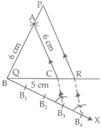
Steps of Construction:
- Draw BC = 5 cm
- Draw two arcs of 6 cm each from B and C in same direction let it be upside.
- Join AB and AC.
- Draw acute ∠CBX and mark B, B1, B2, B3, B4 with compass.
- Join B3C and draw B4R || B3C, R is on BC produced.
- Again, draw RP || CA. P is on BA produced.
Therefore, ΔPQR ~ ΔABC with PQ = PR = 8 cm. It’s scale factor is {tex}\frac { 4 } { 3 }{/tex}.
Posted by Ayush Chauhan 7 years, 2 months ago
- 0 answers
Posted by Shivam Yadav 7 years, 2 months ago
- 2 answers
Aryan Shishodia 7 years, 2 months ago
Posted by S N Mahato 7 years, 2 months ago
- 1 answers
Marrisetty Jayalakshmi 7 years, 2 months ago
Posted by S N Mahato 7 years, 2 months ago
- 2 answers
Yogita Ingle 7 years, 2 months ago
Co-prime number is a set of numbers or integers which have only 1 as their common factor. That is their highest common factor (HCF) will be 1. It is also known as relatively prime or mutually prime numbers.
Consider a set of two numbers, if they have no positive integer that can divide both, other than 1, the pair of numbers is co-prime.
Ex 1: 21 and 22
21 and 22:
- The factors of 21 are 1, 3, 7 and 21.
- The factors of 22 are 1, 2, 11 and 22.
Here 21 and 22 have only one common factor that is 1.Hence their HCF is 1 and are co-prime.

myCBSEguide
Trusted by 1 Crore+ Students

Test Generator
Create papers online. It's FREE.

CUET Mock Tests
75,000+ questions to practice only on myCBSEguide app
