
Ask questions which are clear, concise and easy to understand.
Ask QuestionPosted by Sai Ram 6 years, 10 months ago
- 1 answers
Posted by Munesh Yadav 6 years, 10 months ago
- 1 answers
Posted by Sandip Kumar 6 years, 10 months ago
- 1 answers
Posted by Manpreet Kaur 6 years, 10 months ago
- 2 answers
Puja Sahoo? 6 years, 10 months ago
Posted by Kajal Dogra 6 years, 10 months ago
- 1 answers
Bhavya Vardhan Jain 6 years, 10 months ago
Posted by N Hussain 6 years, 10 months ago
- 1 answers
Posted by Hansika Jindal 6 years, 10 months ago
- 0 answers
Posted by Raghav P 6 years, 10 months ago
- 1 answers
Utkarsh Singh 6 years, 10 months ago
Posted by Bushra Qureshi 6 years, 10 months ago
- 2 answers
Rita Choudhary 6 years, 10 months ago
Gunjan Sharma 6 years, 10 months ago
Posted by Kajal Dogra 6 years, 10 months ago
- 3 answers
Ujjwal Gautam 6 years, 10 months ago
Lavish Pareek 6 years, 10 months ago
Posted by Afeef Iniyavan 6 years, 10 months ago
- 1 answers
Abhishek Anand 6 years, 10 months ago
Posted by Abhishek Anand 6 years, 10 months ago
- 2 answers
Kajal Dogra 6 years, 10 months ago
Utkarsh Singh 6 years, 10 months ago
Posted by Sarthak Singh 6 years, 10 months ago
- 1 answers
Utkarsh Singh 6 years, 10 months ago
Posted by Tera Baap 6 years, 10 months ago
- 2 answers
Posted by Tera Baap 6 years, 10 months ago
- 2 answers
Puja Sahoo? 6 years, 10 months ago
Posted by Tera Baap 6 years, 10 months ago
- 2 answers
Posted by Tera Baap 6 years, 10 months ago
- 3 answers
#Itz_Desi_Gujjar_Ravi???? (Kannu?) 6 years, 10 months ago
#Itz_Desi_Gujjar_Ravi???? (Kannu?) 6 years, 10 months ago
Posted by Harleen Kaur 6 years, 10 months ago
- 5 answers
Puja Sahoo? 6 years, 10 months ago
Posted by Anushka Jain 6 years, 6 months ago
- 1 answers
Sia ? 6 years, 6 months ago
We have,
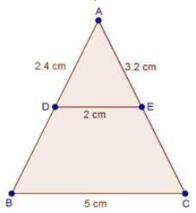
DE || BC
Now, In {tex}\triangle{/tex}ADE and {tex}\triangle {/tex}ABC
{tex}\angle A = \angle A{/tex} [common]
{tex}\angle A D E = \angle A B C{/tex} [{tex}\because{/tex} DE || BC {tex}\Rightarrow{/tex} Corresponding angles are equal]
{tex}\Rightarrow \triangle A D E= \triangle A B C{/tex} [By AA criteria]
{tex}\Rightarrow \frac { A B } { B C } = \frac { A D } { D E }{/tex} [{tex}\because{/tex} Corresponding sides of similar triangles are proportional]
{tex}\Rightarrow \frac { A B } { 5 } = \frac { 2.4 } { 2 }{/tex}
{tex}\Rightarrow A B = \frac { 2.4 \times 5 } { 2 }{/tex}
{tex}\Rightarrow{/tex} AB = 1.2 {tex}\times{/tex} 5
= 6.0 cm
{tex}\Rightarrow{/tex} AB = 6 cm
{tex}\therefore{/tex} BD = AB - AD
= 6 - 2.4
= 3.6 cm
{tex}\Rightarrow{/tex} DB = 3.6 cm
Now,
{tex}\frac { A C } { B C } = \frac { A E } { D E }{/tex} [{tex}\because{/tex} Corresponding sides of similar triangles are equal]
{tex}\Rightarrow \frac { A C } { 5 } = \frac { 3.2 } { 2 }{/tex}
{tex}\Rightarrow A C = \frac { 3.2 \times 5 } { 2 }{/tex}
= 1.6 {tex}\times{/tex} 5
= 8.0 cm
{tex}\Rightarrow{/tex} AC = 8 cm
{tex}\therefore{/tex} CE = AC - AE
= 8 - 3.2
= 4.8 cm
Hence, BD = 3.6 cm and CE = 4.8 cm
Posted by Shekhar Singh Thakur 6 years, 10 months ago
- 1 answers
Posted by Khushi Agrawal 6 years, 6 months ago
- 1 answers
Sia ? 6 years, 6 months ago
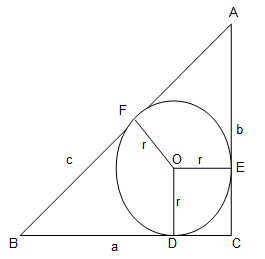
The circle touches the sides BC, CA, AB of the right triangle ABC at D, E and F respectively. Let BC = a, CA = b and AB = c
Now, AF = AE and BD = BF
⇒ AF = AE = AC - CE and BF = BD = BC - CD
⇒ AF = b - r and BF = a - r ( {tex}\because{/tex} OEDC is a square)
⇒ AF + BF = ( b - r ) + (a - r)
⇒ AB = a + b - 2r
⇒ c = a + b - 2 r
⇒ r = {tex}\frac { a + b - c } { 2 }{/tex}
Posted by Khushi Agrawal 6 years, 6 months ago
- 1 answers
Sia ? 6 years, 6 months ago
Let n be any positive integer.
By Euclid's division lemma, n = 5q + r, 0{tex}\leqslant{/tex}r < 5
n = 5q,5q + 1,5q + 2 ,5q 4- 3 or 5q + 4, where q{tex}\in \omega{/tex}
Now we find the square of n
If n=5q then (5q)2 = 25q2= 5(5q2) = 5m
If n=5q+1then n2= (5q + 1 )2 = 25q2 + 10q + 1 = 5m + 1
If n=5q+2 then n2 = (5q + 2)2 = 25q2 + 20q + 4 = 5m + 4
If n=5q+4 then n2=(5q + 3)2=25q2+30q+9=5m + 1
Thus square of any positive integer is in the form of 5m,5m+1 or 5m+4, hence cannot be of the form 5m + 2 or 5m + 3.
Posted by Khushi Agrawal 6 years, 6 months ago
- 1 answers
Sia ? 6 years, 6 months ago
Let B takes x days to finish the work, then A alone can finish it in (x - 6) days
According to question,
{tex}\frac { 1 } { x } + \frac { 1 } { x - 6 } = \frac { 1 } { 4 }{/tex}
{tex}\Rightarrow \frac { x - 6 + x } { x ^ { 2 } - 6 x } = \frac { 1 } { 4 }{/tex}
{tex}\Rightarrow \frac { 2 x - 6 } { x ^ { 2 } - 6 x } = \frac { 1 } { 4 }{/tex}
{tex}\Rightarrow{/tex} x2 - 6x = 8x - 24
{tex}\Rightarrow{/tex} x2 - 14x + 24 = 0
{tex}\Rightarrow{/tex} x2 - 12x - 2x + 24 = 0
{tex}\Rightarrow{/tex} x(x - 12) - 2(x - 12) = 0
{tex}\Rightarrow{/tex} (x - 12)(x - 2) = 0
{tex}\Rightarrow{/tex} x = 12 or x = 2
x = 2 (Neglect as A's days can't be negative)
So, B takes x = 12 days.
Posted by Khushi Agrawal 6 years, 6 months ago
- 1 answers
Sia ? 6 years, 6 months ago
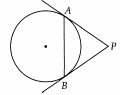
In Triangle APB
Since PA = PB (Tangents from same external point are euqal)
{tex}\therefore {/tex} {tex}\angle P A B = \angle P B A{/tex}
(Opposite angles to equal sides are equal)
Posted by Sudish Kumar 6 years, 10 months ago
- 4 answers
Gaurav Seth 6 years, 10 months ago
Question: What is the common difference of an A.P. in which a21-a7=84
Answer:
Let a is the first term and d is the common difference of an AP
a21 = a + ( 21 -1)d = a + 20d
a7 = a + (7 -1)d = a + 6d
now,
a +20d -a -6d = 84
14d = 84
d = 6 ( answer)
Posted by Aquil Ahmad 6 years, 10 months ago
- 1 answers
Gaurav Seth 6 years, 10 months ago
Let a be any positive integer and b = 3
a = 3q + r, where q ≥ 0 and 0 ≤ r < 3
Therefore, every number can be represented as these three forms. There are three cases.
Case 1: When a = 3q,
Where m is an integer such that m =
Case 2: When a = 3q + 1,
a 3 = (3q +1) 3
a 3 = 27q 3 + 27q 2 + 9q + 1
a 3 = 9(3q 3 + 3q 2 + q) + 1
a 3 = 9m + 1
Where m is an integer such that m = (3q 3 + 3q 2 + q)
Case 3: When a = 3q + 2,
a 3 = (3q +2) 3
a 3 = 27q 3 + 54q 2 + 36q + 8
a 3 = 9(3q 3 + 6q 2 + 4q) + 8
a 3 = 9m + 8
Where m is an integer such that m = (3q 3 + 6q 2 + 4q)
Therefore, the cube of any positive integer is of the form 9m, 9m + 1, or 9m + 8.
Posted by Ansh-_## Choudhary 6 years, 10 months ago
- 2 answers
Tera Baap 6 years, 10 months ago
Gaurav Seth 6 years, 10 months ago
(1+cotA+tanA)(sinA-cosA)
= (sinA+sinAcotA +tanAsinA-cosA -cosAcotA -tanAcosA)
=(sinA+sinAcosA/sinA+tanAsinA-cosA-cosAcotA -cosAsinA/cosA)
= (sinA+cosA+tanAsinA -cosA- cosAcotA -sinA)
= tanAsinA -cosAcotA
= sinAtanA-cotAcosA
Posted by Tera Baap 6 years, 10 months ago
- 1 answers
Posted by Twinkle Star ( Atul )....... ?? 6 years, 10 months ago
- 3 answers
Kabir Gurjar (Up-17) 6 years, 10 months ago

myCBSEguide
Trusted by 1 Crore+ Students

Test Generator
Create papers online. It's FREE.

CUET Mock Tests
75,000+ questions to practice only on myCBSEguide app

Puja Sahoo? 6 years, 10 months ago
1Thank You