
Ask questions which are clear, concise and easy to understand.
Ask QuestionPosted by Vardhan Pandey 6 years, 10 months ago
- 1 answers
Posted by Khushi Joshi 6 years, 10 months ago
- 4 answers
Geetanand Yadav 6 years, 10 months ago
Posted by Khushi Joshi 6 years, 6 months ago
- 1 answers
Sia ? 6 years, 6 months ago
We have to find the ratio in which the x-axis divides the line segment joining the points (- 4, - 6) and (- 1, 7).We will also find the coordinates of the point of division.
Let x-axis divides the line-segment joining (- 4, - 6) and (-1, 7) at the point P in the ratio 1: k.
Now, the coordinates of point of division P,
{tex}= \frac { 1 × ( - 1 ) + k× ( - 4 ) } { k + 1 } , \frac { 1 × 7 + k × ( - 6 ) } { k + 1 }{/tex}
{tex}= \frac { - 1 - 4 k } { k + 1 } , \frac { 7 - 6 k } { k + 1 }{/tex}
Since P lies on x-axis, therefore
{tex}\frac { 7 - 6 k } { k + 1 } = 0{/tex}
or, 7 - 6k = 0 {tex}\Rightarrow k = \frac { 7 } { 6 }{/tex}
Hence, the ratio is 1:{tex}\frac 76{/tex} or 6 : 7
And the coordinates of P are {tex}\frac{-1-\frac{28}{6}}{\frac{7+6}{6}},0=\frac{-6-28}{7+6},0{/tex}
i.e {tex}\left( - \frac { 34 } { 13 } , 0 \right){/tex}.
Posted by Khushi Joshi 6 years, 6 months ago
- 1 answers
Sia ? 6 years, 6 months ago
The diameter of well = 3 m
{tex}\therefore {/tex} The radius of well {tex}(r) = \frac{3}{2}{/tex}m and Depth of earth dug (h) = 14 m
Width of the embankment = 4 m
{tex}\therefore {/tex} The radius of the well with embankment r' = {tex}\frac{3}{2} + 4 = \frac{{11}}{2}{/tex}m
Let the height of the embankment be h'm
According to the question,
The volume of embankment = Volume of the earth dug
{tex} \Rightarrow \pi \left[ {{{(r')}^2} - {r^2}} \right]h' = \pi {r^2}h{/tex}
{tex} \Rightarrow \left[ {{{\left( {\frac{{11}}{2}} \right)}^2} - {{\left( {\frac{3}{2}} \right)}^2}} \right]h' = {\left( {\frac{3}{2}} \right)^2} \times 14{/tex}
{tex} \Rightarrow \left[ {\frac{{121}}{4} - \frac{9}{4}} \right]h' = \frac{9}{4} \times 14{/tex}
{tex} \Rightarrow \frac{{112}}{4} \times h' = \frac{9}{4} \times 14{/tex}
{tex} \Rightarrow h' = \frac{{9 \times 14 \times 4}}{{4 \times 112}}{/tex}
{tex} \Rightarrow h' = 1.125m{/tex}
Posted by Khushi Joshi 6 years, 6 months ago
- 1 answers
Sia ? 6 years, 6 months ago
For conical portion, r = 2m and {tex}l{/tex} = 2.8 m. Let S1 the curved surface area of conical portion. Then,
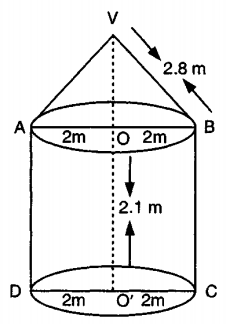
{tex}S _ { 1 } = \pi r l = \pi \times 2 \times 2.8 \mathrm { m } ^ { 2 } = 5.6 \pi \mathrm { m } ^ { 2 }{/tex}
For cylindrical portion, we have r = 2m ,h = 2.1m
Let S2 be the curved surface area of cylindrical portion. Then
{tex}S _ { 2 } = 2 \pi r h = 2 \pi \times 2 \times 2.1 \mathrm { m } = 8.4 \pi \mathrm { m } ^ { 2 }{/tex}
Let S be the area of the canvas used. Then,
S = S1 + S2 = {tex}( 5.6 \pi + 8.4 \pi ) \mathrm { m } ^ { 2 } = 14 \times \frac { 22 } { 7 } \mathrm { m } ^ { 2 } = 44 \mathrm { m } ^ { 2 }{/tex}
Total cost of the canvas at the rate of Rs 500 per m2 = Rs {tex}( 500 \times 44 ){/tex}= Rs 22000
Posted by Khushi Joshi 6 years, 6 months ago
- 1 answers
Sia ? 6 years, 6 months ago
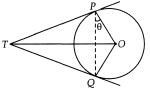
Let {tex}\angle O P Q \text { be } \theta{/tex}
{tex}\therefore \quad \angle T P Q = \left( 90 ^ { \circ } - \theta \right){/tex}
Since TP = TQ (Tangents)
{tex}\therefore \quad \angle T Q P = \left( 90 ^ { \circ } - \theta \right){/tex}
(Opposite angels of equal sides)
Now, {tex}\angle T P Q + \angle T Q P + \angle P T Q{/tex} = 180o
{tex}\Rightarrow 90 ^ { \circ } - \theta + 90 ^ { \circ } - \theta + \angle P T Q{/tex} {tex}= 180 ^ { \circ }{/tex}
{tex}\Rightarrow \quad \angle P T Q = 180 ^ { \circ } - 180 ^ { \circ } + 2 \theta{/tex}
{tex}\Rightarrow \quad \angle P T Q = 2 \theta{/tex}
Hence {tex}\angle P T Q = 2 \angle O P Q{/tex}
Posted by Khushi Joshi 6 years, 10 months ago
- 1 answers
Gaurav Seth 6 years, 10 months ago
We know that, the lengths of tangents drawn from an external point to a circle are equal.
∴ TP = TQ
In ΔTPQ,
TP = TQ
⇒ ∠TQP = ∠TPQ ...(1) (In a triangle, equal sides have equal angles opposite to them)
∠TQP + ∠TPQ + ∠PTQ = 180º (Angle sum property)
∴ 2 ∠TPQ + ∠PTQ = 180º (Using(1))
⇒ ∠PTQ = 180º – 2 ∠TPQ ...(1)
We know that, a tangent to a circle is perpendicular to the radius through the point of contact.
OP ⊥ PT,
∴ ∠OPT = 90º
⇒ ∠OPQ + ∠TPQ = 90º
⇒ ∠OPQ = 90º – ∠TPQ
⇒ 2∠OPQ = 2(90º – ∠TPQ) = 180º – 2 ∠TPQ ...(2)
From (1) and (2), we get
∠PTQ = 2∠OPQ
Posted by Khushi Joshi 6 years, 10 months ago
- 2 answers
Gaurav Seth 6 years, 10 months ago

Given:
Radius of larger circle,(OA) R = 7 cm
Diameter of smaller circle,(OD) = 7 cm
Radius of smaller circle = 7/2 cm
Height of ΔBCA( OC) = 7 cm
Base of ΔBCA ( AB )= 14 cm
Area of ΔBCA = 1/2 × base × height
Area of ΔBCA = 1/2 × AB × OC = 1/2 × 7 × 14 = 49 cm²
Area of larger semicircle with radius (OA)7 cm = 1/2 ×π ×7²= 1/2 ×22/7 ×7×7 = 77 cm²
Area of smaller circle with radius 7/2 cm = πr²= 22/7 × 7/2 × 7/2 = 77/2 cm²
Area of the shaded region =Area of smaller circle with radius 7/2 cm +Area of larger semicircle with radius 7 cm - Area of ΔBCA
Area of the shaded region = 77/2 + 77 - 49= 77/2 + 28 = (77 +56) /2= 133/2
Area of the shaded region = 66.5 cm²
Posted by Khushi Joshi 6 years, 10 months ago
- 1 answers
Gaurav Seth 6 years, 10 months ago
Given ABCD is a ||gm such that its sides touch a circle with centre O.
∴ AB = CD and AB || CD,
AD = BC and AD || BC
Now, P, Q, R and S are the touching point of both the circle and the ||gm
We know that, tangents to a circle from an exterior point are equal in length.
∴ AP = AS [Tangents from point A] ... (1)
BP = BQ [Tangents from point B] ... (2)
CR = CQ [Tangents from point C] ... (3)
DR = DS [Tangents from point D] ... (4)
On adding (1), (2), (3) and (4), we get
AP + BP + CR + DR = AS + BQ + CQ + DS
⇒ (AP + BP) + (CR + DR) = (AS + DS) + (BQ + CQ)
⇒ AB + CD = AD + BC
⇒ AB + AB = BC + BC [∵ ABCD is a ||gm . ∴ AB = CD and AD = BC]
⇒ 2AB = 2BC
⇒ AB = BC
Therefore, AB = BC implies
AB = BC = CD = AD
Hence, ABCD is a rhombus.
In rhombus, it is not necessary that diagonals are equal. If they are equal, then rhombus is considered as a square whose diagonals are always equal. So, there isn't any use of proving that the diagonals of a rhombus are equal.
Posted by Shubham Saini 6 years, 10 months ago
- 3 answers
Garima Sharma 6 years, 10 months ago
Posted by Amit Tiwari 6 years, 10 months ago
- 4 answers
Posted by Jyoti Patra 6 years, 10 months ago
- 2 answers
Posted by Aastha Paliwal 6 years, 10 months ago
- 1 answers
Posted by Aryavansh Sain 6 years, 10 months ago
- 3 answers
Posted by Manish Yadav 6 years, 10 months ago
- 5 answers
Puja Sahoo? 6 years, 10 months ago
Posted by Garima Sharma 6 years, 10 months ago
- 4 answers
Honey ? 6 years, 10 months ago
Posted by Radhika Kanwar 6 years, 10 months ago
- 4 answers
Mishthi ? 6 years, 10 months ago
Garima Sharma 6 years, 10 months ago
Posted by Kishan Kumar 6 years, 10 months ago
- 2 answers
Anushka S 6 years, 10 months ago
Jaya Maji 6 years, 10 months ago
Posted by Yaduvanshi Ankit Kumar 6 years, 10 months ago
- 0 answers
Posted by Prayansh Singh 6 years, 10 months ago
- 1 answers
Posted by Hardik Popli 4 years, 9 months ago
- 0 answers
Posted by Dude Liveable 6 years, 10 months ago
- 1 answers
Kalyani Pathak 6 years, 10 months ago
Posted by Ruchipanday Ruchipanday 6 years, 10 months ago
- 0 answers

myCBSEguide
Trusted by 1 Crore+ Students

Test Generator
Create papers online. It's FREE.

CUET Mock Tests
75,000+ questions to practice only on myCBSEguide app

Aruneeraj K 6 years, 10 months ago
2Thank You