
Ask questions which are clear, concise and easy to understand.
Ask QuestionPosted by Aditya Nagar 6 years, 10 months ago
- 1 answers
Posted by Mohammad Amir 6 years, 10 months ago
- 1 answers
Posted by Kunal Anand 6 years, 10 months ago
- 0 answers
Posted by S Sriram 6 years, 10 months ago
- 1 answers
Posted by Dgf Chd 6 years, 10 months ago
- 1 answers
Posted by Tripti Sharma 6 years, 10 months ago
- 2 answers
Eliza ? 6 years, 10 months ago
Thanks Ki Baarish ........???? 6 years, 10 months ago
Posted by Pranav Kaushal 6 years, 10 months ago
- 3 answers
Swetanshu Kumar 6 years, 10 months ago
Thanks Ki Baarish ........???? 6 years, 10 months ago
Posted by Expert Boy'S 6 years, 10 months ago
- 2 answers
Abhishek Bishnoi 6 years, 10 months ago
Posted by Aman Kumar 6 years, 10 months ago
- 1 answers
Posted by Pavankumar Pavankumar 6 years, 4 months ago
- 1 answers
Sia ? 6 years, 4 months ago
LHS{tex} = \left( {\frac{1}{{{{\sec }^2}\theta - {{\cos }^2}\theta }} + \frac{1}{{\cos e{c^2}\theta - {{\sin }^2}\theta }}} \right){\sin ^2}\theta {\cos ^2}\theta {/tex}
{tex} = \left( {\frac{1}{{\frac{1}{{{{\cos }^2}\theta }} - {{\cos }^2}\theta }} + \frac{1}{{\frac{1}{{{{\sin }^2}\theta }} - {{\sin }^2}\theta }}} \right){\sin ^2}\theta {\cos ^2}\theta {/tex}
{tex} = \left( {\frac{1}{{\frac{{1 - {{\cos }^4}\theta }}{{{{\cos }^2}\theta }}}} + \frac{1}{{\frac{{1 - {{\sin }^4}\theta }}{{{{\sin }^2}\theta }}}}} \right){\sin ^2}\theta {\cos ^2}\theta {/tex}
{tex} = \left( {\frac{{{{\cos }^2}\theta }}{{1 - {{\cos }^4}\theta }} + \frac{{{{\sin }^2}\theta }}{{1 - {{\sin }^4}\theta }}} \right){\sin ^2}\theta {\cos ^2}\theta {/tex}
{tex} = \left( {\frac{{{{\cos }^2}\theta \left( {1 - {{\sin }^4}\theta } \right) + {{\sin }^2}\theta \left( {1 - {{\cos }^4}\theta } \right)}}{{\left( {1 - {{\cos }^4}\theta } \right)\left( {1 - {{\sin }^4}\theta } \right)}}} \right){\sin ^2}\theta {\cos ^2}\theta {/tex}
{tex}=\left( {\frac{{{{\cos }^2}\theta \left( {1 - {{\sin }^2}\theta } \right)\left( {1 + {{\sin }^2}\theta } \right) + {{\sin }^2}\theta \left( {1 - {{\cos }^2}\theta } \right)\left( {1 + {{\cos }^2}\theta } \right)}}{{\left( {1 - {{\cos }^2}\theta } \right)\left( {1 + {{\cos }^2}\theta } \right)\left( {1 - {{\sin }^2}\theta } \right)\left( {1 + {{\sin }^2}\theta } \right)}}} \right){\sin ^2}\theta {\cos ^2}\theta {/tex}
{tex} = \left( {\frac{{{{\cos }^2}\theta \cdot {{\cos }^2}\theta \left( {1 + {{\sin }^2}\theta } \right) + {{\sin }^2}\theta {{\sin }^2}\theta \left( {1 + {{\cos }^2}\theta } \right)}}{{{{\sin }^2}\theta \left( {1 + {{\cos }^2}\theta } \right){{\cos }^2}\theta \left( {1 + {{\sin }^2}\theta } \right)}}} \right){\sin ^2}\theta {\cos ^2}\theta {/tex} {tex}\left[ {\because {{\sin }^2}\theta + {{\cos }^2}\theta = 1} \right]{/tex}
{tex} = \left( {\frac{{{{\cos }^4}\theta \left( {1 + {{\sin }^2}\theta } \right) + {{\sin }^4}\theta \left( {1 + {{\cos }^2}\theta } \right)}}{{{{\sin }^2}\theta {{\cos }^2}\theta \left( {1 + {{\cos }^2}\theta } \right)\left( {1 + {{\sin }^2}\theta } \right)}}} \right){\sin ^2}\theta {\cos ^2}\theta {/tex}
{tex} = \left( {\frac{{{{\cos }^4}\theta \left( {1 + {{\sin }^2}\theta } \right) + {{\sin }^4}\theta \left( {1 + {{\cos }^2}\theta } \right)}}{{\left( {1 + {{\cos }^2}\theta } \right)\left( {1 + {{\sin }^2}\theta } \right)}}} \right){/tex}
{tex} = \left( {\frac{{{{\cos }^4}\theta + {{\cos }^4}\theta {{\sin }^2}\theta + {{\sin }^4}\theta + {{\sin }^4}\theta {{\cos }^2}\theta }}{{\left( {1 + {{\cos }^2}\theta } \right)\left( {1 + {{\sin }^2}\theta } \right)}}} \right){/tex}
{tex} = \left( {\frac{{{{\cos }^4}\theta + {{\sin }^4}\theta + {{\cos }^4}\theta {{\sin }^2}\theta + {{\sin }^4}\theta {{\cos }^2}\theta }}{{\left( {1 + {{\cos }^2}\theta } \right)\left( {1 + {{\sin }^2}\theta } \right)}}} \right){/tex}
{tex} = \frac{{{{\left( {{{\cos }^2}\theta + {{\sin }^2}\theta } \right)}^2} - 2{{\cos }^2}\theta {{\sin }^2}\theta + {{\cos }^2}\theta {{\sin }^2}\theta \left( {{{\cos }^2}\theta + {{\sin }^2}\theta } \right)}}{{\left( {1 + {{\cos }^2}\theta } \right)\left( {1 + {{\sin }^2}\theta } \right)}}{/tex}
{tex} = \frac{{1 - 2{{\cos }^2}\theta {{\sin }^2}\theta + {{\cos }^2}\theta {{\sin }^2}\theta \times 1}}{{1 + {{\sin }^2}\theta + {{\cos }^2}\theta + {{\cos }^2}\theta {{\sin }^2}\theta }}{/tex} {tex}\left[ {{{\sin }^2}\theta + {{\cos }^2}\theta = 1} \right]{/tex}
{tex} = \frac{{1 - {{\cos }^2}\theta {{\sin }^2}\theta }}{{1 + 1 + {{\cos }^2}\theta {{\sin }^2}\theta }}{/tex}
{tex} = \frac{{1 - {{\cos }^2}\theta {{\sin }^2}\theta }}{{2 + {{\cos }^2}\theta {{\sin }^2}\theta }}{/tex}
= RHS
Hence proved
Posted by Supriya Tiwari 6 years, 10 months ago
- 2 answers
Abhi Singh 6 years, 10 months ago
Prasanna Punwatkar 6 years, 10 months ago
Posted by Suman Kumar 6 years, 10 months ago
- 1 answers
Thanks Ki Baarish ........???? 6 years, 10 months ago
Posted by Abhay Awasthi 6 years, 10 months ago
- 0 answers
Posted by Shivam Punjabi 6 years, 10 months ago
- 3 answers
Posted by Manish Kumar 6 years, 10 months ago
- 2 answers
Vikram Singh 6 years, 10 months ago
Posted by Ranveer Singh 6 years, 10 months ago
- 1 answers
Posted by Netra Verma 6 years, 10 months ago
- 1 answers
Posted by Lovepreet Singh Behal 6 years, 10 months ago
- 1 answers
Posted by Vikram Singh 6 years, 10 months ago
- 0 answers
Posted by Aqdas Shaikh 6 years, 10 months ago
- 1 answers
Posted by Noor Chander 6 years, 4 months ago
- 1 answers
Sia ? 6 years, 4 months ago
Given: PQ is a diameter of a circle with centre O. The lines AB and CD are the tangents at P and Q respectively.
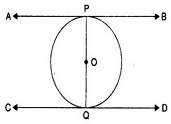
To prove: AB {tex}\parallel{/tex} CD
Proof: AB is a tangent to the circle at P and Op is the radius through the point of contact
{tex}\because{/tex} {tex}\angle{/tex}OPA = 90o .......(1) [The tangent at any point of a circle is perpendicular to the radius through the point of contact]
{tex}\because{/tex} CD is a tangent to the circle at Q and OQ is the radius through the point of contact.
{tex}\therefore{/tex} {tex}\angle{/tex}OQD = 90o ........(2) [The tangent at any point of a circle is perpendicular to the radius through the point of contact]
From (1) and (2),
{tex}\angle{/tex}OPA = {tex}\angle{/tex}OQD
But these form a pair of equal alternate angles.
{tex}\because{/tex} AB {tex}\parallel{/tex} CD
Posted by Harshit Hada 6 years, 10 months ago
- 3 answers
Navjot Singh 6 years, 10 months ago
Posted by Nisha Das 6 years, 10 months ago
- 1 answers
_T_A_N_U_78 ??? 6 years, 10 months ago
Posted by Usha Yadav 6 years, 10 months ago
- 1 answers
Posted by Charanjit Bajwa 6 years, 10 months ago
- 1 answers
Posted by Vikram Singh 6 years, 10 months ago
- 2 answers
_T_A_N_U_78 ??? 6 years, 10 months ago

myCBSEguide
Trusted by 1 Crore+ Students

Test Generator
Create papers online. It's FREE.

CUET Mock Tests
75,000+ questions to practice only on myCBSEguide app

Lustig Yashu? 6 years, 10 months ago
3Thank You