
Ask questions which are clear, concise and easy to understand.
Ask QuestionPosted by Aishreet ... 6 years, 4 months ago
- 29 answers
Aishreet ... 6 years, 4 months ago
Aishreet ... 6 years, 4 months ago
Posted by Nirvail Singh 6 years, 4 months ago
- 0 answers
Posted by Dheeraj Upraity 6 years, 4 months ago
- 5 answers
Posted by Seenath Abdulsalam M.M Seenath 6 years, 4 months ago
- 0 answers
Posted by Kung Fu ?? 6 years, 4 months ago
- 3 answers
Harsh Mishra 6 years, 4 months ago
You'n do your Time- Pass at some other website Too...... kyonki yahaan toh sirf exam mein log ate hain naheen toh bahot boring website Hai.....
Kung Fu ?? 6 years, 4 months ago
Posted by Durgesh Kumar Singh 6 years, 4 months ago
- 0 answers
Posted by Ashvin Chaudhary 6 years, 4 months ago
- 1 answers
Posted by Dipesh Yadav 6 years, 3 months ago
- 1 answers
Sia ? 6 years, 3 months ago
You can check NCERT Solutions here : https://mycbseguide.com/ncert-solutions.html
Posted by Purnima Chandani 6 years, 4 months ago
- 2 answers
Nanu Yadav 6 years, 4 months ago
?Niharika Sharma ? 6 years, 4 months ago
Posted by Sougata Mandal 6 years, 3 months ago
- 1 answers
Sia ? 6 years, 3 months ago
You can check NCERT Solutions here : https://mycbseguide.com/ncert-solutions.html
Posted by Vivek Singh 6 years, 4 months ago
- 2 answers
Vinayak Chaudhary 6 years, 4 months ago
Dheeraj Upraity 6 years, 4 months ago
Posted by Chetna ❤️ 6 years, 4 months ago
- 2 answers
Posted by Naman Sharma 5 years, 8 months ago
- 2 answers
Posted by Cbse Student 6 years, 4 months ago
- 0 answers
Posted by Prem Jadhav 6 years, 3 months ago
- 1 answers
Sia ? 6 years, 3 months ago
The given equations may be written as
{tex} \frac { x + 1 } { 2 } + \frac { y - 1 } { 3 } = 8 {/tex}
⇒ 3(x + 1) + 2 (y - 1) = 48
⇒ 3x + 3 + 2y - 2 = 48
⇒ 3x + 2y + 1= 48
⇒ 3x+2y = 47 ... (i)
{tex}\frac { x - 1 } { 3 } + \frac { y + 1 } { 2 } = 9{/tex}
⇒ 2(x -1 ) + 3(y +1) = 54
⇒ 2x - 2 + 3y + 3 = 54
⇒ 2x + 3y + 1 = 54
⇒ 2x + 3y = 53. ... (ii)
Multiplying (i) by 2 and (ii) by 3 and subtracting, we get
(4 - 9)y = 94-159
{tex} \Rightarrow - 5 y = - 65 {/tex}
{tex}\Rightarrow y = \frac { - 65 } { - 5 } {/tex}
{tex}\Rightarrow y = 13{/tex}
Putting y = 13 in (i), we get
3x + (2 {tex} \times{/tex} 13) = 47
{tex} \Rightarrow{/tex} 3x + 26 = 47
{tex} \Rightarrow{/tex} 3x = (47 - 26)
{tex} \Rightarrow{/tex}3x = 21
{tex} \Rightarrow \quad x = \frac { 21 } { 3 } = 7{/tex}
So, x = 7
Hence, x = 7 and y = 13
Posted by Sushmita Sen 6 years, 4 months ago
- 3 answers
Posted by Ojus Gupta 6 years, 4 months ago
- 1 answers
Posted by Bablu Kumar Sharma 6 years, 4 months ago
- 0 answers
Posted by Sahib Ansari 6 years, 3 months ago
- 1 answers
Sia ? 6 years, 3 months ago
We will prove this by contradiction.
Let us suppose that (3+2 {tex}\sqrt { 5 }{/tex}) is rational.
It means that we have co-prime integers a and b such that
{tex}\frac { a } { b } = 3 + 2 \sqrt { 5 } \quad \frac { a } { b } - 3 = 2 \sqrt { 5 }{/tex}
{tex}\Rightarrow \frac{{a - 3b}}{b} = 2{\sqrt 5 \,{ \Rightarrow }}\frac{{a - 3b}}{{2b}} = \sqrt 5 {/tex} ....(1)
a and b are integers.
It means L.H.S of (1) is rational but we know that {tex}\sqrt { 5 }{/tex} is irrational. It is not possible. Therefore, our supposition is wrong. (3+2 {tex}\sqrt { 5 }{/tex}) cannot be rational.
Hence, (3+2 {tex}\sqrt { 5 }{/tex}) is irrational.
Posted by Sahib Ansari 6 years, 4 months ago
- 3 answers
Posted by Ayushman Nautiyal 6 years, 4 months ago
- 4 answers
Posted by Sujal Chaudhary 6 years, 4 months ago
- 3 answers
Posted by Yashavant Kumar Sharma 6 years, 4 months ago
- 0 answers
Posted by Aadya Singh 6 years, 3 months ago
- 1 answers
Sia ? 6 years, 3 months ago
Let ABCD be a square and B (x, y) be the unknown vertex.
AB = BC
{tex} \Rightarrow {/tex} AB2 = BC2
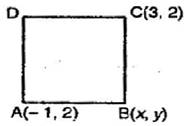
{tex} \Rightarrow {/tex} (x + 1)2 + (y - 2)2 = (x - 3)2 + (y - 2)2
{tex} \Rightarrow {/tex} x2 + 1 + 2x + y2 + 4 - 4x = x2 - 6x + 9 + y2 + 4 - 4x
{tex} \Rightarrow {/tex} 2x + 1 = - 6x + 9
{tex} \Rightarrow {/tex} 8x = 8
{tex} \Rightarrow {/tex} x = 1 ........ (i)
In {tex}\triangle{/tex}ABC, AB2 + BC2 = AC2
{tex} \Rightarrow {/tex} (x + 1)2 + (y - 2)2 + (x - 3)2 + (y - 2)2 = (3 + 1)2 + (2 - 2)2
{tex} \Rightarrow {/tex}x2 + 1 + 2x + y2 - 4x + 4 + x2 + 9 - 6x + y2 + 4 - 2y = 16 + 0
{tex} \Rightarrow {/tex} 2x2 + 2y2 + 2x - 4y - 6x - 4y + 1 + 4 + 9 + 4 = 16
{tex} \Rightarrow {/tex} 2x2 + 2y2 - 4x - 8y + 2 = 0
{tex} \Rightarrow {/tex} x2 + y2 - 2x - 4y + 1 = 0 ..... (ii)
Putting the value of x in eq. (ii),
1 + y2 - 2 - 4y + 1 = 0
{tex} \Rightarrow {/tex} y2 - 4y = 0
{tex} \Rightarrow {/tex} y(y - 4) = 0
{tex} \Rightarrow {/tex} y = 0 or 4
Hence the other vertices are (1, 0) and (1, 4).
Posted by Jerlin Christy 6 years, 4 months ago
- 0 answers
Posted by Suniksha Bhatia 6 years, 4 months ago
- 2 answers
Sia ? 6 years, 4 months ago
Sin 18/cos72 cos(90-72)/cos72
Cos72/sin72=1
Tan26/tan(90-74)=1
Cos48-sin42=sin(90-42)-sin42=0
Cosec31-Cosec(90-69) Cose31-Cosec31=0
Tanisha Yadav 6 years, 4 months ago
Posted by Suniksha Bhatia 6 years, 4 months ago
- 3 answers
Sia ? 6 years, 4 months ago
Consider a triangle ABC in which {tex}\angle A = \theta {/tex} and {tex}\angle B = {90^o}{/tex}
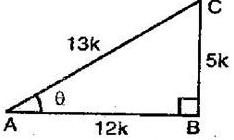
Let AB = 12k and AC = 13k
Then, using Pythagoras theorem,
{tex}BC=\sqrt { ( \mathrm { AC } ) ^ { 2 } - ( \mathrm { AB } ) ^ { 2 } } = \sqrt { ( 13 k ) ^ { 2 } - ( 12 k ) ^ { 2 } }{/tex}
{tex}= \sqrt { 169 k ^ { 2 } - 144 k ^ { 2 } } = \sqrt { 25 k ^ { 2 } } = 5 k{/tex}
{tex}\therefore {/tex} {tex}\sin \theta = \frac { B C } { A C } = \frac { 5 k } { 13 k } = \frac { 5 } { 13 }{/tex}
{tex}\cos \theta = \frac { A B } { A C } = \frac { 12 k } { 13 k } = \frac { 12 } { 13 } \tan \theta = \frac { B C } { A B } = \frac { 5 k } { 12 k } = \frac { 5 } { 12 }{/tex}
{tex}\cot \theta = \frac { A B } { B C } = \frac { 12 k } { 5 k } = \frac { 12 } { 5 } \cos e c \theta = \frac { A C } { B C } = \frac { 13 k } { 5 k } = \frac { 13 } { 5 }{/tex}
Tanisha Yadav 6 years, 4 months ago
Anshuman Singh Chouhan 6 years, 4 months ago
Posted by Anna Shivani 6 years, 4 months ago
- 1 answers
Sia ? 6 years, 4 months ago
Let seven years ago arya's age be x years.
As per given condition
Seven years ago sparsh's age was five times the square of arya's age.
Then, seven years ago sparsh's age was 5x2 years.
Therefore, arya's present age = (x + 7) years
And sparsh's present age = (5x2 + 7) years
Three years hence arya's age = (x + 7 + 3) years = (x + 10) years
And three years hence sparsh's age = (5x2 + 7 + 3) years = (5x2 + 10) years
As per given condition
Three years hence arya's age will be {tex}\frac{2}{5}{/tex} of sparsh's age.
Therefore, x + 10 = {tex}\frac{2}{5}{/tex}(5x2 + 10)
{tex}\Rightarrow{/tex} x + 10 = 2(x2 + 2)
{tex}\Rightarrow{/tex} x + 10 = 2x2 + 4
{tex}\Rightarrow{/tex} 2x2 - x - 6 = 0
{tex}\Rightarrow{/tex} 2x2 - 4x + 3x - 6 = 0
{tex}\Rightarrow{/tex} 2 x ( x - 2 ) + 3 ( x - 2 ) = 0
{tex}\Rightarrow{/tex} (2x + 3) (x - 2) = 0
{tex}\Rightarrow{/tex} x - 2 = 0 [{tex}\because{/tex} 2x + 3 {tex}\neq{/tex} 0 as x > 0]
{tex}\Rightarrow{/tex} x = 2
Hence, arya's present age = (2 + 7) years = 9 years
sparsh's present age = (5 {tex}\times{/tex}22 + 7) years = 27 years
Posted by Md Shadil 6 years, 4 months ago
- 0 answers
Posted by Shikshita Naryal 6 years, 4 months ago
- 1 answers
Sia ? 6 years, 4 months ago
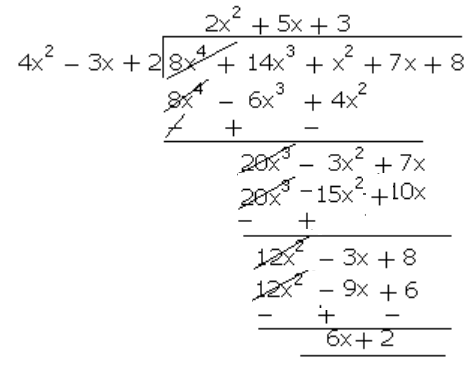
Here the remainder =6x+2
Therefore, when 6x+2 is subtracted from 8x4 + 14x3 + x2 + 7x + 8, then it will be divisible by 4x2 - 3x + 2.

myCBSEguide
Trusted by 1 Crore+ Students

Test Generator
Create papers online. It's FREE.

CUET Mock Tests
75,000+ questions to practice only on myCBSEguide app

Abcd Pro 6 years, 4 months ago
0Thank You