
Ask questions which are clear, concise and easy to understand.
Ask QuestionPosted by Madhavanunni Km 6 years, 4 months ago
- 2 answers
Mayank Sharma 6 years, 4 months ago
Posted by Madhavanunni Km 6 years, 4 months ago
- 3 answers
Gaurav Seth 6 years, 4 months ago
Let three consecutive natural numbers be x, x + 1 and x +2.
Then according to problem
(x)2 + (x + 1)2 + (x + 2)2 = 110
⇒ x2 + x2 + 1 + 2x + x2 + 4 + 4x – 110 = 0
⇒ 3x2 + 6x – 105 = 0
⇒ x2 + 2x – 35 = 0
⇒ x2 + 7x – 5x – 35 = 0
⇒ x(x + 7) – 5(x + 7) = 0
⇒ (x + 7)(x – 5) = 0
⇒ x + 7 = 0 or x – 5 = 0
⇒ x = -7 or x = 5
But x = - 7 is rejected as it is not a natural number.
Then x = 5
Hence, required numbers are 5, (5 + 1), (5 + 2)
i.e., 5, 6 and 7.
Mayank Sharma 6 years, 4 months ago
Posted by Syed Mustafa K 6 years, 4 months ago
- 2 answers
Pranav Mehta 6 years, 4 months ago
Posted by Aman Kumar 6 years, 4 months ago
- 2 answers
Posted by Krish Gupta 6 years, 4 months ago
- 3 answers
Chaitanya Dasari 6 years, 4 months ago
Posted by Ashok Mishra 6 years, 4 months ago
- 1 answers
Posted by Seema Mishra 6 years, 4 months ago
- 2 answers
Sumit Kumar 6 years, 4 months ago
Posted by Nisi Sinha 6 years, 4 months ago
- 0 answers
Posted by Aaron Dsouza Gohan Dragon 6 years, 4 months ago
- 3 answers
Posted by Jatin Osara 6 years, 4 months ago
- 1 answers
Posted by Sneha Mandal 6 years, 4 months ago
- 1 answers
Posted by Sneha Mandal 6 years, 4 months ago
- 1 answers
Posted by Vishal Bajaj 6 years, 4 months ago
- 1 answers
Yogita Ingle 6 years, 4 months ago
Let us assume that √5 is a rational number.
we know that the rational numbers are in the form of p/q form where p,q are intezers.
so, √5 = p/q
p = √5q
we know that 'p' is a rational number. so √5 q must be rational since it equals to p
but it doesnt occurs with √5 since its not an intezer
therefore, p =/= √5q
this contradicts the fact that √5 is an irrational number
hence our assumption is wrong and √5 is an irrational number.
Posted by Himanshu Yadav 6 years, 4 months ago
- 3 answers
Mayank Sharma 6 years, 4 months ago
Posted by Shivam Kumar 6 years, 3 months ago
- 1 answers
Sia ? 6 years, 3 months ago
Let the numerator and the denominator of the fraction be x and y respectively.
Then the fraction is {tex}\frac{x}{y}{/tex}.
Given, The sum of the numerator and the denominator of the fraction is 3 less than the twice of the denominator.
Thus, we have
{tex}x + y = 2y - 3{/tex}
{tex}\Rightarrow{/tex} {tex}x + y - 2y + 3 = 0{/tex}
{tex}\Rightarrow{/tex} {tex}x - y + 3 = 0{/tex}..............(1)
Also given, If the numerator and the denominator both are decreased by 1, the numerator becomes half the denominator. Thus, we have
{tex}x - 1 = \frac{1}{2}(y - 1){/tex}
{tex}{/tex}
{tex}\Rightarrow{/tex} {tex}2(x - 1) = (y - 1){/tex}
{tex}\Rightarrow{/tex} 2x - 2 = (y - 1)
{tex}\Rightarrow{/tex} 2x - y - 1 = 0.......................(2)
So, we have formed two linear equations in x & y as following:-
x - y + 3 = 0
2x - y - 1 = 0
Here x and y are unknowns.
We have to solve the above equations for x and y.
By using cross-multiplication method , we have
{tex}\frac{x}{{( - 1) \times ( - 1) - ( - 1) \times 3}}{/tex} {tex}= \frac{{ - y}}{{1 \times ( - 1) - 2 \times 3}}{/tex} {tex}= \frac{1}{{1 \times ( - 1) - 2 \times ( - 1)}}{/tex}
{tex}\Rightarrow \frac{x}{{1 + 3}}{/tex} {tex}= \frac{{ - y}}{{ - 1 - 6}} = \frac{1}{{ - 1 + 2}}{/tex}
{tex}\Rightarrow \frac{x}{4} = \frac{{ - y}}{{ - 7}} = \frac{1}{1}{/tex}
{tex}\Rightarrow \frac{x}{4} = \frac{y}{7} = 1{/tex}
Using Part I & III , we get x = 4
& From part II & III, we get y = 7 {tex}{/tex}
{tex}\Rightarrow{/tex} x = 4, y = 7
Hence, The fraction is {tex}\frac{x}{y}{/tex} = {tex}\frac{4}{7}{/tex}
Posted by Raj Kumar 6 years, 4 months ago
- 3 answers
Shreya Saraswat 6 years, 4 months ago
Posted by Girish Singhania 6 years, 4 months ago
- 1 answers
Posted by Abhay Singh 6 years, 4 months ago
- 5 answers
Abhay Singh 6 years, 4 months ago
Ayushi Rawat 6 years, 4 months ago
Sid Patel 6 years, 4 months ago
Posted by Sujeet Hazra 6 years, 4 months ago
- 4 answers
Vidhi Singla 6 years, 4 months ago
Posted by Jyoti Tiwari 6 years, 4 months ago
- 0 answers
Posted by Rahul Kumar 6 years, 4 months ago
- 0 answers
Posted by Manjeet Yadav 6 years, 4 months ago
- 0 answers
Posted by ????? ?????? 6 years, 4 months ago
- 7 answers
Palak Jatwa ?? 6 years, 4 months ago
Posted by ????? ?????? 6 years, 4 months ago
- 3 answers
Renu Rekwar 6 years, 4 months ago
Posted by Saiyam Aggarwal 6 years, 4 months ago
- 3 answers
Posted by Dj Python 6 years, 4 months ago
- 1 answers
Posted by Somshekar Kambi 6 years, 4 months ago
- 1 answers
Posted by Maria Manuel 6 years, 3 months ago
- 1 answers
Sia ? 6 years, 3 months ago
AD is the median of {tex}\triangle{/tex}ABC from vertex A
D(x, y) = {tex}\left( \frac { 3 + 5 } { 2 } , \frac { - 2 + 2 } { 2 } \right){/tex}= (4, 0)
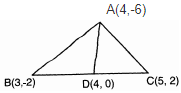
Area of {tex}\Delta{/tex}ADB ={tex}\frac { 1 } { 2 } \times {/tex}(4 (0 + 2) + 4 (-2 + 6) + 3 (- 6 - 0))
= {tex}\frac { 1 } { 2 } \times {/tex}(8 + 16 + -18)
= {tex}\frac { 1 } { 2 } \times {/tex}6 = 3 square units.........(i)
Area of {tex}\Delta{/tex}ACD
= {tex}\frac { 1 } { 2 } \times{/tex} ( 4(0 - 2) + 4(2 + 6) + 5 (- 6 - 0))
= {tex}\frac { 1 } { 2 } \times{/tex}(-8 + 32 - 30)
= {tex}\frac { 1 } { 2 } \times{/tex}-6 = -3
Since area can not the negative
Area of {tex}\Delta{/tex}ACD = 3 square units .........(ii)
From (i) and (ii) Area {tex}\Delta{/tex}ADB = Area {tex}\Delta{/tex}ACD, it is verified that median of ∆ABC divides it into two triangles of equal areas.
Posted by Darshan Panda 6 years, 4 months ago
- 4 answers
Posted by Manoj Kumar Shukla Mp 6 years, 4 months ago
- 1 answers
Yogita Ingle 6 years, 4 months ago
We are given the equation
x-3y-3 = 0
3x-9y-2 = 0
1/3 = -3/-9 and not equal to -3/-2
1/3 = 1/3 and not equal to 3/2
So, it has unique solution.
Because they satisfied the condition of unique solution

myCBSEguide
Trusted by 1 Crore+ Students

Test Generator
Create papers online. It's FREE.

CUET Mock Tests
75,000+ questions to practice only on myCBSEguide app

Sia ? 6 years, 4 months ago
26
0Thank You