
Ask questions which are clear, concise and easy to understand.
Ask QuestionPosted by Faiza Saifi 6 years, 3 months ago
- 2 answers
Gaurav Seth 6 years, 3 months ago
Two levels of Mathematics in class 10
- The two levels of Examination will be held in the subject of Mathematics in the Board examination for Class X in the year 2020 and the same shall not be applicable to the internal assessment in class X.
- There shall not be two levels of Assessment/Examination for class IX.
- First level would be the same as the existing one, and the other would be an easier level.
- The nomenclature for the two Examinations will be; Mathematics-Standard for the existing level of examination, and Mathematics-Basic for the easier level of examination.
- The syllabus, class room teaching and internal assessment for both the levels of examination would remain the same; so that the students get an opportunity to study the whole range of topics throughout the year and are able to decide upon the level of Board examination depending upon their aptitude and abilities.
- The Standard level will be meant for students who wish to opt for Mathematics at Sr. Secondary level and the Basic level would be for students not keen to pursue Mathematics at higher levels.
- A student will have the right to choose between the two levels of Examination at the time of submission of List of Candidates (LoC) by the affiliated school to the Board online.
- In case student fails at any level of Mathematics, he/she can appear at the compartment examination as per norms of the Board. The student failed in Mathematics-standard will have the option to sit in the compartmental exam of Mathematics-Basic in place of Mathematics-Standard again.
- A student who qualifies the Mathematics-Basic, shall be given an option to appear in Mathematics-Standard at the time of Compartment exams as per norms of the Board, in case he/she changes his/her mind to pursue Mathematics at Senior Secondary level.
Posted by ?Queen #Alone#Weak#Always?? 6 years, 3 months ago
- 9 answers
Rohan Stark 6 years, 3 months ago
Rohan Stark 6 years, 3 months ago
Posted by Babban Singh 6 years, 3 months ago
- 1 answers
Sia ? 6 years, 3 months ago
5 x - 4 y - 8 = 0
7 x + 6 y - 9 = 0
Here, a1= 5, b1 = -4, c1= 8
a2= 7, b2= 6, c2 = 9
We see that {tex}\frac { a _ { 1 } } { a _ { 2 } } \neq \frac { b _ { 1 } } { b _ { 2 } }{/tex}
Hence, the lines representing the given pair of linear equations intersect at the point and the equations are consistent having unique solution.
Posted by Khushi Keshri 6 years, 3 months ago
- 8 answers
Yadav Kishorkumar 6 years, 3 months ago
Posted by @Madhavi Paiwal 6 years, 3 months ago
- 2 answers
Gaurav Seth 6 years, 3 months ago
Given that -
The sum of two numbers is 11 and the sum of their reciprocal is 11/28.
Let the numbers be x and y respectively.
Sum of numbers is 11.
⇒ x + y = 11.... (i)
⇒ y = 11 - x .... (ii)
Sum of reciprocals is 11/28.
⇒ .... (iii)
Now, on solving (iii),
Putting the value of (i) and (ii) here, we get -
Hence, the required numbers are 7 and 4.
Posted by Aaliya ? 6 years, 3 months ago
- 29 answers
Aaliya ? 6 years, 3 months ago
Pk . 6 years, 3 months ago
Pk . 6 years, 3 months ago
Pk . 6 years, 3 months ago
Pk . 6 years, 3 months ago
Aaliya ? 6 years, 3 months ago
Posted by Ansh Juneja 6 years, 3 months ago
- 1 answers
Gaurav Seth 6 years, 3 months ago
The answer is given below
Let the coordinates of point A be (x, y). Mid-point of AB is (2, - 3), which is the center of the circle. ⇒ x + 1 = 4 and y + 4 = -6 ⇒ x = 3 and y = -10 Therefore, the coordinates of A are (3,-10).
Posted by Pk . 6 years, 3 months ago
- 5 answers
Harsimran Singh ? 6 years, 3 months ago
Pk . 6 years, 3 months ago
Harsimran Singh ? 6 years, 3 months ago
? ? 6 years, 3 months ago
Posted by Hema Dharshini 6 years, 3 months ago
- 1 answers
Posted by Nikhil Dhiman 6 years, 3 months ago
- 0 answers
Posted by Rahul Taleja 6 years, 3 months ago
- 0 answers
Posted by Amit Kumar 6 years, 3 months ago
- 1 answers
Namami Saxena 6 years, 3 months ago
Posted by Suryansh Mishra 6 years, 3 months ago
- 1 answers
Rahul Taleja 6 years, 3 months ago
Posted by Renu Kashyap 6 years, 3 months ago
- 0 answers
Posted by Biswanath Sarkar 6 years, 3 months ago
- 1 answers
Sia ? 6 years, 3 months ago
Given : {tex}\Delta A B C \sim \Delta P Q R{/tex}
To Prove : {tex}\frac { \operatorname { ar } ( \Delta A B C ) } { \operatorname { ar } ( \Delta P Q R ) } = \left( \frac { A B } { P Q } \right) ^ { 2 }= \left( \frac { BC } { QR } \right) ^ { 2 }= \left( \frac { A C } { P R } \right) ^ { 2 }{/tex}
Construction: Draw AD {tex} \bot {/tex}BC and PE {tex} \bot {/tex} QR
Proof :
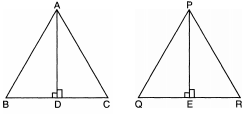
{tex}\Delta A B C \sim \Delta P Q R{/tex}
{tex}\therefore\frac { A B } { P Q } = \frac { B C } { Q R } = \frac { A C } { P R }{/tex} ( Ratio of corresponding sides of similar triangles are equal) ...(i)
{tex}\angle B = \angle Q{/tex} (Corresponding angles of similar triangles)......... (ii)
In {tex}\Delta A D B \text { and } \Delta P E Q{/tex}
{tex}\angle B = \angle Q{/tex} ( From (ii))
{tex}\angle A D B = \angle P E Q{/tex} {tex}\left[\; \operatorname { each } 90 ^ { \circ } \right]{/tex}
{tex}\therefore {/tex} {tex}\Delta A D B \sim \Delta P E Q{/tex} [ By AA criteria]
{tex}\Rightarrow{/tex} {tex}\frac { A D } { P E } = \frac { A B } { P Q }{/tex} (Corresponding sides of similar triangles) ...(iii)
From equation (i) and equation (iii)
{tex}\frac { A B } { P Q } = \frac { B C } { Q R } = \frac { A C } { P R } = \frac { A D } { P E }{/tex} ...(iv)
{tex}\frac { \operatorname { ar } ( \Delta A B C ) } { \operatorname { ar } ( \Delta P Q R ) } = \frac { \frac { 1 } { 2 } \times B C \times A D } { \frac { 1 } { 2 } \times Q R \times P E }{/tex}
{tex}= \left( \frac { B C } { Q R } \right) \times \left( \frac { A D } { P E } \right){/tex}
({tex}\frac{AD}{PE}=\frac{BC}{QR}{/tex})
{tex}= \frac { B C } { Q R } \times \frac { B C } { Q R }{/tex}
{tex}\Rightarrow{/tex} {tex}\frac { a r ( \Delta A B C ) } { a r ( \Delta P Q R ) } = \frac { B C ^ { 2 } } { Q R ^ { 2 } }{/tex} ....(v) [from eq. (iv)]
From equation (iv) and equation (v),
{tex}\therefore\frac { \operatorname { ar } ( \Delta A B C ) } { \operatorname { ar } ( \Delta P Q R ) } = \left( \frac { A B } { P Q } \right) ^ { 2 }= \left( \frac { BC } { QR } \right) ^ { 2 }= \left( \frac { A C } { P R } \right) ^ { 2 }{/tex}
{tex}\therefore{/tex} Ratio of the areas of two similar triangles is equal to the square of the ratio of their corresponding sides.
Posted by Ashi Jain 6 years, 3 months ago
- 1 answers
Sia ? 6 years, 3 months ago
It is given that the gap between two consecutive rungs is 25 cm and the top and bottom rungs are 2.5 metre i.e., 250 cm apart.
{tex}\therefore{/tex} Number of rungs = {tex}\frac { 250 } { 25 } {/tex}+ 1 = 10 + 1 = 11.
It is given that the rungs are decreasing uniformly in length from 45 cm at the bottom to 25 cm at the top.
Therefore, lengths of the rungs form an A.P. with first term a = 45 cm and 11th term l = 25 cm. n = 11
{tex}\therefore{/tex} Length of the wood required for rungs = Sum of 11 terms of an A.P. with first term 45 cm and last term is 25 cm
{tex}= \frac { 11 } { 2 }{/tex} ( 45 + 25 ) cm {tex}\left[ \because S _ { n } = \frac { n } { 2 } ( a + l ) \right]{/tex}
{tex}= \frac { 11 } { 2 }{/tex}(70) cm
= 11 (35) cm
= 385 cm
Length of the wood required for rungs = {tex}\frac{385}{100}{/tex} = 3.85 metres ({tex}\because{/tex}100 cm = 1 m)
The length of the wood required for the rungs is 3.85 metres.
Posted by Abhiraj Rajput 6 years, 3 months ago
- 1 answers
Posted by Navansh Shukla 6 years, 3 months ago
- 1 answers
Sia ? 6 years, 3 months ago
According to question it is given that triangles ABC and PQR are similar.
Also, perimeter of ∆ ABC = 32 & Perimeter of ∆ PQR = 24
Therefore,
{tex}\frac { \text { Perimeter } ( \triangle A B C ) } { \text {Perimeter } ( \triangle P Q R ) }{/tex}{tex}= \frac { A B } { P Q }{/tex}
{tex}\Rightarrow \frac { 32 } { 24 } = \frac { A B } { 12 }{/tex}
{tex}\Rightarrow A B = \frac { 32 \times 12 } { 24 }{/tex}
= 16 cm
Posted by Aayush Jain 6 years, 3 months ago
- 3 answers
Ã.P.W.B.Đ ⚡ 6 years, 3 months ago
Posted by Gaurav Rathore 6 years, 3 months ago
- 3 answers
Posted by Suman Jangra 6 years, 3 months ago
- 5 answers
Sirat Kaur 6 years, 3 months ago
Har Har Mahadev 🙏 6 years, 3 months ago
? ? 6 years, 3 months ago
Faiza Saifi 6 years, 3 months ago
Posted by Parag Deshpande 6 years, 3 months ago
- 2 answers
Kiran Sharma 6 years, 3 months ago
Posted by Purva Jain 6 years, 3 months ago
- 4 answers
Sirat Kaur 6 years, 3 months ago
Posted by Jugnu Sinha 6 years, 3 months ago
- 1 answers
Posted by Aman Kumar 6 years, 3 months ago
- 3 answers
Student Lyf ? 6 years, 3 months ago
Aman Kumar 6 years, 3 months ago
Suman Jangra 6 years, 3 months ago
Posted by Sumit Chandra 6 years, 3 months ago
- 5 answers
Posted by Ansuman Rathore 6 years, 3 months ago
- 0 answers
Posted by Zeel Patel 6 years, 3 months ago
- 0 answers
Posted by Hema Dharshini 6 years, 3 months ago
- 1 answers
Gaurav Seth 6 years, 3 months ago
Let the radius of the cone = R
and Height of a cone = r [Given]
Volume of cone =
Now,
Volume of sphere = Volume of cone
thus,the radius of the base of cone =2r

myCBSEguide
Trusted by 1 Crore+ Students

Test Generator
Create papers online. It's FREE.

CUET Mock Tests
75,000+ questions to practice only on myCBSEguide app

Faiza Saifi 6 years, 3 months ago
1Thank You