
Ask questions which are clear, concise and easy to understand.
Ask QuestionPosted by Praveen Kumar 6 years, 3 months ago
- 1 answers
Posted by Gowri Gopakumar 6 years, 3 months ago
- 1 answers
Sia ? 6 years, 3 months ago
Given A parallelogram ABCD in which P is a point on side BC such that DP produced meets AB produced at L.
To Prove
- {tex}\frac { D P } { P L } = \frac { D C } { B L }{/tex}
- {tex}\frac { D L } { D P } = \frac { A L } { D C }{/tex}
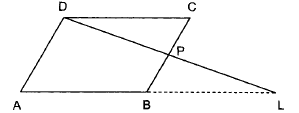
Proof
- In {tex}\triangle{/tex} ALD, we have
{tex}B P \| A D{/tex}
{tex}\therefore \quad \frac { L B } { B A } = \frac { L P } { P D }{/tex}
{tex}\Rightarrow \quad \frac { B L } { A B } = \frac { P L } { D P }{/tex}
{tex}\Rightarrow \quad \frac { B L } { D C } = \frac { P L } { D P }{/tex} [{tex}\because{/tex} AB = DC]
{tex}\Rightarrow \quad \frac { D P } { P L } = \frac { D C } { B L }{/tex} [Taking reciprocals of both sides]. - From (i), we have
{tex}\frac { D P } { P L } = \frac { D C } { B L }{/tex}
{tex}\Rightarrow \quad \frac { P L } { D P } = \frac { B L } { D C }{/tex}
{tex}\Rightarrow \quad \frac { P L } { D P } = \frac { B L } { A B }{/tex} [{tex}\because{/tex} DC = AB]
{tex}\Rightarrow \quad \frac { P L } { D P } + 1 = \frac { B L } { A B } + 1{/tex} [Adding 1 on both sides]
{tex}\Rightarrow \quad \frac { D P + P L } { D P } = \frac { B L + A B } { A B }{/tex}
{tex}\Rightarrow \quad \frac { D L } { D P } = \frac { A L } { A B }{/tex}
{tex}\Rightarrow \quad \frac { D L } { D P } = \frac { A L } { D C }{/tex} [ {tex}\because{/tex} AB = DC]
Posted by Omprakash Yadav 6 years, 3 months ago
- 5 answers
Sachin Yadav 6 years, 3 months ago
Archana Kumari 6 years, 3 months ago
Posted by Nageswararao Sakuru 6 years, 3 months ago
- 1 answers
Sia ? 6 years, 3 months ago
Let a be the first term and d be the common difference of the given A.P.
Clearly, in an A.P. consisting of 11 terms, {tex} \left( \frac { 11 + 1 } { 2 } \right) ^ { t h }{/tex} i.e. 6th term is the middle term.
{tex}\text{ it is given that the middle term =30}{/tex}
So a+5d=30 .....(1)
.{tex}S_{11}=\frac{11}{2}(2a+10d){/tex}
= 11(a+5d)
But a+5d=30 from (1)
Hence S11 = 11 × 30= 330
Posted by Nibha Kumari 6 years, 3 months ago
- 1 answers
Sia ? 6 years, 3 months ago
Given: Circles are described with sides AB and AC of a triangle ABC as diameters. They intersect in a point D.
To prove: D lies on the third side BC of {tex}\triangle{/tex}ABC.
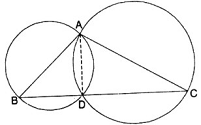
Construction: Join AD.
Proof: Circle described on AB as diameter intersects BC in D.
{tex}\angle {/tex}ADB = 90° [Angle in a semi-circle]
But {tex}\angle {/tex}ADB + {tex}\angle {/tex}ADC = 180° [Linear Pair Axiom]
{tex}\therefore{/tex} {tex}\angle {/tex}ADC = 90°
Hence, the circle described on AC as diameter must pass through D.
Thus, the two circles intersect in D.
Now {tex}\angle {/tex}ADB + {tex}\angle {/tex}ADC = 180°
{tex}\therefore{/tex} Points B, D, C are collinear
{tex}\therefore{/tex} D lies on BC.
Posted by Het Patel 6 years, 3 months ago
- 1 answers
Gourav ## Back ## Happy ? ? 6 years, 3 months ago
Posted by Het Patel 6 years, 3 months ago
- 1 answers
Gourav ## Back ## Happy ? ? 6 years, 3 months ago
Posted by Mani Singh Rajput 6 years, 3 months ago
- 2 answers
Sachin Yadav 6 years, 3 months ago
Posted by Komal Rathore 6 years, 3 months ago
- 1 answers
Posted by Mani Singh Rajput 6 years, 3 months ago
- 0 answers
Posted by Rudram Yaduvanshi 6 years, 3 months ago
- 0 answers
Posted by Sangita Devi 6 years, 3 months ago
- 0 answers
Posted by Samuel Philip 6 years, 3 months ago
- 0 answers
Posted by ?Harshitha? Harshi 6 years, 3 months ago
- 7 answers
Gourav ## Back ## Happy ? ? 6 years, 3 months ago
Posted by Baba Tech 6 years, 3 months ago
- 4 answers
Abhinav Baghel 6 years, 3 months ago
Lucky Raj. 6 years, 3 months ago
Posted by Ramandeep Kaur 6 years, 3 months ago
- 2 answers
Bhumika Singla 6 years, 3 months ago
Posted by Rishav Sharma 6 years, 3 months ago
- 2 answers
Posted by Aayush Jaiswal 6 years, 3 months ago
- 1 answers
Yogita Ingle 6 years, 3 months ago
In a Rt. angle Triangle,
Let the side be "a"
By Pythogorus therom
a2 + a2 = h2
h = a√2
Sin(45°) = a/a√2 = 1/√2
Posted by Hitesh Thakur 6 years, 3 months ago
- 1 answers
Gaurav Seth 6 years, 3 months ago
Given,
AC = √3 BC
Let < ABC = @ then,
Tan @ = perp./ base
= AC / BC
= √3 BC/ BC
= √3
So,
@ = 60°
Posted by Prerna Kumari 6 years, 3 months ago
- 3 answers
Rani Mishra ??? 6 years, 3 months ago
Posted by Kavya Khurana 6 years, 3 months ago
- 2 answers
Posted by Aman Agarwal 6 years, 3 months ago
- 0 answers
Posted by Esha Mathur 6 years, 3 months ago
- 0 answers
Posted by Esha Mathur 6 years, 3 months ago
- 0 answers
Posted by Esha Mathur 6 years, 3 months ago
- 2 answers
Posted by Mukul Mishra 6 years, 3 months ago
- 3 answers
Prerna Kumari 6 years, 3 months ago
Joy Shukla 6 years, 3 months ago

myCBSEguide
Trusted by 1 Crore+ Students

Test Generator
Create papers online. It's FREE.

CUET Mock Tests
75,000+ questions to practice only on myCBSEguide app

Sia ? 6 years, 3 months ago
Sample paper wiil be released in the month of September
0Thank You