
Ask questions which are clear, concise and easy to understand.
Ask QuestionPosted by Shivam Kushwaha 6 years, 3 months ago
- 3 answers
Yogita Singh 6 years, 3 months ago
Posted by Sonam Singh 6 years, 3 months ago
- 1 answers
Posted by Shirv Chandar Prasad 6 years, 3 months ago
- 2 answers
Posted by Vartika Mishra 6 years, 3 months ago
- 3 answers
Posted by Mo Anas 6 years, 3 months ago
- 0 answers
Posted by Reshma Byju 6 years, 3 months ago
- 1 answers
Rhythm Garg 6 years, 3 months ago
Posted by Yogesh Yadav 6 years, 3 months ago
- 1 answers
Posted by Yogesh Yadav 6 years, 3 months ago
- 4 answers
Posted by Abhinav Jaiswal 6 years, 3 months ago
- 3 answers
Prachi ☺️ 6 years, 3 months ago
Posted by Gurmeet Sandhu 6 years, 3 months ago
- 2 answers
Posted by Sandeep Singh 6 years, 3 months ago
- 1 answers
Gaurav Seth 6 years, 3 months ago
Given: ABCD be a parallelogram circumscribing a circle with centre O.
To prove: ABCD is a rhombus.
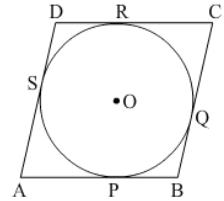
We know that the tangents drawn to a circle from an exterior point are equal in length.
Therefore, AP = AS, BP = BQ, CR = CQ and DR = DS.
Adding the above equations,
AP + BP + CR + DR = AS + BQ + CQ + DS
(AP + BP) + (CR + DR) = (AS + DS) + (BQ + CQ)
AB + CD = AD + BC
2AB = 2BC
(Since, ABCD is a parallelogram so AB = DC and AD = BC)
AB = BC
Therefore, AB = BC = DC = AD.
Hence, ABCD is a rhombus.
Posted by Samyak Jain 6 years, 3 months ago
- 0 answers
Posted by Kriti Agrawal 6 years, 3 months ago
- 1 answers
Gaurav Seth 6 years, 3 months ago
Sol;
Let us three consecutive integers be, n, n + 1 and n + 2.
Whenever a number is divided by 3 the remainder obtained is either 0 or 1 or 2.
let n = 3p or 3p + 1 or 3p + 2, where p is some integer.
If n = 3p, then n is divisible by 3.
If n = 3p + 1, then n + 2 = 3p + 1 + 2 = 3p + 3 = 3(p + 1) is divisible by 3.
If n = 3p + 2, then n + 1 = 3p + 2 + 1 = 3p + 3 = 3(p + 1) is divisible by 3.
So that n, n + 1 and n + 2 is always divisible by 3.
⇒ n (n + 1) (n + 2) is divisible by 3.
Similarly, whenever a number is divided 2 we will get the remainder is 0 or 1.
∴ n = 2q or 2q + 1, where q is some integer.
If n = 2q, then n and n + 2 = 2q + 2 = 2(q + 1) are divisible by 2.
If n = 2q + 1, then n + 1 = 2q + 1 + 1 = 2q + 2 = 2 (q + 1) is divisible by 2.
So that n, n + 1 and n + 2 is always divisible by 2.
⇒ n (n + 1) (n + 2) is divisible by 2.
But n (n + 1) (n + 2) is divisible by 2 and 3.
∴ n (n + 1) (n + 2) is divisible by 6.
Posted by Varun Verma 6 years, 3 months ago
- 0 answers
Posted by Bharat Garg 6 years, 3 months ago
- 1 answers
Gaurav Seth 6 years, 3 months ago
Mid-Point Theorem :-
The line segment joining the mid-points of two sides of a triangle is parallel to the third side and equal to half the third side.
Given: In triangle ABC, P and Q are mid-points of AB and AC respectively.
To Prove: i) PQ || BC ii) PQ = 1/ 2 BC
Construction: Draw CR || BA to meet PQ produced at R.
Proof:
∠QAP = ∠QCR. (Pair of alternate angles) ---------- (1)
AQ = QC. (∵ Q is the mid-point of side AC) ---------- (2)
∠AQP = ∠CQR (Vertically opposite angles) ---------- (3)
Thus, ΔAPQ ≅ ΔCRQ (ASA Congruence rule)
PQ = QR. (by CPCT). or PQ = 1/ 2 PR ---------- (4)
⇒ AP = CR (by CPCT) ........(5)
But, AP = BP. (∵ P is the mid-point of the side AB)
⇒ BP = CR
Also. BP || CR. (by construction)
In quadrilateral BCRP, BP = CR and BP || CR
Therefore, quadrilateral BCRP is a parallelogram.
BC || PR or, BC || PQ
Also, PR = BC (∵ BCRP is a parallelogram)
⇒ 1 /2 PR = 1/ 2 BC
⇒ PQ = 1/ 2 BC. [from (4)]
Posted by Sanjay Doot 6 years, 3 months ago
- 0 answers
Posted by Sanjay Doot 6 years, 3 months ago
- 0 answers
Posted by Aman Singh Bisht 6 years, 3 months ago
- 2 answers
Shreya .... 6 years, 3 months ago
Dp Singh 6 years, 3 months ago
Posted by Shahnawaz Ansari 6 years, 3 months ago
- 1 answers
Rajani Sahu 6 years, 3 months ago
Posted by Priyanka Das 6 years, 3 months ago
- 0 answers
Posted by Sandeep Sahu 6 years, 3 months ago
- 1 answers
Gaurav Seth 6 years, 3 months ago
Given that,
S7 = 49
S17 = 289
S7
= 7/2 [2a + (n - 1)d]
S7 = 7/2 [2a + (7 - 1)d]
49 = 7/2 [2a + 16d]
7 = (a + 3d)
a + 3d = 7 ... (i)
Similarly,
S17 = 17/2 [2a + (17 - 1)d]
289 = 17/2 (2a + 16d)
17 = (a + 8d)
a + 8d = 17 ... (ii)
Subtracting equation (i) from equation (ii),
5d = 10
d = 2
From equation (i),
a + 3(2) = 7
a + 6 = 7
a = 1
Sn = n/2 [2a + (n - 1)d]
= n/2 [2(1) + (n - 1) × 2]
= n/2 (2 + 2n - 2)
= n/2 (2n)
= n2
Posted by Shivamani Shiva 6 years, 3 months ago
- 2 answers
Gaurav Seth 6 years, 3 months ago
Q: If the perimeter and the area of a circle are numerically equal then find the radius of the circle?
Answer:
r=2
Step-by-step explanation:
Perimeter of circle = 2πr
Area of circle = πr²
According to the Question,
Perimeter of circle = Area of circle
2πr = πr²
or, 2πr / πr = r
or, 2 = r
or, r = 2
Hence the radius is 2.
Posted by Swayam Mishra 6 years, 3 months ago
- 2 answers
Gaurav Seth 6 years, 3 months ago
In ΔDOC and ΔBOA,
∠CDO = ∠ABO [Alternate interior angles as AB || CD]
∠DCO = ∠BAO [Alternate interior angles as AB || CD]
∠DOC = ∠BOA [Vertically opposite angles]
∴ ΔDOC ~ ΔBOA [AAA similarity criterion]
∴ DO/BO = OC/OA [ Corresponding sides are proportional]
⇒ OA/OC = OB/OD
Posted by Vikash Kumar 6 years, 3 months ago
- 1 answers
Mansi Sengar 6 years, 3 months ago
Posted by Debangan Saha 6 years, 3 months ago
- 0 answers
Posted by Rafique Uddin Laskar 6 years, 3 months ago
- 2 answers
Posted by Mrudali Joshi 6 years, 3 months ago
- 0 answers
Posted by Pankaja Pradhan 6 years, 3 months ago
- 1 answers
Rani Mishra ??? 6 years, 3 months ago
Posted by Rishi Khandelwal 6 years, 3 months ago
- 0 answers
Posted by Keshav Yadav 6 years, 3 months ago
- 2 answers
Veenus Varghese 6 years, 3 months ago

myCBSEguide
Trusted by 1 Crore+ Students

Test Generator
Create papers online. It's FREE.

CUET Mock Tests
75,000+ questions to practice only on myCBSEguide app

Ritesh Tiwari 6 years, 3 months ago
0Thank You