
Ask questions which are clear, concise and easy to understand.
Ask QuestionPosted by Rafiya Khan 6 years, 5 months ago
- 0 answers
Posted by Laxman Laxman 6 years, 5 months ago
- 3 answers
Sagar Rana 6 years, 5 months ago
Gaurav Saraswat 6 years, 5 months ago
Harsh Dagar 6 years, 5 months ago
Posted by Ujjval Chaurasiya 6 years, 5 months ago
- 5 answers
Abhinandan Uday Mangla 6 years, 5 months ago
Posted by Mayank Raj 6 years, 5 months ago
- 1 answers
Posted by Sweta Dwivedi 6 years, 5 months ago
- 9 answers
Deep... Honey ...?? 6 years, 5 months ago
Posted by Sahil ???? 6 years, 5 months ago
- 8 answers
Posted by Prashant Singh 6 years, 5 months ago
- 1 answers
Posted by Sahil Singh 6 years, 5 months ago
- 22 answers
Deep... Honey ...?? 6 years, 5 months ago
Sahil Singh 6 years, 5 months ago
Deep... Honey ...?? 6 years, 5 months ago
Posted by Alan Xavier 6 years, 5 months ago
- 1 answers
Posted by Somil Agrawal 6 years, 5 months ago
- 0 answers
Posted by Ali Ahmed 6 years, 5 months ago
- 1 answers
Posted by Neeru Sharma 6 years, 5 months ago
- 6 answers
Posted by Sachin R.D 6 years, 5 months ago
- 4 answers
Yogita Ingle 6 years, 5 months ago
As a cylinder can be seen as a collection of multiple congruent disks stacked one above the other. In order to calculate the space occupied by a cylinder, we calculate the space occupied by each disk and then add them up. Thus, the volume of the cylinder can be given by the product of the area of base and height.
The volume of a cylinder = πr2h cubic units.
Posted by Gagan Deep 6 years, 5 months ago
- 0 answers
Posted by Parul Mishra 6 years, 5 months ago
- 0 answers
Posted by Anita Das 6 years, 5 months ago
- 1 answers
Sia ? 4 years, 9 months ago
Complete Step-by-step answer:
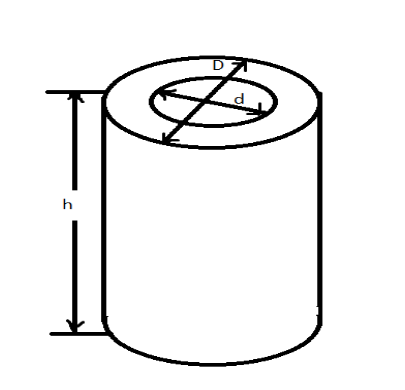 </div>
<div itemprop="description">The difference of outer curved surface area and inner curved surface area is 88<nobr aria-hidden="true">cm2</nobr><script type="math/tex" id="MathJax-Element-5">cm^2</script> given in the question.
</div>
<div itemprop="description">The difference of outer curved surface area and inner curved surface area is 88<nobr aria-hidden="true">cm2</nobr><script type="math/tex" id="MathJax-Element-5">cm^2</script> given in the question.So,
Outer curved surface area – Inner curved surface area <nobr aria-hidden="true">=88cm2</nobr><script type="math/tex" id="MathJax-Element-6">=88c{{m}^{2}}</script>.
Since, the curved surface area of a cylinder is <nobr aria-hidden="true">2πrh</nobr><script type="math/tex" id="MathJax-Element-7">2\pi rh</script>, where r is the radius and h is the height of the cylinder.
In our problem, the height of the cylinder is 14 cm.
<nobr aria-hidden="true">2πRh − 2πrh = 882πh (R−r) = 88R − r = 882 × 227 × 14R − r = 88 × 72 × 22 × 14R−r = 1...(1)</nobr>
Also, the difference of volume of outer part and inner part of cylinder is given.
So, Volume of outer part – Volume of inner part<nobr aria-hidden="true">=176</nobr><script type="math/tex" id="MathJax-Element-9">=176</script>.
Since, the volume of a cylinder is <nobr aria-hidden="true">πr2h</nobr><script type="math/tex" id="MathJax-Element-10">\pi {{r}^{2}}h</script>, where r is the radius and h is the height of the cylinder.
<nobr aria-hidden="true">πR2h − πr2h = 176πh(R2 − r2) = 176</nobr>
We expand the <nobr aria-hidden="true">(R2−r2)</nobr><script type="math/tex" id="MathJax-Element-12">({{R}^{2}}-{{r}^{2}})</script> using the identity <nobr aria-hidden="true">(a2−b2)=(a−b)(a+b)</nobr>.
<nobr aria-hidden="true">πh(R−r)(R+r) = 176π × 14(R+r) = 176R+r = 176×722×14R+r = 4 ...(2)</nobr>
Adding equation (1) and equation (2), we get
<nobr aria-hidden="true">R+r+R−r=52R=5R=52D=5</nobr>
Putting in equation (2),
<nobr aria-hidden="true">52+r=4r=4−52r=8−52r=32d=3.</nobr>
Hence, the diameter of outer cylinder is 5cm and the diameter of inner cylinder is 3cm.</div> </div>
Posted by Diya❤ 5 years, 11 months ago
- 4 answers
Diya❤ 6 years, 5 months ago
Posted by Daljit Kaur Saini 6 years, 5 months ago
- 1 answers
Posted by Diya❤ 6 years, 5 months ago
- 8 answers
Posted by Hemalatha Tamarapu 6 years, 5 months ago
- 2 answers
Vaibhav Kumar 6 years, 5 months ago
?Ahista Mishra? 6 years, 5 months ago
As the share of his both sons,i.e., Elder and Younger One are same,viz., 5/11 and 5/11 and the rest is for widow,i.e., 1/11.
And as the widow gets Rs. 3600 of her share....
Therefore, the sharing of both the boys will be...... => 5 into 3600 = Rs. 18000
And as the sharing of both the son is same...... Thus, Both will get Rs. 18000. That's It. :)
Posted by Sharan S 6 years, 5 months ago
- 0 answers
Posted by Sonakshi Tomar 6 years, 5 months ago
- 0 answers
Posted by Ruby Kumari 6 years, 5 months ago
- 0 answers
Posted by Anshuman Suna 6 years, 5 months ago
- 1 answers
Sia ? 6 years, 5 months ago
Consider two right triangles ABC and PQR in which {tex} \angle B{/tex} and {tex}\angle Q{/tex} are the right angles.
We have,
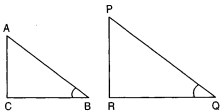
In {tex}\triangle ABC{/tex}
{tex}\sin B=\frac{AC}{AB}{/tex}
and, In {tex}\triangle PQR{/tex}
{tex}\sin Q=\frac{PR}{PQ}{/tex}
{tex} \because \quad \sin B = \sin Q{/tex}
{tex} \Rightarrow \quad \frac { A C } { A B } = \frac { P R } { P Q }{/tex}
{tex} \Rightarrow \quad \frac { A C } { P R } = \frac { A B } { P Q } = k{/tex}(say) ...... (i)
{tex} \Rightarrow {/tex} AC = kPR and AB = kPQ .....(ii)
Using Pythagoras theorem in triangles ABC and PQR, we obtain
AB2 = AC2 + BC2 and PQ2 = PR2 + QR2
{tex} \Rightarrow \quad B C = \sqrt { A B ^ { 2 } - A C ^ { 2 } } \text { and } Q R = \sqrt { P Q ^ { 2 } - P R ^ { 2 } }{/tex}
{tex} \Rightarrow \quad \frac { B C } { Q R } = \frac { \sqrt { A B ^ { 2 } - A C ^ { 2 } } } { \sqrt { P Q ^ { 2 } - P R ^ { 2 } } } = \frac { \sqrt { k ^ { 2 } P Q ^ { 2 } - k ^ { 2 } P R ^ { 2 } } } { \sqrt { P Q ^ { 2 } - P R ^ { 2 } } }{/tex} [ using (ii) ]
{tex} \Rightarrow \quad \frac { B C } { Q R } = \frac { k \sqrt { P Q ^ { 2 } - P R ^ { 2 } } } { \sqrt { P Q ^ { 2 } - P R ^ { 2 } } } = k{/tex}...(iii)
From (i) and (iii), we get
{tex} \frac { A C } { P R } = \frac { A B } { P Q } = \frac { B C } { Q R }{/tex}
{tex} \Rightarrow \quad \Delta A C B - \Delta P R Q{/tex} [By S.A.S similarity]
{tex} \therefore \quad \angle B = \angle Q{/tex}
Hence proved.

myCBSEguide
Trusted by 1 Crore+ Students

Test Generator
Create papers online. It's FREE.

CUET Mock Tests
75,000+ questions to practice only on myCBSEguide app
