
Ask questions which are clear, concise and easy to understand.
Ask QuestionPosted by Shreyasi Bharti 6 years, 6 months ago
- 1 answers
Posted by Anshika Bhargava 7 years, 9 months ago
- 6 answers
Posted by Kaur Deep 7 years, 9 months ago
- 2 answers
Posted by Anshika Bhargava 6 years, 6 months ago
- 1 answers
Sia ? 6 years, 6 months ago
Given:
d = -2, n = 5 and an = 0
We know that , an = a + (n - 1) d
{tex}0 = a + (n - 1) d{/tex}
{tex}[ a_n = 0]{/tex}
{tex}0 = a + ( 5 - 1 ) (-2){/tex}
0 = a + 4 {tex}\times{/tex} - 2
{tex}0 = a - 8{/tex}
0 + 8 = a
a = 8
Hence, the value of a is 8.
Posted by Sarvjot Singh 6 years, 6 months ago
- 1 answers
Sia ? 6 years, 6 months ago
Given that at the foot of a mountain the elevation of its summit is 45°; after ascending 1000 m towards the mountain up a slope of 30° inclination, the elevation is found to be 60°. We have to find the height of the mountain.
Let F be the foot and S be the summit of the mountain FOS. Then {tex}\angle O F S = 45 ^ { \circ }{/tex}and therefore, {tex}\angle O S F = 45 ^ { \circ }.{/tex}Consequently, OF = OS = h km (say). Let FP = 1000 m = 1 km be the slope so that {tex}\angle O F P = 30 ^ { \circ }.{/tex}Draw PM {tex}\perp {/tex}OF. join PS. It is given that {tex}\angle M P S = 60 ^ { \circ }.{/tex}
In {tex}\triangle F P L,{/tex}we have
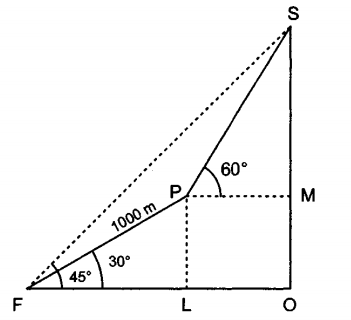
{tex}\sin 30 ^ { \circ } = \frac { P L } { P F }{/tex}
{tex}\Rightarrow \quad P L = P F \sin 30 ^ { \circ } = \left( 1 + \frac { 1 } { 2 } \right) \mathrm { km } = \frac { 1 } { 2 } \mathrm { km }{/tex}
{tex}\therefore \quad O M = P L = \frac { 1 } { 2 } \mathrm { km }{/tex}
{tex}\Rightarrow \quad M S = O S - O M = \left( h - \frac { 1 } { 2 } \right) \mathrm { km }{/tex} ...(i)
Also, {tex}\cos 30 ^ { \circ } = \frac { F L } { P F }{/tex}
{tex}\Rightarrow \quad F L = P F \cos 30 ^ { \circ } = \left( 1 \times \frac { \sqrt { 3 } } { 2 } \right) \mathrm { km } = \frac { \sqrt { 3 } } { 2 } \mathrm { km }{/tex}
Now, h = OS = OF = OL + LF
{tex}\Rightarrow \quad h = O L + \frac { \sqrt { 3 } } { 2 }{/tex}
{tex}\Rightarrow \quad O L = \left( h - \frac { \sqrt { 3 } } { 2 } \right) \mathrm { km }{/tex}
{tex}\Rightarrow \quad P M = \left( h - \frac { \sqrt { 3 } } { 2 } \right) \mathrm { km }{/tex} ...(ii)
In {tex}\triangle S P M,{/tex} we have
{tex}\tan 60 ^ { \circ } = \frac { S M } { P M }{/tex}
{tex}\Rightarrow{/tex} SM = PM . tan60 °
{tex}\Rightarrow \quad \left( h - \frac { 1 } { 2 } \right) = \left( h - \frac { \sqrt { 3 } } { 2 } \right) \sqrt { 3 }{/tex}
{tex}\Rightarrow \quad h - \frac { 1 } { 2 } = h \sqrt { 3 } - \frac { 3 } { 2 }{/tex}
{tex}\Rightarrow \quad \sqrt { 3 } h - h = \frac { 3 } { 2 } - \frac { 1 } { 2 }{/tex}
{tex}\Rightarrow \quad h ( \sqrt { 3 } - 1 ) = 1{/tex}
{tex}\Rightarrow \quad h = \frac { 1 } { \sqrt { 3 } - 1 } = \frac { \sqrt { 3 } + 1 } { ( \sqrt { 3 } - 1 ) ( \sqrt { 3 } + 1 ) } = \frac { \sqrt { 3 } + 1 } { 2 } = \frac { 2.732 } { 2 } = 1.366 \mathrm { km }{/tex}
Hence, the height of the mountain is 1.366 km.
Posted by Nagbhushan Hegde 7 years, 9 months ago
- 2 answers
Posted by Himanshu Srivastav 7 years, 9 months ago
- 0 answers
Posted by Anwar Khan 7 years, 9 months ago
- 1 answers
Posted by Mayank Pandey 7 years, 9 months ago
- 6 answers
Jitender Shaw 7 years, 9 months ago
Posted by Amol Amol 7 years, 9 months ago
- 0 answers
Posted by Rinkle Prajapati 7 years, 9 months ago
- 1 answers
Mr Lovely 7 years, 9 months ago
Posted by Iram Qureshi 6 years, 4 months ago
- 1 answers
Sia ? 6 years, 4 months ago
Let the points A (2, 3), B{tex}\left( {4,k} \right){/tex} and C{tex}\left( {6, - 3} \right){/tex} be collinear.
If the points are collinear then area of triangle ABC formed by these three points is 0.
{tex}\therefore {/tex}{tex}{\text{ar}}\left( {\Delta {\text{ABC}}} \right) = \frac{1}{2}\left[ {{x_1}\left( {{y_2} - {y_3}} \right) + {x_2}\left( {{y_3} - {y_1}} \right) + {x_3}\left( {{y_1} - {y_2}} \right)} \right]{/tex}= 0
{tex} \Rightarrow {/tex}{tex}\frac{1}{2}\left[ {2\left( {k + 3} \right) + 4\left( { - 3 - 3} \right) + 6\left( {3 - k} \right)} \right] = 0{/tex}
{tex} \Rightarrow {/tex}{tex}\left[ {2k + 6 - 24 + 18 - 6k} \right] = 0{/tex}
{tex} \Rightarrow {/tex}{tex}\left[ { - 4k} \right] = 0{/tex}
{tex} \Rightarrow {/tex}{tex}k = 0{/tex}
Posted by Neelam Rana 7 years, 9 months ago
- 2 answers
Nishant Verma 7 years, 9 months ago
Posted by Renu Gupta 7 years, 9 months ago
- 0 answers
Posted by Utkarsh Prakash 7 years, 9 months ago
- 5 answers
Cutiee Princess 7 years, 9 months ago
Posted by Molika Agrawal 7 years, 9 months ago
- 4 answers
Posted by Ankit Yadav 7 years, 9 months ago
- 0 answers
Posted by Sneha Sreenivasan 7 years, 9 months ago
- 1 answers
Nishant Verma 7 years, 9 months ago
Posted by Molika Agrawal 7 years, 9 months ago
- 5 answers
Posted by Amit Batra 7 years, 9 months ago
- 2 answers
Cutiee Princess 7 years, 9 months ago
Posted by Gurvinder Singh 7 years, 9 months ago
- 5 answers
Gurvinder Singh 7 years, 9 months ago
Cutiee Princess 7 years, 9 months ago
Posted by Molika Agrawal 7 years, 9 months ago
- 2 answers
Deepali Bhardwaj 7 years, 9 months ago
Posted by Bitthal Patel 7 years, 9 months ago
- 0 answers
Posted by Kevin Thomas 7 years, 9 months ago
- 5 answers
Posted by Ishaan G 7 years, 9 months ago
- 6 answers
Ishaan G 7 years, 9 months ago
Posted by Ishaan G 7 years, 9 months ago
- 2 answers
Complicated Life 7 years, 9 months ago
Posted by Ishaan G 7 years, 9 months ago
- 4 answers
Complicated Life 7 years, 9 months ago
Posted by Ishaan G 7 years, 9 months ago
- 3 answers
Complicated Life 7 years, 9 months ago
Posted by Abhi Verma 7 years, 9 months ago
- 3 answers
Nishant Verma 7 years, 9 months ago

myCBSEguide
Trusted by 1 Crore+ Students

Test Generator
Create papers online. It's FREE.

CUET Mock Tests
75,000+ questions to practice only on myCBSEguide app

Sia ? 6 years, 6 months ago
Let a, and A be the first terms and d and D be the common difference of two A.Ps
Then, according to the question,
{tex}\frac { S _ { n } } { S _ { n } ^ { \prime } } = \frac { \frac { n } { 2 } [ 2 a + ( n - 1 ) d ] } { \frac { n } { 2 } [ 2 A + ( n - 1 ) D ] } = \frac { 7 n + 1 } { 4 n + 27 }{/tex}
or, {tex}\frac { 2 a + ( n - 1 ) d } { 2 A + ( n - 1 ) D } = \frac { 7 n + 1 } { 4 n + 27 }{/tex}
or,{tex}\frac { a + \left( \frac { n - 1 } { 2 } \right) d } { A + \left( \frac { n - 1 } { 2 } \right) D } = \frac { 7 n + 1 } { 4 n + 27 }{/tex}
Putting, {tex}\frac { n - 1 } { 2 } = m - 1{/tex}
{tex}n-1 = 2m - 2{/tex}
{tex}n= 2m - 2 + 1{/tex}
or, {tex}n = 2m - 1{/tex}
{tex}\frac { a + ( m - 1 ) d } { A + ( m - 1 ) D } = \frac { 7 ( 2 m - 1 ) + 1 } { 4 ( 2 m - 1 ) + 27 }{/tex}
{tex}\frac { a + ( m - 1 ) d } { A + ( m - 1 ) D } = \frac { 14 m - 7 + 1 } { 8 m - 4 + 27 }{/tex}
{tex}\frac { a + ( m - 1 ) d } { A + ( m - 1 ) D } = \frac { 14 m - 6 } { 8 m + 23 }{/tex}
Hence, {tex}\frac { a _ { m } } { A _ { m } } = \frac { 14 m - 6 } { 8 m + 23 }{/tex}
0Thank You