
Ask questions which are clear, concise and easy to understand.
Ask QuestionPosted by Gungun Gujjar 7 years, 8 months ago
- 4 answers
Ayush Gujjar 7 years, 8 months ago
Vikansh Taneja 7 years, 8 months ago
Aditi Goyal 7 years, 8 months ago
Aurthur Strange 7 years, 8 months ago
Posted by Kapil Upadhyay 7 years, 8 months ago
- 3 answers
Posted by Naman Jain 7 years, 8 months ago
- 0 answers
Posted by Amanpreet Singh 7 years, 8 months ago
- 4 answers
Posted by Anjii Tiwari 7 years, 8 months ago
- 3 answers
Jasmeen Kaur 7 years, 8 months ago
Posted by Kevin Paul 7 years, 8 months ago
- 0 answers
Posted by Kunal Aggarwal 7 years, 8 months ago
- 3 answers
Khushbu J 7 years, 8 months ago
Posted by Utkarsh Gupta 7 years, 8 months ago
- 3 answers
Posted by Himanshu Shekhar 7 years, 8 months ago
- 3 answers
Posted by Mohit Sharma 7 years, 8 months ago
- 2 answers
Anshu Rajpoot 7 years, 8 months ago
Mohd Abdullah Asim 7 years, 8 months ago
Posted by Himanshu Shekhar 7 years, 8 months ago
- 2 answers
Arif Iqbal Rahman 7 years, 8 months ago
Posted by Vivek Pal 7 years, 8 months ago
- 1 answers
Posted by Shiva Charan 6 years, 5 months ago
- 1 answers
Sia ? 6 years, 5 months ago
tan A = {tex}=\frac{1}{\cot A}{/tex}
{tex}\Rightarrow{/tex} tan2 A = {tex}\frac{1}{\cot ^{2} A}{/tex}
{tex}\Rightarrow{/tex} sec2 A - 1 = {tex}\frac{1}{\cot ^{2} A}{/tex}
{tex}\Rightarrow{/tex} sec2 A = {tex}\frac{1}{\cot ^{2} A}{/tex}+ 1
{tex}\Rightarrow{/tex} sec2 A = {tex}\frac{1+\cot ^{2} A}{\cot ^{2} A}{/tex}
{tex}\Rightarrow{/tex} sec A = {tex}\sqrt{\frac{1+\cot ^{2} A}{\cot ^{2} A}}{/tex}
{tex}\Rightarrow{/tex} {tex}\frac{1}{\cos A}=\sqrt{\frac{1+\cot ^{2} A}{\cot ^{2} A}}{/tex}
{tex}\Rightarrow{/tex} cos A = {tex}\sqrt{\frac{\cot ^{2} A}{1+\cot ^{2} A}}{/tex} {tex}=\frac{\cot A}{\sqrt{1+\cot ^{2} A}}{/tex}
{tex}\therefore{/tex} cos A = {tex}\frac{\cot A}{\sqrt{1+\cot ^{2} A}}{/tex}
Posted by Divanshi Singla 7 years, 8 months ago
- 0 answers
Posted by Himanshu Shekhar 7 years, 8 months ago
- 9 answers
M K 7 years, 8 months ago
Naaaaaaaaaaaaaaaaaaa Naaaaaaaaaaaaaaaaaaa 7 years, 8 months ago
Posted by Darshit Ahir 7 years, 8 months ago
- 2 answers
Posted by Aman Singh 6 years, 5 months ago
- 1 answers
Sia ? 6 years, 5 months ago
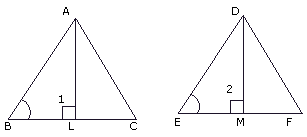
Given: Two triangles ABC and DEF such that {tex}\triangle {/tex}ABC {tex} \sim {/tex} {tex}\triangle {/tex}DEF
To prove: {tex}\frac{{ar\left( {\vartriangle ABC} \right)}}{{ar\left( {\vartriangle DEF} \right)}} = \frac{{A{B^2}}}{{D{E^2}}} = \frac{{B{C^2}}}{{E{F^2}}} = \frac{{A{C^2}}}{{D{F^2}}}{/tex}
Construction: Draw AL {tex} \bot {/tex} BC and DM {tex} \bot {/tex} EF
Proof:- Since similar triangles are equiangular and their corresponding sides are proportional
{tex}\therefore {/tex} {tex}\triangle {/tex} ABC {tex} \sim {/tex}{tex}\triangle {/tex}DEF
{tex}\Rightarrow {/tex} {tex}\angle{/tex} A = {tex}\angle{/tex} D, {tex}\angle{/tex} B = {tex}\angle{/tex} E, {tex}\angle{/tex} C ={tex}\angle{/tex}F
And {tex}\frac{{AB}}{{DE}} = \frac{{BC}}{{EF}} = \frac{{AC}}{{DF}}{/tex} .......(i)
In {tex}\triangle {/tex} ALB and {tex}\triangle {/tex} DMB,
{tex}\angle{/tex} 1= {tex}\angle{/tex} 2 and {tex}\angle{/tex} B= {tex}\angle{/tex} E
{tex}\Rightarrow {/tex} {tex}\triangle {/tex} ALB {tex} \sim {/tex} {tex}\triangle {/tex}DME [By AA similarity]
{tex}\Rightarrow {/tex}{tex}\frac{{AL}}{{DM}} = \frac{{AB}}{{DE}}{/tex} .....(ii)
From (i) and (ii), we get
{tex}\frac{{AB}}{{DE}} = \frac{{BC}}{{EF}} = \frac{{AC}}{{DF}} = \frac{{AL}}{{DM}}{/tex} ......(iii)
Now{tex}\frac{{area\left( {\vartriangle ABC} \right)}}{{area\left( {\vartriangle DEF} \right)}} = \frac{{\frac{1}{2}\left( {BC \times AL} \right)}}{{\frac{1}{2}\left( {BF \times DM} \right)}}{/tex}
{tex} \Rightarrow \frac{{area\left( {\vartriangle ABC} \right)}}{{area\left( {\vartriangle DEF} \right)}} = \frac{{BC}}{{EF}} \times \frac{{AL}}{{DM}}{/tex}
{tex} \Rightarrow \frac{{area\left( {\vartriangle ABC} \right)}}{{area\left( {\vartriangle DEF} \right)}} = \frac{{BC}}{{EF}} \times \frac{{BC}}{{EF}} = \frac{{B{C^2}}}{{E{F^2}}}{/tex}
Hence, {tex}\frac{{area\left( {\vartriangle ABC} \right)}}{{area\left( {\vartriangle DEF} \right)}} = \frac{{A{B^2}}}{{D{E^2}}} \times \frac{{B{C^2}}}{{E{F^2}}} = \frac{{A{C^2}}}{{D{F^2}}}{/tex}
Let the largest side of the largest triangle be x cm
Using above theorem,
{tex}\frac{{{x^2}}}{{{{27}^2}}} = \frac{{144}}{{81}} \Rightarrow \frac{x}{{27}} = \frac{{12}}{9}{/tex}
{tex}\Rightarrow {/tex} x = 36 cm
Posted by Mohd Abdur Rahman Khan 7 years, 8 months ago
- 0 answers
Posted by Mohd Abdur Rahman Khan 7 years, 8 months ago
- 2 answers
Posted by Susmitha S 7 years, 8 months ago
- 1 answers
Suzain Pathan 7 years, 8 months ago
Posted by Bharat Mangal 7 years, 8 months ago
- 0 answers
Posted by Anupama Chandran 6 years, 5 months ago
- 1 answers
Sia ? 6 years, 5 months ago
We will find zeroes of p(x) which are not the zeroes of q(x) by using Factor theorem and Euclid’s division algorithm.
By factor theorem if q(x) is a factor of p(x), then r(x) must be zero.
p(x) = x5 – x4 – 4x3 + 3x2 + 3x + b
q(x) = x3 + 2x2 + a
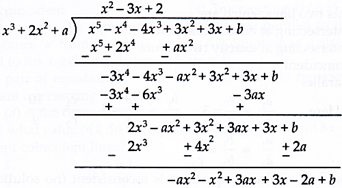
So, by factor theorem remainder must be zero i.e.,
r(x) = 0
Value of r(x) is - ax2 - x2 + 3ax + 3x - 2a + b .
- ax2 - x2 + 3ax + 3x - 2a + b = 0x2 + 0x + 0
⇒ -(a + 1)x2 + (3a + 3)x + (b – 2a) = 0x2 + 0x + 0
Comparing the coefficients of x2, x and constant. on both sides, we get
-(a + 1) = 0 and 3a + 3 = 0 and b – 2a = 0
a + 1 = 0
a = -1
and 3a + 3 = 0
3a = - 3
a = -1
Put a = -1 in b - 2a = 0
Then b – 2(-1) = 0
⇒ b + 2 = 0
⇒ b = -2
For a = -1 and b = -2, zeroes of q(x) will be zeroes of p(x).
For zeroes of p(x), p(x) = 0
⇒ (x3 + 2x2 + a)(x2 – 3x + 2) = 0 [∵ a = -1]
⇒ [x3 + 2x2 – 1][x2 – 2x – 1x + 2] =0
⇒ (x3 + 2x2 – 1)[x(x – 2) – 1(x – 2) = 0
⇒ (x3 + 2x2 – 1) (x – 2) (x – 1) = 0
⇒ (x – 2) = 0 and (x – 1) = 0
⇒ x = 2 and x = 1
Hence, x = 2 and 1 are not the zeroes of q(x).

myCBSEguide
Trusted by 1 Crore+ Students

Test Generator
Create papers online. It's FREE.

CUET Mock Tests
75,000+ questions to practice only on myCBSEguide app

Khushi Prasad 7 years, 8 months ago
0Thank You