
Ask questions which are clear, concise and easy to understand.
Ask QuestionPosted by Khushi Saksena 7 years, 8 months ago
- 1 answers
Posted by Mahesh M 7 years, 8 months ago
- 0 answers
Posted by Sarang Anupam 7 years, 8 months ago
- 6 answers
Posted by Usha Ush 7 years, 8 months ago
- 1 answers
Posted by Lakshya Saini Lucky 7 years, 8 months ago
- 0 answers
Posted by Nikita Jain 7 years, 8 months ago
- 4 answers
Posted by Nikita Jain 7 years, 8 months ago
- 5 answers
Posted by Megha Sharma 7 years, 8 months ago
- 2 answers
Posted by Anuj Thapa Anuj Thapa 7 years, 8 months ago
- 5 answers
Posted by Vishal Sharma 7 years, 8 months ago
- 1 answers
Posted by H T 7 years, 8 months ago
- 1 answers
Abhishek Mishradelhi Holy Convent School 7 years, 8 months ago
Posted by Rohan Ddhich 7 years, 8 months ago
- 4 answers
Posted by Sumith Reddy 7 years, 8 months ago
- 1 answers
Posted by H T 7 years, 8 months ago
- 6 answers
Posted by Rahul Rawat 7 years, 8 months ago
- 2 answers
Posted by Rahul Kumar 7 years, 8 months ago
- 0 answers
Posted by Mahesh M 7 years, 8 months ago
- 3 answers
Posted by Mehak Kaur 7 years, 8 months ago
- 3 answers
Posted by Devash Sharma 7 years, 8 months ago
- 1 answers
Souravvv Sharmaa 7 years, 8 months ago
Posted by Jyothi Habib 6 years, 5 months ago
- 1 answers
Sia ? 6 years, 5 months ago
Given equations,
{tex}2 x - y - 2 = 0{/tex}
{tex}4x + 3y - 24 = 0{/tex}
{tex}y + 4 = 0{/tex}
We have, {tex}2x - y - 2 = 0{/tex} or {tex}x = {{y+2}\over2} {/tex}
When y = 0, we have {tex}x = {{0+2}\over2} = 1{/tex}
When x = 0, we have y = -2.
Thus, we obtain the following table giving coordinates of two point on the line represented by the equation {tex}2x - y - 2 = 0{/tex} and its graph is shown below.
| x | 1 | 0 |
| y | 0 | -2 |
Now we have, {tex}\begin{array}{l}4x+3y-24=0\Rightarrow y=\frac{24-4x}3\\\end{array}{/tex}
When y = 0, we have x = 6
When x = 0, we have y = 8
Thus, we obtain the following table giving coordinates of two points on the line represented by the equation {tex}4x + 3y - 24 = 0{/tex} and its graph is shown below.
| x | 6 | 0 |
| y | 0 | 8 |
Also we have {tex}y + 4 = 0{/tex}
Clearly, y = - 4 for every value of x.
So, let E(2, -4) and F(0, -4) be two points on the line represented by y + 4 = 0. Plotting these points on the same graph and drawing a line passing through them, we obtain the graph of the line represented by the equation y + 4 = 0 as shown in Figure.
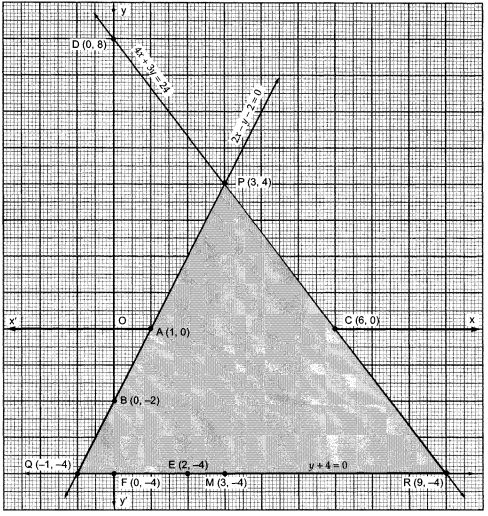
From Fig. we have {tex}\begin{array}{l}\bigtriangleup PQR\\\end{array}{/tex} having vertices P(3,4), Q(-1,-4) and R(9, -4).
Also, PM = 8 and QR = 10.
{tex}\therefore \quad \text { Area of } \triangle P Q R = \frac { 1 } { 2 } ( \text { Base } \times \text { Height } ){/tex}
{tex}\Rightarrow \quad \text { Area of } \triangle P Q R = \frac { 1 } { 2 } ( Q R \times P M ) = \frac { 1 } { 2 } ( 10 \times 8 )sq.\ units{/tex}
{tex}\Rightarrow \quad \text { Area of } \triangle P Q R = 40 \mathrm { sq } .units.{/tex}
Posted by Divanshi Singla 7 years, 8 months ago
- 4 answers
Posted by Avnik Kaur 7 years, 8 months ago
- 2 answers
????Shubham Sihag?????? 7 years, 8 months ago
Posted by Subi Varsha 7 years, 8 months ago
- 2 answers
Keshav Bindal 7 years, 8 months ago
Keshav Bindal 7 years, 8 months ago
Posted by Vikas Jadrmakunti 6 years, 6 months ago
- 1 answers
Sia ? 6 years, 6 months ago
Let the integers be x, x + 1 and x + 2. Then,
x2 + (x + 1)(x + 2) = 46
{tex}\Rightarrow{/tex} x2 + (x2 + 2x + 1x + 2) = 46
{tex}\Rightarrow{/tex} 2x2 + 3x + 2 = 46
{tex}\Rightarrow{/tex} 2x2 + 3x + 2 - 46 = 0
{tex}\Rightarrow{/tex} 2x2 + 3x - 44 = 0
{tex}\Rightarrow{/tex} 2x2 + 11x - 8x - 44 = 0
{tex}\Rightarrow{/tex} x(2x + 11) - 4(2x + 11) = 0
{tex}\Rightarrow{/tex} (x - 4)(2x + 11) = 0
{tex}\Rightarrow{/tex} x - 4 = 0 [{tex}\because{/tex} x is an integer {tex}\therefore{/tex} 2x + 11 {tex}\ne{/tex} 0]
{tex}\Rightarrow{/tex} x = 4
{tex}\therefore{/tex} x + 1 = 4 + 1 = 5
And, x + 2 = 4 + 2 = 6
Hence, required numbers are 4, 5 and 6.
Posted by M Raja Gana Reddy Rukumini 6 years, 6 months ago
- 1 answers
Sia ? 6 years, 6 months ago
{tex}\frac{1}{2a + b + 2x}{/tex} = {tex}\frac{1}{2a}{/tex} + {tex}\frac{1}{b}{/tex} + {tex}\frac{1}{2x}{/tex}
{tex}\Rightarrow{/tex} {tex}\frac{1}{2a + b + 2x}{/tex} - {tex}\frac{1}{2x}{/tex} = {tex}\frac{1}{2a}{/tex} + {tex}\frac{1}{b}{/tex}
{tex}\Rightarrow{/tex}{tex}\frac { 2 x - 2 a - b - 2 x } { ( 2 a + b + 2 x ) ( 2 x ) }{/tex} = {tex}\frac{b + 2a}{2a \times b}{/tex}
{tex}\Rightarrow{/tex} {tex}\frac { - ( 2 a + b ) } { ( 2 a + b + 2 x ) 2 x }{/tex} = {tex}\frac{b + 2a}{2ab}{/tex}
{tex}\Rightarrow{/tex}{tex}\frac { - 1 } { 4 a x + 2 b x + 4 x ^ { 2 } }{/tex} = {tex}\frac{1}{2ab}{/tex}
{tex}\Rightarrow{/tex} {tex}4x^2 + 2bx + 4ax = -2ab{/tex}
{tex}\Rightarrow{/tex} {tex}4x^2 + 2bx + 4ax + 2ab = 0{/tex}
{tex}\Rightarrow{/tex} {tex}2x(2x + b) + 2a(2x + b) = 0{/tex}
{tex}\Rightarrow{/tex} (2x + b)(2x + 2a) = 0
{tex}\Rightarrow{/tex} x = -{tex}\frac{b}{2}{/tex} or x = -a
Posted by Deepesh Mehoriya 7 years, 8 months ago
- 3 answers

myCBSEguide
Trusted by 1 Crore+ Students

Test Generator
Create papers online. It's FREE.

CUET Mock Tests
75,000+ questions to practice only on myCBSEguide app

Shivshant Upadhyay 7 years, 8 months ago
1Thank You