
Ask questions which are clear, concise and easy to understand.
Ask QuestionPosted by Thazneem Saleem 5 years, 8 months ago
- 2 answers
Posted by Pushpa Sharma 7 years, 9 months ago
- 3 answers
Posted by Sonali Kumari 5 years, 8 months ago
- 1 answers
Posted by Ayush Dahiya 7 years, 9 months ago
- 1 answers
Posted by Naveen Bafna 7 years, 9 months ago
- 0 answers
Posted by Yuvraj Shivhare 7 years, 9 months ago
- 3 answers
P A 7 years, 9 months ago
Posted by Shaziya Mehrin 7 years, 9 months ago
- 2 answers
Joy Chandel 7 years, 9 months ago
Posted by Joy Chandel 7 years, 9 months ago
- 1 answers
Posted by Sparsh Agarwal 7 years, 9 months ago
- 1 answers
Posted by Kanishka Sharma 7 years, 9 months ago
- 2 answers
Posted by Daksh Bhardwaj 7 years, 9 months ago
- 1 answers
Posted by Allen Rathi 7 years, 9 months ago
- 7 answers
Posted by Ghanashyam Krishna 6 years, 6 months ago
- 1 answers
Sia ? 6 years, 6 months ago
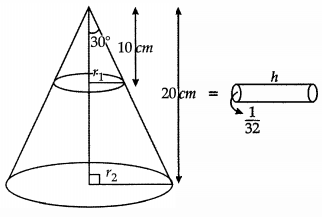
According to the question,A metallic right circular cone 20 cm high and whose vertical angel is 60° is cut into two parts at the middle of its height by a plane parallel to its base if the frustum so obtained be drawn into a wire of uniform diameter {tex}\frac { 1 } { 16 }{/tex} cm.
Total height of cone = 20 cm and Vertex angle = 30°
Let the radius of cone be r{tex}_2{/tex}.
{tex}\therefore \frac { r _ { 2 } } { 20 } = \tan 30 ^ { \circ } \Rightarrow \frac { 1 } { \sqrt { 3 } }{/tex}
{tex}r _ { 2 } = \frac { 20 } { \sqrt { 3 } } \mathrm { cm }{/tex}
The height of the cone cut off = 10 cm Let its radius be r1
{tex}\Rightarrow \frac { r _ { 1 } } { 10 } = \tan 30 ^ { \circ } \Rightarrow r _ { 1 } = \frac { 10 } { \sqrt { 30 } } \mathrm { cm }{/tex}
Let the length of wire be l
Its radius {tex}= \frac { 1 } { 32 } \mathrm { cm }{/tex}
{tex}\therefore{/tex} Volume of frustum = Volume of wire
{tex}\Rightarrow \frac { 1 } { 3 } \pi \times h \left[ \left( r _ { 1 } \right) ^ { 2 } + \left( r _ { 2 } \right) ^ { 2 } + \left( r _ { 1 } r _ { 2 } \right) \right] = \pi r ^ { 2 } l{/tex}
{tex}\Rightarrow \frac { 1 } { 3 } \times 10 \times \pi \left[ \left( \frac { 10 } { 3 } \right) ^ { 2 } + \left( \frac { 20 } { 3 } \right) ^ { 2 } + \frac { 10 } { 3 } \times \frac { 20 } { 3 } \right]{/tex}
{tex}= \pi \left( \frac { 1 } { 32 } \right) ^ { 2 } \times l{/tex}
{tex}\Rightarrow \frac { 1 } { 3 } \times 10 \left[ \frac { 100 } { 9 } + \frac { 400 } { 9 } + \frac { 200 } { 9 } \right] = \frac { 1 } { 32 \times 32 } \times l{/tex}
{tex}\Rightarrow \frac { 1 } { 3 } \times 10 \times \frac { 700 } { 9 } = \frac { 1 } { 32 } \times \frac { 1 } { 32 } \times l{/tex}
{tex}\Rightarrow l = \frac { 32 \times 32 \times 700 \times 10 } { 3 \times 9 }{/tex}
= 796444.4 cm.
Hence, the length of wire = 7964.44 m
Posted by Joy Chandel 7 years, 9 months ago
- 0 answers
Posted by Dollon D 7 years, 9 months ago
- 3 answers
Posted by Huma Khan 7 years, 9 months ago
- 2 answers
Posted by Vishal Raj 7 years, 9 months ago
- 1 answers
Posted by Chandan Varshey 7 years, 9 months ago
- 1 answers
Keshav Bindal 7 years, 9 months ago
Posted by Anish Anand 6 years, 6 months ago
- 1 answers
Sia ? 6 years, 6 months ago
Let coordinate of P be (0, y) and of Q be (x,0)
A(2, -5) is mid - point of PQ.
By Section Formula,
(2, -5) = {tex}\left( \frac { 0 + x } { 2 } , \frac { y + 0 } { 2 } \right){/tex}
{tex}\therefore 2=\frac x2 \text{ and }-5=\frac y2{/tex}
x = 4 and y = -10.
Therefore, P is (0, -10) and Q is (4, 0).
Posted by Ramneek Daleh 7 years, 9 months ago
- 1 answers
Posted by Chandan Varshey 7 years, 9 months ago
- 1 answers
Posted by Shakshi Singh 7 years, 9 months ago
- 1 answers
Posted by Rohit Gaonkar 6 years, 6 months ago
- 1 answers
Sia ? 6 years, 6 months ago
Let a and d be the first term and common difference respectively of the given A.P. Then
an = a + (n - 1)d
{tex}\frac { 1 } { n } ={/tex} mth term
{tex}\Rightarrow \frac { 1 } { n } {/tex}= a + ( m - 1 ) d ...(i)
{tex}\frac { 1 } { m }{/tex}= nth term
{tex}\Rightarrow \frac { 1 } { m } {/tex}= a + ( n - 1 ) d ...(ii)
On subtracting equation (ii) from equation (i), we get
{tex}\frac { 1 } { n } - \frac { 1 } { m } = {/tex} [a+ (m-1) d] -[ a+ (n -1)d]
= a + md - d - a - nd + d
{tex}= ( m - n ) d{/tex}
{tex} \Rightarrow \frac { m - n } { m n } = ( m - n ) d {/tex}
{tex}\Rightarrow d = \frac { 1 } { m n }{/tex}
Putting d = {tex}\frac { 1 } { m n }{/tex} in equation (i), we get
{tex}\frac { 1 } { n } = a + \frac { ( m - 1 ) } { m n } {/tex}
{tex}\Rightarrow \frac { 1 } { n } = a + \frac { 1 } { n } - \frac { 1 } { m n } {/tex}
{tex}\Rightarrow a = \frac { 1 } { m n }{/tex}
{tex}\therefore{/tex} (mn)th term = a + (mn - 1) d
= {tex}\frac { 1 } { m n } + ( m n - 1 ) \frac { 1 } { m n } {/tex}{tex}\left[ \because a = \frac { 1 } { m n } = d \right]{/tex}
= {tex}\frac { 1 } { m n } + \frac { mn } { m n } - \frac { 1 } { m n }{/tex}
= 1
Posted by Jyothi Habib 7 years, 9 months ago
- 1 answers
Posted by Bhavya Bhatnagar 7 years, 9 months ago
- 0 answers
Posted by Gunjan Dawar 7 years, 9 months ago
- 2 answers
Posted by Himanshu Singh 7 years, 9 months ago
- 3 answers
Keshav Bindal 7 years, 9 months ago
Posted by Papu Naik 7 years, 9 months ago
- 1 answers
Posted by Samaira Sen 7 years, 9 months ago
- 2 answers

myCBSEguide
Trusted by 1 Crore+ Students

Test Generator
Create papers online. It's FREE.

CUET Mock Tests
75,000+ questions to practice only on myCBSEguide app

Taran Kamboj 7 years, 9 months ago
1Thank You