
Ask questions which are clear, concise and easy to understand.
Ask QuestionPosted by Hunar Mehta 7 years, 9 months ago
- 0 answers
Posted by Akriti Chaudhary 7 years, 9 months ago
- 0 answers
Posted by Bhoma Ram 7 years, 9 months ago
- 1 answers
Dhanuja Shri 7 years, 9 months ago
Posted by Ayushman Giri 7 years, 9 months ago
- 3 answers
Ayushman Giri 7 years, 9 months ago
Posted by Retika Malhotra 7 years, 9 months ago
- 0 answers
Posted by Ayushman Giri 7 years, 9 months ago
- 1 answers
Keshav Bindal 7 years, 9 months ago
Posted by Shashank Karan 6 years, 6 months ago
- 1 answers
Sia ? 6 years, 6 months ago
Let breadth of the rectangular park = {tex}x {/tex} m
Then, length of the rectangular park = ({tex}x+3{/tex}) m
Now, area of the rectangular park is = {tex}x(x+3)=(x^2+3x)m^2{/tex} {tex}[\because area=length\times breadth]{/tex}
Given, base of the triangular park = Breadth of the rectangular park
Therefore base of triangular park is = {tex}x{/tex} m
and it is given that altitude of triangular park is = {tex}12 {/tex} m
Therefore, area of the triangular park will be = {tex}\frac{1}{2}\times x\times 12= 6x {/tex} {tex}m^2{/tex} {tex}[\because area(Triangle)=\frac{1}{2}\times base\times altitude]{/tex}
As per the question area of rectangular park is = {tex}4 + {/tex} Area of triangular park
{tex}\Rightarrow x^2+3x=4+6x{/tex}
{tex}\Rightarrow x^2+3x-6x-4=0{/tex}
{tex}\Rightarrow x^2-3x-4=0{/tex}
{tex}\Rightarrow x^2-4x+x-4=0{/tex} [ by factorization ]
{tex}\Rightarrow x(x-4)+1(x-4)=0{/tex}
{tex}\Rightarrow (x-4)(x+1)=0{/tex}
{tex}\Rightarrow x-4=0 {/tex} or {tex}x+1=0{/tex} {tex}{/tex}
⇒ x = 4 or x = - 1
Since, breadth cannot be negative , so we will neglect {tex}x=-1{/tex} and choose {tex}x = 4{/tex}
Hence, breadth of the rectangular park will be = 4 m
and length of the rectangular park will be = {tex}x+3=4+3=7m{/tex}
Verification:
Area of rectangular park is = 28 m2
Area of triangular park is = 24 m2 = (28 – 4) m2
Posted by Aisha Massey 7 years, 9 months ago
- 1 answers
Divya D Synrem 7 years, 9 months ago
Posted by Apoorva Mishra 7 years, 9 months ago
- 1 answers
Posted by Vishnu Jha 7 years, 9 months ago
- 2 answers
Tarun Umashankar 7 years, 9 months ago
Posted by Priya Dharshini ? 6 years, 6 months ago
- 1 answers
Sia ? 6 years, 6 months ago
Let an be the n th term of the A.P. Then,
an = Sn - Sn-1
{tex}\Rightarrow{/tex} an= (5n2 + 3n) - {5(n -1)2 + 3 (n- 1)} {tex}\left[ \begin{array} { l } { \text { Replacing } n \text { by } ( n - 1 ) \text { in } S _ { n } } \\ { \text { to get } S _ { n - 1 } = 5 ( n - 1 ) ^ { 2 } + 3 ( n - 1 ) } \end{array} \right]{/tex}
{tex}\Rightarrow{/tex}an = (5n2 + 3n) - {5(n2 - 2n+ 1) + 3n - 3}
{tex}\Rightarrow{/tex} an = (5n2 + 3n) - {5n2 -10n + 5 + 3n - 3}
{tex}\Rightarrow{/tex} an = (5n2 + 3n) - (5n2 - 7n + 2)
{tex}\Rightarrow{/tex} an = 10n - 2
Posted by Virat Kumar 5 years, 8 months ago
- 1 answers
Sia ? 6 years, 6 months ago
Let the present ages of Aftab and his daughter be x year and y year respectively. Then the algebraic representation is
Given by the following equations:
x - 7 = 7(y - 7)
{tex}\Rightarrow{/tex} x - 7y + 42 = 0 ...(1)
And x + 3 = 3(y + 3)
{tex}\Rightarrow{/tex} x - 3y - 6 = 0 ...(2)
To, represent this equation graphically, well find two solution for each equation, These solution are given below;
For Equation (1) x - 7y + 42 = 0
{tex}\Rightarrow{/tex} 7y = x + 42
{tex}\Rightarrow y = \frac{{x + 42}}{7}{/tex}
Table 1 of solutions
| x | 0 | 7 |
| y | 6 | 7 |
For Equation (2) x - 3y - 6 = 0
{tex}\Rightarrow{/tex} 3y = x - 6
{tex}\Rightarrow y = \frac{{x - 6}}{3}{/tex}
Table 2 of solutions
| x | 0 | 6 |
| y | -2 | 0 |
We plot the A(0, 6) and B(7, 7)
Corresponding to the solutions in table 1 on a graph paper to get the line AB representing the equation (1) and the points C(0, -2) and D(6, 0) corresponding to the solutions in table 2 on the same graph paper to get the line CD representing the equation (2), as shown in the figure

We observe in figure that the two lines representing the two equations are intersecting at the point P(42, 12).
Posted by Gouri Kumari 7 years, 9 months ago
- 1 answers
Posted by Allen Rathi 7 years, 9 months ago
- 4 answers
Aditi Raghav 7 years, 9 months ago
Vishnu Jha 7 years, 9 months ago
Posted by Shakshi Singh 7 years, 9 months ago
- 1 answers
Posted by Mohit Sharma 7 years, 9 months ago
- 5 answers
Posted by Anshay Jain 7 years, 9 months ago
- 3 answers
Vishnu Jha 7 years, 9 months ago
Posted by Apa Dui 7 years, 9 months ago
- 1 answers
Posted by Rohit Bhunya 7 years, 9 months ago
- 0 answers
Posted by Ayush Sharma 7 years, 9 months ago
- 1 answers
Posted by Ritik Kumar 7 years, 9 months ago
- 1 answers
Shivangi Agrawal 7 years, 9 months ago
Posted by Devash Sharma 7 years, 9 months ago
- 2 answers
Posted by Devash Sharma 7 years, 9 months ago
- 1 answers
Posted by Prakash Raj 6 years, 6 months ago
- 1 answers
Sia ? 6 years, 6 months ago
g(x) = x2 + 3x + 1, f(x)= 3x4 + 5x3 - 7x2 + 2x + 4
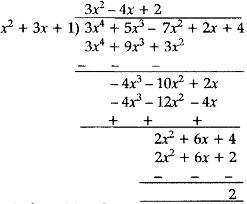
If we divide f(x) by g(x) then remainder, r(x) = 2
Hence, r(x) {tex}\ne{/tex} 0.
If remainder is not 0, then g(x) is not a factor of p(x).
Posted by Amanpreet Singh 7 years, 9 months ago
- 4 answers
Posted by Jyotheesh Khandelwal 7 years, 9 months ago
- 1 answers
Posted by Aditya Kumar 7 years, 9 months ago
- 6 answers
Aditya Kumar 7 years, 9 months ago
Kumar Vishal Behera 7 years, 9 months ago

myCBSEguide
Trusted by 1 Crore+ Students

Test Generator
Create papers online. It's FREE.

CUET Mock Tests
75,000+ questions to practice only on myCBSEguide app
