
Ask questions which are clear, concise and easy to understand.
Ask QuestionPosted by Aniket Singh 7 years, 9 months ago
- 2 answers
Sanjana Yadav 7 years, 9 months ago
Posted by Abhinav Jha 7 years, 9 months ago
- 0 answers
Posted by Rishab Tyagi 7 years, 9 months ago
- 6 answers
Aniket Singh 7 years, 9 months ago
Posted by Ankit Kumar 7 years, 9 months ago
- 1 answers
Posted by Pragati Srivastava 7 years, 9 months ago
- 1 answers
Posted by Prerna J 7 years, 9 months ago
- 5 answers
Posted by Shiwani Kothari 6 years, 6 months ago
- 1 answers
Sia ? 6 years, 6 months ago
Let n be any positive integer. Applying Euclids division lemma with divisor = 5, we get
{tex}\style{font-family:Arial}{\begin{array}{l}n=5q+1,5q+2,5q+3\;and\;5q+4\;\\\end{array}}{/tex}
Now (5q)2 = 25q2 = 5m, where m = 5q2, which is an integer;
{tex}\style{font-family:Arial}{\begin{array}{l}(5q\;+\;1)^{\;2}\;=\;25q^2\;+\;10q\;+\;1\;=\;5(5q^2\;+\;2q)\;+\;1\;=\;5m\;+\;1\\where\;m\;=\;5q^2\;+\;2q,\;which\;is\;an\;integer;\\\;(5q\;+\;2)^2\;=\;25q^2\;+\;20q\;+\;4\;=\;5(5q^2\;+\;4q)\;+\;4\;=\;5m\;+\;4,\\\;where\;m\;=\;5q^2\;+\;4q,\;which\;is\;an\;integer;\\\;(5q\;+\;3)^{\;2}\;=\;25q^2\;+\;30q\;+\;9\;=\;5(5q^2\;+\;6q+\;1)\;+\;4\;=\;5m\;+\;4,\\\;where\;m\;=\;5q^2\;+\;6q\;+\;1,\;which\;is\;an\;integer;\\\;(5q\;+\;4)^2\;=\;25q^2\;+\;40q\;+\;16\;=\;5(5q^2\;+\;8q\;+\;3)\;+\;1\;=\;5m\;+\;1,\;\\where\;m\;=\;5q^2\;+\;8q\;+\;3,\;which\;is\;an\;integer\\\end{array}}{/tex}
Thus, the square of any positive integer is of the form 5m, 5m + 1 or 5m + 4 for some integer m.
It follows that the square of any positive integer cannot be of the form 5m + 2 or 5m + 3 for some integer m.
Posted by Pratham Jain 7 years, 9 months ago
- 2 answers
Posted by Karna Ds 7 years, 9 months ago
- 1 answers
Posted by Alok Yadav 7 years, 9 months ago
- 2 answers
Keshav Bindal 7 years, 9 months ago
Posted by Guru Patel 7 years, 9 months ago
- 0 answers
Posted by Abhinav Jha 7 years, 9 months ago
- 2 answers
Posted by Srushti Bagi 7 years, 9 months ago
- 4 answers
Aditya Makwana 7 years, 9 months ago
Posted by Gaurav Bisht 7 years, 9 months ago
- 1 answers
Posted by Bishal Mitra 7 years, 9 months ago
- 1 answers
Posted by . . 7 years, 9 months ago
- 0 answers
Posted by Shubh Khandelwal 6 years, 6 months ago
- 1 answers
Sia ? 6 years, 6 months ago
Distance travelled by the train = 480 km
Let the speed of the train be x kmph
Time taken for the journey = {tex}\frac { 480 } { x }{/tex}
Given speed is decreased by 8 kmph
Hence the new speed of train = (x – 8) kmph
Time taken for the journey = {tex}\frac { 480 } { x - 8 }{/tex}
{tex}\frac { 480 } { x - 8 } = \frac { 480 } { x } + 3{/tex}
{tex}\Rightarrow{/tex} {tex}\frac { 480 } { x - 8 } - \frac { 480 } { x } = 3{/tex}
{tex}\Rightarrow \frac { 480 ( x - x + 8 ) } { x ( x - 8 ) } = 3{/tex}
{tex}\Rightarrow \frac { 480 \times 8 } { x ( x - 8 ) } = 3{/tex}
{tex}\Rightarrow 3 x ( x - 8 ) = 480 \times 8{/tex}
{tex}\Rightarrow x(x - 8 ) = 160\times 8 \\ \Rightarrow x^2 - 8x - 1280 = 0{/tex}
On solving we get x = 40
Thus the speed of train is 40 kmph.
Posted by Anu Keerthana 7 years, 9 months ago
- 1 answers
Raj Sharma 7 years, 9 months ago
Posted by Nivedita Pandey 5 years, 8 months ago
- 1 answers
Posted by H T 5 years, 8 months ago
- 1 answers
Posted by Dhananjay Yadav 6 years, 5 months ago
- 1 answers
Sia ? 6 years, 5 months ago
Let us assume that <m:omath><m:r>√</m:r></m:omath>3 is rational.
That is, we can find integers a and b (<m:omath><m:r>≠0)</m:r></m:omath> such that a and b are co-prime
{tex}\style{font-family:Arial}{\begin{array}{l}\sqrt3=\frac ab\\b\sqrt3=a\\on\;squaring\;both\;sides\;we\;get\\3b^2=a^2\end{array}}{/tex}
Therefore, a2 is divisible by 3,
it follows that a is also divisible by 3.
So, we can write a = 3c for some integer c.
Substituting for a, we get 3b2 = 9c2, that is, b2 = 3c2
This means that b2 is divisible by 3, and so b is also divisible by 3
Therefore, a and b have at least 3 as a common factor.
But this contradicts the fact that a and b are co-prime.
This contradiction has arisen because of our incorrect assumption that <m:omath><m:r>√</m:r></m:omath>3 is rational.
So, we conclude that <m:omath><m:r>√</m:r></m:omath>3 is irrational.
Posted by Puja Guru 7 years, 9 months ago
- 9 answers
Sanjana Yadav 7 years, 9 months ago
Sanjana Yadav 7 years, 9 months ago
Posted by Gourav Giri 7 years, 9 months ago
- 2 answers
Posted by Santosh Kumar 7 years, 9 months ago
- 1 answers
Sia ? 6 years, 6 months ago
Given: PQ is a diameter of a circle with centre O. The lines AB and CD are the tangents at P and Q respectively.
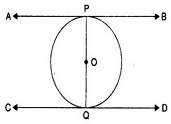
To prove: AB {tex}\parallel{/tex} CD
Proof: AB is a tangent to the circle at P and Op is the radius through the point of contact
{tex}\because{/tex} {tex}\angle{/tex}OPA = 90o .......(1) [The tangent at any point of a circle is perpendicular to the radius through the point of contact]
{tex}\because{/tex} CD is a tangent to the circle at Q and OQ is the radius through the point of contact.
{tex}\therefore{/tex} {tex}\angle{/tex}OQD = 90o ........(2) [The tangent at any point of a circle is perpendicular to the radius through the point of contact]
From (1) and (2),
{tex}\angle{/tex}OPA = {tex}\angle{/tex}OQD
But these form a pair of equal alternate angles.
{tex}\because{/tex} AB {tex}\parallel{/tex} CD
Posted by Srushti Bagi 7 years, 9 months ago
- 6 answers
Raj Sharma 7 years, 9 months ago
Varsh Vaibhav 7 years, 9 months ago
Posted by . . 7 years, 9 months ago
- 1 answers
Posted by Samridhi Goel 7 years, 9 months ago
- 3 answers
Avni Rathore 7 years, 9 months ago
Posted by Asha Nair 7 years, 9 months ago
- 0 answers
Posted by Anushka Prasad 7 years, 9 months ago
- 1 answers

myCBSEguide
Trusted by 1 Crore+ Students

Test Generator
Create papers online. It's FREE.

CUET Mock Tests
75,000+ questions to practice only on myCBSEguide app

Varsh Vaibhav 7 years, 9 months ago
1Thank You