
Ask questions which are clear, concise and easy to understand.
Ask QuestionPosted by Aman Kasare 7 years, 9 months ago
- 2 answers
Posted by Tejasv Dubey 7 years, 9 months ago
- 2 answers
Posted by Priyanka Nanda 7 years, 9 months ago
- 0 answers
Posted by Himanshu Shekhar 7 years, 9 months ago
- 0 answers
Posted by Soujanya Reddy 5 years, 3 months ago
- 2 answers
Vishu Gupta 7 years, 9 months ago
Vishu Gupta 7 years, 9 months ago
Posted by Mansi Asati 7 years, 9 months ago
- 2 answers
Posted by Jeno Pearlin 7 years, 9 months ago
- 1 answers
Rajnish Yadav 7 years, 9 months ago
Posted by Himanshu Pal 7 years, 9 months ago
- 1 answers
Posted by Golu Kumar 7 years, 9 months ago
- 2 answers
Aman Singh 7 years, 9 months ago
Posted by Manish Prajapati 7 years, 9 months ago
- 0 answers
Posted by Gaurav Pal 6 years, 6 months ago
- 1 answers
Sia ? 6 years, 6 months ago
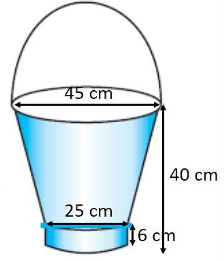
Area of metallic sheet used = curved surface area of Frustum + curved surface area of Cylinder + area of circular Base.
Diameter of the bigger circular end = 45 cm
Radius, r1 = {tex}\frac{45}2{/tex}= 22.5 cm {tex}{/tex}
Diameter of the smaller circular end = 25 cm
Radius, r2 = {tex}\frac{{25}}{2} = 12.5\ cm{/tex}
Height of the frustum, h = Total height of the bucket (H) - Height of the circular base (h1)
{tex}={/tex} 40 - 6 = 34 cm
Slant Height of frustrum (l) {tex}=\sqrt { h ^ { 2 } + \left( r_ 1 - r_ 2 \right) ^ { 2 } }{/tex}
{tex}\Rightarrow l= \sqrt { 34 ^ { 2 } + ( 22.5 - 12.5 ) ^ { 2 } }{/tex}
{tex}\Rightarrow l=\sqrt { 1156 + ( 10 ) ^ { 2 }}{/tex}
{tex}\Rightarrow l=\sqrt { 1156 + 100}{/tex}
{tex}\Rightarrow l=\sqrt { 1256 }{/tex}
{tex}\Rightarrow{/tex} Slant Height, l = 35.44 cm
Curved surface area of Frustum = {tex}\pi ( r_1 + r _2 )l{/tex}
= {tex}\frac{{22}}{7} \times (22.5 + 12.5) \times 35.44{/tex}
{tex}\Rightarrow{/tex}{tex}\frac{{22}}{7} \times 35 \times 35.44{/tex}
= 3898.4 cm2
Area of Circular Base with radius {tex}\frac{{25}}{2} = 12.5{/tex} is given by,
Area of circular base = {tex}\pi r_2^2{/tex}
{tex}{/tex}{tex}=\frac{{22}}{7} \times 12.5 \times 12.5{/tex}
= 491.07 cm2
Curved surface area of Cylinder = {tex}2\pi r_2h_1{/tex}
{tex}={/tex} {tex}2 \times \frac{{22}}{7} \times 12.5 \times 6{/tex}
{tex}={/tex} 471.428 cm2
Area of metallic sheet used = 3898.4 cm2 + 491.07 cm2 + 471.428 cm2
= 4860.898 cm2
Volume of water in bucket = Volume of Frustrum
= {tex}\frac13\pi h(r_1^2\;+\;r_2^2\;+\;r_1r_2){/tex}
= {tex}\frac13\times\frac{22}7\times34\;(22.5^2\;+\;12.5^2\;+\;22.5\times12.5){/tex} = 33615.48 cm3
Now, 1 litre = 1000 cm
Thus, Volume of water in bucket in litres = 33.62 litres
Posted by . . 6 years, 6 months ago
- 1 answers
Sia ? 6 years, 6 months ago
{tex}x^2 - 3x -m(m + 3) = 0 {/tex}
{tex}\Rightarrow{/tex}{tex} x^2 + mx - (m + 3)x - m(m + 3) = 0{/tex}
{tex}\Rightarrow{/tex}{tex}x(x+m)-(m+3)(x+m){/tex}
{tex}\Rightarrow{/tex} (x+m) (x - m - 3) = 0
x = -m and m + 3
Posted by Mental Roy 7 years, 9 months ago
- 1 answers
Jeno Pearlin 7 years, 9 months ago
Posted by Sarvesh Kumar 7 years, 9 months ago
- 1 answers
Posted by Prathmesh Goswami 7 years, 9 months ago
- 0 answers
Posted by Mk Mk 7 years, 9 months ago
- 2 answers
Posted by Satyam Kumar 7 years, 9 months ago
- 2 answers
Posted by Ritikesh Singh 7 years, 9 months ago
- 5 answers
Sheetal Dixit 7 years, 9 months ago
Vidhan Mungad 7 years, 9 months ago
Posted by Annash Choudhury 7 years, 9 months ago
- 1 answers
Posted by Khushbu . 7 years, 9 months ago
- 2 answers
Posted by Aisha Singh 7 years, 9 months ago
- 1 answers
Posted by Mihika Khandelwal 7 years, 9 months ago
- 4 answers
Posted by Khawaish Bhasin 7 years, 9 months ago
- 0 answers
Posted by Mayank Kala 7 years, 9 months ago
- 3 answers
Posted by Mihika Khandelwal 7 years, 9 months ago
- 2 answers
Posted by Sachin Tegur 7 years, 9 months ago
- 2 answers
Posted by Aryan Kaushik 7 years, 9 months ago
- 0 answers

myCBSEguide
Trusted by 1 Crore+ Students

Test Generator
Create papers online. It's FREE.

CUET Mock Tests
75,000+ questions to practice only on myCBSEguide app

Prajjwal Srivastava 7 years, 9 months ago
0Thank You