
Ask questions which are clear, concise and easy to understand.
Ask QuestionPosted by Sreerag R Nair 6 years, 6 months ago
- 1 answers
Posted by Bittu Srivastav 7 years, 7 months ago
- 2 answers
Posted by Khushleen Kaur 7 years, 7 months ago
- 1 answers
Kunal Singh 7 years, 7 months ago
Posted by Rajan Kumar 6 years, 6 months ago
- 1 answers
Sia ? 6 years, 6 months ago
Here we have to find HCF of 1190 and 1445 and express the HCF in the form 1190m + 1445n.
1445 = 1190 × 1 + 255
1190 = 255 × 4 + 170
255 = 170 × 1 + 85
170 = 85 × 2 + 0
So, now the remainder is 0, then HCF is 85
Now,
85 = 255 - 170
= (1445 - 1190) - (1190 - 255 × 4)
= 1445 - 1190 - 1190 + 255 × 4
= 1445 - 1190 × 2 + (1445 - 1190) × 4
= 1445 - 1190 × 2 + 1445 × 4 - 1190 × 4
= 1445 × 5 - 1190 × 6
= 1190 × (- 6) + 1445 × 5
= 1190m + 1445n , where m = - 6 and n = 5
Posted by Deepak Gupta 6 years, 6 months ago
- 1 answers
Sia ? 6 years, 6 months ago
According to the question,
{tex}(x - 5)(x - 6) = \frac{{25}}{{{{\left( {24} \right)}^2}}}{/tex}
{tex}\Rightarrow x(x - 6) - 5(x - 6) = \frac{{25}}{{{{(24)}^2}}}{/tex}
{tex}\Rightarrow {x^2} - 6x - 5x + 30 - \frac{{25}}{{{{(24)}^2}}} = 0{/tex}
{tex}\Rightarrow {x^2} - 11x + 30 - \frac{{25}}{{{{(24)}^2}}} = 0{/tex}
{tex}\Rightarrow {x^2} - 11x + \frac{{30 \times {{24}^2} - 25}}{{{{(24)}^2}}} = 0{/tex}
{tex} \Rightarrow {x^2} - 11x + \frac{{30 \times 576 - 25}}{{{{(24)}^2}}} = 0{/tex}
{tex} \Rightarrow {x^2} - 11x + \frac{{17280 - 25}}{{{{(24)}^2}}} = 0{/tex}
{tex}\Rightarrow {x^2} - \frac{{264x}}{{24}} + \frac{{145}}{{24}} \times \frac{{119}}{{24}} = 0{/tex}
{tex}\Rightarrow {x^2} - \left( {\frac{{145}}{{24}} + \frac{{119}}{{24}}} \right)x + \frac{{145}}{{24}} \times \frac{{119}}{{24}} = 0{/tex}
{tex}\Rightarrow {x^2} - \frac{{145}}{{24}}x - \frac{{119}}{{24}}x + \frac{{145}}{{24}} \times \frac{{119}}{{24}} = 0{/tex}
{tex}\Rightarrow x\left( {x - \frac{{145}}{{24}}} \right) - \frac{{119}}{{24}}\left( {x - \frac{{145}}{{24}}} \right) = 0{/tex}
{tex}\Rightarrow \left( {x - \frac{{145}}{{24}}} \right)\left( {x - \frac{{119}}{{24}}} \right) = 0{/tex}
{tex}\Rightarrow x - \frac{{145}}{{24}} = 0{/tex} or {tex}x - \frac{{119}}{{24}} = 0{/tex}
{tex}\Rightarrow x = \frac{{145}}{{24}}{/tex} or {tex}x = \frac{{119}}{{24}}{/tex}
Posted by Mohd Anas 7 years, 7 months ago
- 0 answers
Posted by Sanjay Kumar 7 years, 7 months ago
- 0 answers
Posted by Sumit Singh 7 years, 7 months ago
- 1 answers
Posted by King Is Only 1 7 years, 7 months ago
- 4 answers
Posted by Sofiya Lochab 7 years, 7 months ago
- 0 answers
Posted by Agaz Ansari 7 years, 7 months ago
- 0 answers
Posted by Yashika Patidar 7 years, 7 months ago
- 1 answers
Posted by Liyansh Bapna 7 years, 7 months ago
- 1 answers
Posted by Unknown Unknown 7 years, 7 months ago
- 2 answers
Posted by Nilesh Godhani 7 years, 7 months ago
- 1 answers
Posted by Lava Goyal 7 years, 7 months ago
- 0 answers
Posted by Sh Ll 6 years, 6 months ago
- 1 answers
Sia ? 6 years, 6 months ago
Yes, 257 is a prime number because it has only two distinct divisors: 1 and itself (257).
Posted by Ranjeet Singh 7 years, 7 months ago
- 1 answers
Posted by Jhanvi Jangid 7 years, 7 months ago
- 0 answers
Posted by Sumit Raj 6 years, 6 months ago
- 1 answers
Sia ? 6 years, 6 months ago
The given polynomial f(x)={tex}\text{x}^3-\text{6x}^2+\text{11x-6}{/tex}
Since 3 is a zero of p(x), so (x - 3) is a factor of f(x).
On dividing f(x) by (x - 3), we get
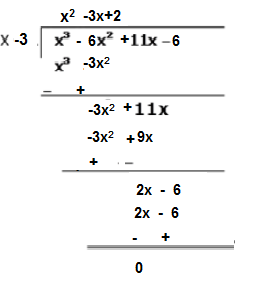
{tex}\therefore{/tex} f(x) = (x2 - 3x + 2)(x - 3)
= ( x2 - 2x - x + 2)( x - 3)
= [x(x - 2) -1(x - 2)](x - 3)
= (x - 1)(x - 2)(x - 3)
Now f(x)=0 if x - 1 = 0 or x - 2 = 0 or x - 3 = 0
{tex}\Rightarrow{/tex} x = 1 or x = 2 or x = 3
{tex}\mathrm{Hence}\;\mathrm{the}\;\mathrm{remainig}\;\mathrm{roots}\;\;\mathrm{of}\;\mathrm f(\mathrm x)\;\mathrm{are}\;1\;\mathrm{and}\;2\;{/tex}
Posted by Jasandeep Singh 7 years, 7 months ago
- 2 answers
Rahul Yadav 7 years, 7 months ago
Posted by Pooja Bora 6 years, 6 months ago
- 1 answers
Sia ? 6 years, 6 months ago
Solution table for {tex}3x + y - 12 = 0 {/tex}
<th scope="row">x</th> <th scope="row">y</th>| 0 | 4 | 2 |
| 12 | 0 | 6 |
Solution table for {tex}x - 3y + 6 = 0{/tex}
<th scope="row">x</th> <th scope="row">y</th>| -6 | 0 | -3 |
| 0 | 2 | 1 |
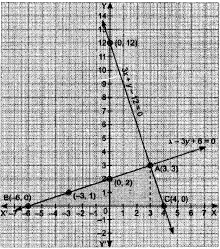
{tex}\triangle{/tex}ABC is the region bounded by the lines and x-axis.
Area {tex}\triangle{/tex}ABC = {tex}\frac{1}{2}{/tex}BC{tex}\times{/tex}AD = {tex}\frac{1}{2}{/tex}{tex}\times{/tex}10 {tex}\times{/tex}3 = {tex}15 sq.units{/tex}
Posted by Saksham Gaba 7 years, 7 months ago
- 6 answers
Amitabh Mondal 7 years, 7 months ago
Posted by Megha Varshney 7 years, 7 months ago
- 2 answers
Harsh Pandey 7 years, 7 months ago
Posted by Saurav Shrivastava 7 years, 7 months ago
- 1 answers
Posted by Jai Thakran 7 years, 7 months ago
- 0 answers
Posted by Avinav Kumar 7 years, 7 months ago
- 2 answers
Kunal Rajour 7 years, 7 months ago

myCBSEguide
Trusted by 1 Crore+ Students

Test Generator
Create papers online. It's FREE.

CUET Mock Tests
75,000+ questions to practice only on myCBSEguide app

Sia ? 6 years, 6 months ago
The given AP is:1, 4, 7, ,...................88
Here a=1 and d=4-1=3
Suppose there are nth terms=88
{tex}\mathrm{We}\;\mathrm{know}\;\mathrm{that}\;{\mathrm a}_{\mathrm n}=\mathrm a+(\mathrm n-1)\mathrm d{/tex}
Now on substitution of value of a and d we get
88 =1+(n-1)(3)
88-1= 3n - 3
87 + 3 = 3n
90 = 3n
n = 30
Hence, the 30th term of the given AP is 88.
0Thank You