
Ask questions which are clear, concise and easy to understand.
Ask QuestionPosted by Sharada N Sharada 7 years, 6 months ago
- 0 answers
Posted by Kiran Sarkar 7 years, 6 months ago
- 1 answers
Posted by Naman Jain 6 years, 6 months ago
- 1 answers
Sia ? 6 years, 6 months ago
Given,
{tex}\frac { 1 } { ( a + b + x ) } = \frac { 1 } { a } + \frac { 1 } { b } + \frac { 1 } { x }{/tex}
{tex}\Rightarrow \quad \frac { 1 } { ( a + b + x ) } - \frac { 1 } { x } = \frac { 1 } { a } + \frac { 1 } { b } \Rightarrow \frac { x - ( a + b + x ) } { x ( a + b + x ) } = \frac { b + a } { a b }{/tex}
{tex}\Rightarrow \quad \frac { - ( a + b ) } { x ( a + b + x ) } = \frac { ( a + b ) } { a b }{/tex}
On dividing both sides by (a+b)
{tex}\Rightarrow \quad \frac { - 1 } { x ( a + b + x ) } = \frac { 1 } { a b }{/tex}
Now cross multiply
{tex}\Rightarrow{/tex} x(a + b + x) = -ab
{tex}\Rightarrow{/tex} x2 + ax + bx + ab = 0
{tex}\Rightarrow{/tex} x(x +a) + b(x +a) = 0
{tex}\Rightarrow{/tex} (x + a) (x + b) = 0
{tex}\Rightarrow{/tex} x + a = 0 or x + b = 0
{tex}\Rightarrow{/tex} x = -a or x = -b.
Therefore, -a and -b are the roots of the equation.
Posted by Anshika Arora 7 years, 6 months ago
- 1 answers
Posted by Anshika Arora 7 years, 6 months ago
- 0 answers
Posted by Nihar Ranjan 7 years, 6 months ago
- 0 answers
Posted by Thair Basha 7 years, 6 months ago
- 0 answers
Posted by Chandan Mohanty 7 years, 6 months ago
- 1 answers
Amandeep Singh 7 years, 6 months ago
Posted by Wesly Balaiah 7 years, 6 months ago
- 0 answers
Posted by Yashika Ahuja 7 years, 6 months ago
- 2 answers
Amandeep Singh 7 years, 6 months ago
Posted by Ayush Kumar 7 years, 6 months ago
- 0 answers
Posted by Ritik Jha 7 years, 6 months ago
- 0 answers
Posted by Snehashish Ambar 7 years, 6 months ago
- 0 answers
Posted by Tushar Rana 7 years, 6 months ago
- 4 answers
Amandeep Singh 7 years, 6 months ago
Posted by Guddu Sharma 7 years, 6 months ago
- 2 answers
Mohit Raj 7 years, 6 months ago
Posted by Avni Bajpai 7 years, 6 months ago
- 4 answers
Posted by Jashan Judge 7 years, 6 months ago
- 2 answers
Posted by Sachin Kumar 7 years, 6 months ago
- 0 answers
Posted by Aditya Sharma 7 years, 6 months ago
- 2 answers
Posted by Aditya Sharma 7 years, 6 months ago
- 1 answers
Posted by Suraj Das 7 years, 6 months ago
- 0 answers
Posted by Honey Sharma 7 years, 6 months ago
- 0 answers
Posted by Nishita Tomar 7 years, 6 months ago
- 0 answers
Posted by Anil Kumar 7 years, 6 months ago
- 1 answers
Pallavi Phalswal 7 years, 6 months ago
Posted by Shruti Sagar 7 years, 6 months ago
- 0 answers
Posted by Pandit Ji 7 years, 6 months ago
- 0 answers
Posted by Guru Ranjani 7 years, 6 months ago
- 2 answers
Amandeep Singh 7 years, 6 months ago

myCBSEguide
Trusted by 1 Crore+ Students

Test Generator
Create papers online. It's FREE.

CUET Mock Tests
75,000+ questions to practice only on myCBSEguide app

Sia ? 6 years, 6 months ago
{tex}2x + 3y = 12{/tex}
{tex}x = \frac{{12 - 3y}}{2}{/tex}
When y = 0, then x = 6
When y = 2, then x = 3
We have,
{tex}x - y = 1{/tex}
{tex}x = 1 + y{/tex}
When y = 0, then x = 1
When y = -1, then x = 0
Graph of the given system is:
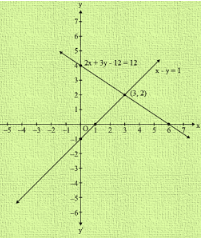
Clearly, the two lines intersect at {tex}A(3, 2){/tex}
We also observe that the lines meet y-axis B(0, -1) and C(0, 4)
Hence the vertices of the required triangle are {tex}A(3,2), B(0, -1)\ and\ C(0,4).{/tex}
0Thank You