
Ask questions which are clear, concise and easy to understand.
Ask QuestionPosted by Ayushi Singh 7 years, 6 months ago
- 0 answers
Posted by Tutu Borah 7 years, 6 months ago
- 0 answers
Posted by Manjinder Singh Manjinder Singh 6 years, 6 months ago
- 1 answers
Sia ? 6 years, 6 months ago
Given, 99x + 101y = 499 ....(i)
101x + 99y = 501... (ii)
Adding eqn. (i) and (ii),
( 99x + 101y ) + (101x + 99y ) = 499 + 501
99x + 101y + 101x + 99y = 1000
200x + 200y = 1000
x + y = 5 ...(iii)
Subtracting eqn. (ii) from eqn. (i), we get
( 99x + 101y ) - (101x + 99y ) = 499 - 501
99x + 101y - 101x - 99y = -2
-2x + 2y = - 2
or, x - y= 1 ........ (iv)
Adding equations (iii) and (iv)
x + y + x - y = 5 + 1
2x = 6
{tex}\therefore {/tex} x = 3
Substituting the value of x in eqn. (iii), we get
3 + y = 5
y = 2
Hence the value of x and y of given equation are 3 and 4 respectively.
Posted by Amit Saini 7 years, 6 months ago
- 1 answers
Rushtam Chakraborty 7 years, 6 months ago
Posted by Harvir Singh 7 years, 6 months ago
- 0 answers
Posted by Yash Nagpure 7 years, 6 months ago
- 4 answers
Akash Kundu 7 years, 6 months ago
Posted by Anmol Raj 7 years, 6 months ago
- 1 answers
Posted by Navjot Kaur 7 years, 6 months ago
- 3 answers
Lipsa Rani 7 years, 6 months ago
Posted by Naina Thakur 7 years, 6 months ago
- 0 answers
Posted by Rashmi Singh 7 years, 6 months ago
- 6 answers
Vanshika Sachdeva 7 years, 6 months ago
Varsha Yadav 7 years, 6 months ago
Posted by Rishi Bajeli 7 years, 6 months ago
- 0 answers
Posted by Sujan Basnet 7 years, 6 months ago
- 0 answers
Posted by Madhu.P. Panigatti 7 years, 6 months ago
- 0 answers
Posted by Neeshant Das 7 years, 6 months ago
- 1 answers
Posted by Kirandeep Kaur 7 years, 6 months ago
- 0 answers
Posted by Navdeep Maan 7 years, 6 months ago
- 1 answers
Posted by Khushboo Mehra 7 years, 6 months ago
- 1 answers
Posted by Sandeep Yadav 7 years, 6 months ago
- 1 answers
Akash Kundu 7 years, 6 months ago
Posted by Rupesh Raut 7 years, 6 months ago
- 0 answers
Posted by Anirudh Bhat 6 years, 6 months ago
- 1 answers
Sia ? 6 years, 6 months ago
n3 - n = n (n2 - 1) = n (n - 1) (n + 1)
Whenever a number is divided by 3, the remainder obtained is either 0 or 1 or 2.
∴ n = 3p or 3p + 1 or 3p + 2, where p is some integer.
If n = 3p, then n is divisible by 3.
If n = 3p + 1, then n – 1 = 3p + 1 –1 = 3p is divisible by 3.
If n = 3p + 2, then n + 1 = 3p + 2 + 1 = 3p + 3 = 3(p + 1) is divisible by 3.
So, we can say that one of the numbers among n, n – 1 and n + 1 is always divisible by 3.
⇒ n (n – 1) (n + 1) is divisible by 3.
Similarly, whenever a number is divided by 2, the remainder obtained is 0 or 1.
∴ n = 2q or 2q + 1, where q is some integer.
If n = 2q, then n is divisible by 2.
If n = 2q + 1, then n – 1 = 2q + 1 – 1 = 2q is divisible by 2 and n + 1 = 2q + 1 + 1 = 2q + 2 = 2 (q + 1) is divisible by 2.
So, we can say that one of the numbers among n, n – 1 and n + 1 is always divisible by 2.
⇒ n (n – 1) (n + 1) is divisible by 2.
Since, n (n – 1) (n + 1) is divisible by 2 and 3.
∴ n (n-1) (n+1) = n3 - n is divisible by 6.( If a number is divisible by both 2 and 3 , then it is divisible by 6)
Posted by Ashwani Thakur 6 years, 6 months ago
- 1 answers
Sia ? 6 years, 6 months ago
To prove : sin4x + cos4x = 1 - 2sin2x cos2x
We have,
LHS = sin4x + cos4x
= (sin2x)2 + (cos2x)2 + 2sin2x cos2x - 2 sin2x cos2x [By adding and subtracting 2sin2xcos2 x]
= (sin2x + cos2x)2 - 2sin2x cos2x
= 1 - 2sin2xcos2x = RHS
Posted by Parminder Singh 6 years, 6 months ago
- 1 answers
Sia ? 6 years, 6 months ago
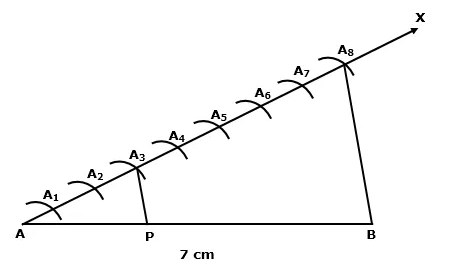
Steps of construction:
- Draw a line segment AB = 7 cm}
- Draw a ray AX making an acute angle BAX with AB
- Along AX mark (3 + 5) = 8 points.
A1, A2, A3, A4, A5, A6, A7, A8
such that AA1 = A1A2 = A2A3 = A3A4 = A4A5 = A5A6 = A6A7 = A7A8 - Join A8B.
- Through the point A3, draw a line parallel to A8B by making an angle equal to {tex}\angle{/tex}AA8B at A3.
Suppose this line meets AB at a point P.
Thus, P is the required point such that {tex}\frac { A P } { P B } = \frac { 3 } { 5 }{/tex}.
Posted by Gautam Chakraborty 7 years, 6 months ago
- 0 answers
Posted by Krishna Verma 7 years, 6 months ago
- 1 answers
Posted by Nipun Goyal 7 years, 6 months ago
- 4 answers
Rushtam Chakraborty 7 years, 6 months ago
Posted by Arjun Gupta 6 years, 6 months ago
- 1 answers
Sia ? 6 years, 6 months ago
2x - (a - 4)y = 2b + 1 ........ (i)
4x - (a - 1)y = 5b - 1 ....... (ii)
Compare the equations with form of equations
a1x + b1y = c1
a2x + b2y = c2
We get, a1 = 2, b1 = - (a - 4) and c1 = (2b + 1)
a2 = 4, b2 = - (a - 1) and c2 = (5b - 1)
Equations has infinite number of solutions, if
{tex} \frac { a _ { 1 } } { a _ { 2 } } = \frac { b _ { 1 } } { b _ { 2 } } = \frac { c _ { 1 } } { c _ { 2 } }{/tex}
Therefore, the given system of equations will have infinite number of solutions, if
{tex}\frac { 2 } { 4 } = \frac { - ( a - 4 ) } { - ( a - 1 ) } = \frac { 2 b + 1 } { 5 b - 1 }{/tex}
{tex}\Rightarrow \quad \frac { 1 } { 2 } = \frac { a - 4 } { a - 1 } = \frac { 2 b + 1 } { 5 b - 1 }{/tex}
{tex}\Rightarrow \quad \frac { 1 } { 2 } = \frac { a - 4 } { a - 1 } \text { and } \frac { 1 } { 2 } = \frac { 2 b + 1 } { 5 b - 1 }{/tex}
{tex}\Rightarrow{/tex} a - 1= 2a - 8 and 5b -1 = 4b + 2
{tex}\Rightarrow{/tex} a = 7 and b = 3
Posted by Rachana Rachana 7 years, 6 months ago
- 1 answers
Sk Jha 7 years, 6 months ago

myCBSEguide
Trusted by 1 Crore+ Students

Test Generator
Create papers online. It's FREE.

CUET Mock Tests
75,000+ questions to practice only on myCBSEguide app
