
Ask questions which are clear, concise and easy to understand.
Ask QuestionPosted by Vgangadharnaik Gangadhar 7 years, 6 months ago
- 3 answers
Posted by Vgangadharnaik Gangadhar 7 years, 6 months ago
- 0 answers
Posted by Vgangadharnaik Gangadhar 7 years, 6 months ago
- 1 answers
Posted by Sajitha Sajitha 7 years, 6 months ago
- 1 answers
Posted by Srishti Pandey 6 years, 6 months ago
- 1 answers
Sia ? 6 years, 6 months ago
We have,
4x2 + 3x + 5 = 0
Divide whole equation by 4
{tex} \Rightarrow \quad x ^ { 2 } + \frac { 3 } { 4 } x + \frac { 5 } { 4 } = 0{/tex}
{tex}\Rightarrow \quad x ^ { 2 } + 2 \left( \frac { 3 } { 8 } x \right) = - \frac { 5 } { 4 }{/tex}
Add ( half of coefficient of x )2 both sides
{tex}\Rightarrow \quad x ^ { 2 } + 2 \left( \frac { 3 } { 8 } \right) x + \left( \frac { 3 } { 8 } \right) ^ { 2 } = \left( \frac { 3 } { 8 } \right) ^ { 2 } - \frac { 5 } { 4 }{/tex}
{tex}\Rightarrow \quad \left( x + \frac { 3 } { 8 } \right) ^ { 2 } = - \frac { 71 } { 64 }{/tex}
{tex}\left( x + \frac { 3 } { 8 } \right) ^ { 2 }{/tex} cannot be negative for any real value of x. Hence, the given equation has no real roots.
Posted by Gaurav Rawat 7 years, 6 months ago
- 0 answers
Posted by Madhu Varshini 7 years, 6 months ago
- 0 answers
Posted by Priyank Raj 7 years, 6 months ago
- 2 answers
Posted by Sairaj Panigrahi 7 years, 6 months ago
- 0 answers
Posted by Abhishek Singh 7 years, 6 months ago
- 1 answers
Posted by Spoorthi Spoo 7 years, 6 months ago
- 2 answers
Posted by Ritesh Barnwal 7 years, 6 months ago
- 0 answers
Posted by Themadhura The 6 years, 6 months ago
- 1 answers
Sia ? 6 years, 6 months ago
ax + by = a - b multiply by a
bx - ay = a + b multiply by b
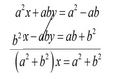
{tex}\Rightarrow{/tex} x = 1
{tex}\therefore{/tex} a + by = a - b
by = -b
y = -1
{tex}\therefore{/tex} x = 1
y = -1
Posted by Priya Priya 7 years, 6 months ago
- 0 answers
Posted by Soni Kuniyal 7 years, 6 months ago
- 1 answers
Tarunjeet Singh Bedi 7 years, 6 months ago
Posted by Ananya Patni 7 years, 6 months ago
- 0 answers
Posted by Komal Ingle 7 years, 6 months ago
- 1 answers
Nitya Singhal 7 years, 6 months ago
Posted by Kushal Choudhary 7 years, 6 months ago
- 1 answers
Nitya Singhal 7 years, 6 months ago
Posted by Kanish Fagetra 7 years, 6 months ago
- 0 answers
Posted by Harsh Rathore 7 years, 6 months ago
- 2 answers
Priyanka Chaurasiya 7 years, 6 months ago
Shreya Gupta 7 years, 6 months ago
Posted by Kuldeep Solanki 7 years, 6 months ago
- 2 answers
Posted by Adnan Shaikh 7 years, 6 months ago
- 0 answers
Posted by Jahnavi Arora 6 years, 6 months ago
- 1 answers
Sia ? 6 years, 6 months ago
Let p(x) = x3 + ax2 + bx + c
As -1 is one of the zeroes of p(x), p(-1) = 0
⇒ (-1)3 + a(-1)2 + b(-1) + c = 0
⇒ - 1 + a – b + c = 0
⇒ c = b –a + 1 …. (i)
Let {tex}\alpha{/tex}, β be two other zeroes of p(x),
then product of zeroes =-1× {tex}\alpha{/tex} × β ={tex}\;\;-\frac{\;\;Cons\tan t\;term\;}{coefficient\;of\;x^3}{/tex}
⇒ (-1) (α β) = {tex}\;\;-\frac{\;\;c}1{/tex}
⇒ - {tex}\alpha{/tex} β = - c
⇒ {tex}\alpha{/tex} β = c
⇒ {tex}\alpha{/tex} β = b –a + 1 [using (i)]
Posted by Ambita Khakha 7 years, 6 months ago
- 0 answers
Posted by Himanshu Kasaudhan 7 years, 6 months ago
- 0 answers

myCBSEguide
Trusted by 1 Crore+ Students

Test Generator
Create papers online. It's FREE.

CUET Mock Tests
75,000+ questions to practice only on myCBSEguide app

Lipsa Rani 7 years, 6 months ago
1Thank You