
Ask questions which are clear, concise and easy to understand.
Ask QuestionPosted by Shaad Khan 7 years, 5 months ago
- 1 answers
Posted by Piju Medhi 7 years, 5 months ago
- 0 answers
Posted by Ramanujan Mondal 7 years, 5 months ago
- 0 answers
Posted by The Tiwari 7 years, 5 months ago
- 0 answers
Posted by Arulselvi Sujatha 7 years, 5 months ago
- 1 answers
Posted by Arjun Arjun 7 years, 5 months ago
- 1 answers
Posted by Vaibhav Bairagi 7 years, 5 months ago
- 1 answers
Shifa Iram 7 years, 5 months ago
Posted by Tamana Bansal☺☺ 7 years, 5 months ago
- 3 answers
Posted by Kaira Goenka 7 years, 5 months ago
- 5 answers
Posted by Sandeep Bhadauriya 7 years, 5 months ago
- 1 answers
Posted by Navdeep Singh Ch 6 years, 6 months ago
- 1 answers
Sia ? 6 years, 6 months ago
Given a6 = 12
{tex}\Rightarrow{/tex} a + (6 - 1)d = 12
{tex}\Rightarrow{/tex} a + 5d = 12 ............(i)
and, a8 = 22
{tex}\Rightarrow{/tex} a + (8 - 1)d = 22
{tex}\Rightarrow{/tex} a + 7d = 22 ............(ii)
Subtracting equation (i) from (ii), we get
(a + 7d) - (a + 5d ) = 22 - 12
{tex}\Rightarrow{/tex} a + 7d - a - 5d = 10
{tex}\Rightarrow{/tex}2d - 10
{tex}\Rightarrow \quad d = \frac { 10 } { 2 } = 5{/tex}
Using value of d in equation (i), we get
a + 5 {tex}\times{/tex} 5 = 12
{tex}\Rightarrow{/tex} a = 12 - 25 = -13
nth term(an) = a + (n - 1)a
= -13 + (n - 1)(5)
= 5n - 18
Posted by Navdeep Singh Ch 7 years, 5 months ago
- 2 answers
Posted by Sweta Yadav 7 years, 5 months ago
- 0 answers
Posted by Mumaiz Peer 7 years, 5 months ago
- 2 answers
Rahul Yadav 7 years, 5 months ago
Posted by Veepin Kumar 7 years, 5 months ago
- 8 answers
Rahul Yadav 7 years, 5 months ago
Prachi Chandila 7 years, 5 months ago
Posted by Nikhil Yadav 7 years, 5 months ago
- 0 answers
Posted by Nikhil Yadav 7 years, 5 months ago
- 0 answers
Posted by Shiva Yadav Shiva Yadav 7 years, 5 months ago
- 1 answers
Aktarul Islam 7 years, 5 months ago
Posted by Ajay Baraik 7 years, 5 months ago
- 0 answers
Posted by Sai Darshan 5 years, 8 months ago
- 2 answers
Posted by Azeem Gour 7 years, 5 months ago
- 4 answers
Sai Darshan 7 years, 5 months ago
Posted by Sinah Chawla 5 years, 8 months ago
- 1 answers
Sia ? 6 years, 6 months ago
According to question the given system of equations are
3x + y = 1.......(1)
and kx + 2y = 5..........(2)
Since we know that,
The given equations are of the form
a1x + b1y + c1= 0 and
a2x + b2y + c2 = 0
has a unique solution if {tex}\frac { a _ { 1 } } { a _ { 2 } } \neq \frac { b _ { 1 } } { b _ { 2 } }{/tex}
Thus, {tex}\frac { 3 } { k } \neq \frac { 1 } { 2 } \Rightarrow k \neq 6{/tex}
Thus, k can take any real values except 6
Posted by Anurag Maurya 5 years, 8 months ago
- 0 answers
Posted by Sourabh Singh 7 years, 5 months ago
- 1 answers
Shubh Pyasi 7 years, 5 months ago
Posted by Sourabh Singh 6 years, 6 months ago
- 1 answers
Sia ? 6 years, 6 months ago
The given system of equations is
{tex}\frac{4}{x} + 5y = 7{/tex} ....(1)
{tex}\frac{3}{x} + 4y = 5{/tex} .....(2)
Put {tex}\frac{1}{x} = X{/tex} ....(3)
Then equations (1) and (2) can be rewritten as
4X + 5y = 7 ....(4)
3X + 4y = 5 .....(5)
{tex}\Rightarrow{/tex} 4X + 5y - 7 = 0 ....(6)
3X + 4y - 5 = 0 .....(7)
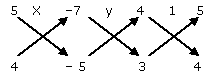
Then,
{tex}\frac{X}{{(5)( - 5) - ( 4)( - 7)}} = \frac{y}{{( - 7)(3) - ( - 5)(4)}}{/tex} {tex}= \frac{1}{{(4)(4) - (3)(5)}}{/tex}
{tex}\Rightarrow \;\frac{X}{{ - 25 + 28}} = \frac{y}{{ - 21 + 20}} = \frac{1}{{16 - 15}}{/tex}
{tex}\Rightarrow \;\frac{X}{3} = \frac{y}{-1} = \frac{1}{1}{/tex}
{tex}\Rightarrow{/tex} X = 3 and y = -1
{tex} \Rightarrow \;\frac{1}{x} = 3{/tex} and y = -1 ....using (3)
{tex}\Rightarrow \;x = \frac{1}{3}{/tex} and y = -1
Hence, the solution of the given system of equations is
{tex}x = \frac{1}{3}{/tex}, y = -1
Verification : Substituting {tex}x = \frac{1}{3}{/tex}, y = -1,
We find that both the equations (1) and (2) are satisfied as shown below
{tex}\frac{4}{x} + 5y = \frac{4}{{\left( {\frac{1}{3}} \right)}} + 5( - 1) = 12 - 5 = 7{/tex}
{tex}\frac{3}{x} + 4y = \frac{3}{{\left( {\frac{1}{3}} \right)}} + 4( - 1) = 9 - 4 = 5{/tex}
Hence, the solution of the given system of equations is {tex}x = \frac{1}{3}{/tex}, y = -1
Posted by Siddharth Galange 7 years, 5 months ago
- 4 answers
Posted by Girdhar Kumar 7 years, 5 months ago
- 0 answers

myCBSEguide
Trusted by 1 Crore+ Students

Test Generator
Create papers online. It's FREE.

CUET Mock Tests
75,000+ questions to practice only on myCBSEguide app

Pihu Saini 7 years, 5 months ago
0Thank You