
Ask questions which are clear, concise and easy to understand.
Ask QuestionPosted by Sonu Kumar 7 years, 5 months ago
- 0 answers
Posted by Chinmay Pathak 7 years, 5 months ago
- 0 answers
Posted by Shubham Singh 7 years, 5 months ago
- 2 answers
Prabhat Emmanuel 7 years, 5 months ago
Posted by Sangeeta Sangeeta Kabber 7 years, 5 months ago
- 2 answers
Posted by Sangeeta Sharma 7 years, 5 months ago
- 3 answers
Lakshmish Lakshmish 7 years, 5 months ago
Posted by P C 7 years, 5 months ago
- 1 answers
Madhan Saravanakumar 7 years, 5 months ago
Posted by Ramneet Virk Virk 6 years, 4 months ago
- 1 answers
Posted by Tanu Priya 6 years, 6 months ago
- 1 answers
Sia ? 6 years, 6 months ago
Given, In {tex}\triangle ABC,{/tex}, {tex}DE || BC{/tex},
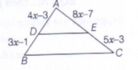
By Thales theorem , we get
{tex}\frac{AD}{DB}=\frac{AE}{EC}{/tex}
{tex}\Rightarrow \frac{4x-3}{3x-1}=\frac{8x-7}{5x-3}{/tex}
{tex}\Rightarrow (4x-3)(5x-3)= (8x-7)(3x-1){/tex}
{tex}\Rightarrow 20x^2-12x+9-15x=24x^2-21x-8x+7{/tex}
{tex}\Rightarrow + 24x^2 - 20x^2 -21x + 12x+ 15 x-8x+7- 9 = 0{/tex}
{tex}\Rightarrow 4x^2-2x-2=0{/tex}
{tex}\Rightarrow 2x^2-x-1=0{/tex}
{tex}\Rightarrow 2x^2-2x+x-1=0{/tex}
{tex}\Rightarrow 2x(x-1)+x(x-1)=0{/tex}
{tex}\Rightarrow (2x+1)(x-1)=0{/tex}
{tex}\Rightarrow (2x+1)=0{/tex} or {tex}(x-1)=0{/tex}
{tex}\Rightarrow 2x = -1{/tex} or {tex}x = 1{/tex}
{tex}x=-\frac{1}{2}{/tex} or 1
If {tex}x=-\frac{1}{2}{/tex} , then {tex}AD=4\times \frac{-1}{2}-3=-5{/tex} < 0 [not possible]
Hence, x = 1 is the required value.
Posted by Asad Ullah 7 years, 5 months ago
- 0 answers
Posted by Madhav Kumar 7 years, 5 months ago
- 2 answers
Posted by Disha Bansal 6 years, 6 months ago
- 1 answers
Sia ? 6 years, 6 months ago
Let father's age be x years and the sum of the ages of his two children be y years.
Then,
{tex}x = 2y{/tex}
{tex}\Rightarrow{/tex} {tex}x - 2y = 0{/tex} ....(i)
20 years hence,
Father's age = {tex}(x + 20) years{/tex}
Sum of the ages of two children {tex}= y + 20 + 20 = (y + 40) years{/tex}
Then, we have
{tex}x + 20 = y + 40{/tex}
{tex}\Rightarrow{/tex} {tex}x - y = 20 {/tex}....(ii)
Multiplying (ii) by 2, we get
{tex}2x - 2y = 40{/tex} ...(iii)
Subtracting (i) from (iii), we have
x = 40
Thus, the age of father is 40 years.
Posted by Asheesh Ahseesh 7 years, 5 months ago
- 0 answers
Posted by Jayesh Patidar 7 years, 5 months ago
- 1 answers
Asheesh Ahseesh 7 years, 5 months ago
Posted by Pranjal Trivedi 7 years, 5 months ago
- 0 answers
Posted by Sadir S 7 years, 5 months ago
- 1 answers
Posted by Aadash Kumar 7 years, 5 months ago
- 0 answers
Posted by Rajesh Kumar 7 years, 5 months ago
- 0 answers
Posted by Harsh Sharma 7 years, 5 months ago
- 1 answers
Aruni Shandilya 7 years, 5 months ago
Posted by Vikash Gupta 7 years, 5 months ago
- 1 answers
Posted by Ayush Gupta 6 years, 6 months ago
- 1 answers
Sia ? 6 years, 6 months ago
Let p(x) ={tex} x^3 + 2x^2 + kx + 3{/tex}
Now, x - 3 = 0
{tex}\Rightarrow{/tex} x = 3
By the remainder theorem, we know that when p(x) is divided by (x - 3), the remainder is p(3).
Now, p(3) = (3)3 + 2(3)2 + k(3) + 3
= 27 + 2(9) + 3k + 3
= 30 + 18 + 3k
= 48 + 3k
But, remainder = 21
{tex}\Rightarrow{/tex} 48 + 3k = 21
{tex}\Rightarrow{/tex} 3k = 21 - 48
{tex}\Rightarrow{/tex} 3k = -27
{tex}\Rightarrow{/tex} k = {tex}\frac{-27}3{/tex}
{tex}\Rightarrow{/tex} k = -9
So, the value of k is -9.
Posted by N.P. Dhanush 6 years, 6 months ago
- 1 answers
Sia ? 6 years, 6 months ago
Let a be the first term and d be the common difference of the given AP. Now, we know that in general mth and nth terms of the given A.P can be written as
Tm = a + (m-l)d and Tn = a + (n-1)d respectively.
Now, Tm = {tex}\frac{1}{n}{/tex} and Tn = {tex}\frac{1}{m}{/tex} (given).
{tex}\therefore{/tex} a + (m-1)d = {tex}\frac{1}{n}{/tex} ......................(i)
and a + (n-1)d ={tex}\frac{1}{m}{/tex}................ ... (ii)
On subtracting (ii) from (i), we get
(m-n)d = ({tex}\frac{1}{n}{/tex}-{tex}\frac{1}{m}{/tex}) = ({tex}\frac{{m - n}}{{mn}}{/tex}) {tex}\Rightarrow{/tex} d = {tex}\frac{1}{{mn}}{/tex}
Putting d ={tex}\frac{1}{{mn}}{/tex} in (i), we get
a + {tex}\frac{{(m - 1)}}{{mn}}{/tex} {tex} \Rightarrow {/tex} a = {{tex}\frac{1}{n}{/tex}-{tex}\frac{{(m - 1)}}{{mn}}{/tex}} = {tex}\frac{1}{{mn}}{/tex}
Thus, a={tex}\frac{1}{{mn}}{/tex} and d={tex}\frac{1}{{mn}}{/tex}
{tex}\therefore{/tex}Now, in general (mn)th term can be written as Tmn = a +(mn-1)d
= {{tex}\frac{1}{{mn}}{/tex}+{tex}\frac{{(mn - 1)}}{{mn}}{/tex}} [{tex}\because {/tex}a={tex}\frac{1}{{mn}}{/tex}]
= 1.
Hence, the (mn)th term of the given AP is 1.
Posted by Jeevi Jeevi 7 years, 5 months ago
- 3 answers
Shalu Gupta 7 years, 5 months ago
Posted by Eshant Singh 7 years, 5 months ago
- 1 answers
Posted by Priyanshu Sharma 7 years, 5 months ago
- 3 answers
Astitva Astitva 7 years, 5 months ago
Ankita Mohanty 7 years, 5 months ago
Posted by Shubham Kedia 6 years, 6 months ago
- 1 answers
Sia ? 6 years, 6 months ago
Suppose {tex}\text{α,β and γ}{/tex} are the zeros of the said polynomial p(x)
Then, we have {tex}\alpha{/tex} = 2, {tex}\beta{/tex} = -3 and {tex}\gamma{/tex} = 4
Now,
{tex}\text{α+β +γ=2-3+4=3}{/tex}......(1)
{tex}\text{αβ +βγ+γα=2(-3)+(-3)(4)+(4)(2)=-6-12+8=-10......(.2)}{/tex}
{tex}\text{αβγ=2(-3)(4)=-24 .......(3)}{/tex}
Now, a cubic polynomial whose zeros are {tex}\alpha, \space \beta \space and \space \gamma{/tex} is given by
p(x) = x3 - {tex}\text{(α+β+γ)x}^2{/tex} + {tex}\text{(αβ+βγ+γα)x}{/tex} - {tex}\alpha\beta\gamma{/tex}
Now putting the values from (1),(2) and (3) we get
p(x) = x3 -(3)x2 + (-10)x - (-24)
= x3 -3x2 -10x +24
Posted by Řøÿął. Vipul 7 years, 5 months ago
- 1 answers
Posted by Abdul Matin 7 years, 5 months ago
- 0 answers

myCBSEguide
Trusted by 1 Crore+ Students

Test Generator
Create papers online. It's FREE.

CUET Mock Tests
75,000+ questions to practice only on myCBSEguide app
