
Ask questions which are clear, concise and easy to understand.
Ask QuestionPosted by Varun Arora 7 years, 4 months ago
- 2 answers
Palak Jhawar 7 years, 4 months ago
Posted by Govind Patel 7 years, 4 months ago
- 1 answers
Hemang Garg 7 years, 4 months ago
Posted by Dev R 6 years, 5 months ago
- 1 answers
Sia ? 6 years, 5 months ago
Given:
{tex}∆ABC\sim∆PQR{/tex}
and {tex}ar∆ABC=ar∆PQR{/tex}
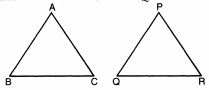
To prove: {tex}∆ABC\cong∆PQR{/tex}
Proof: {tex}∆ABC\sim∆PQR{/tex}
Also {tex}\operatorname { ar } ( \Delta A B C ) = \operatorname { ar } ( \Delta P Q R ){/tex} (given)
or, {tex}\frac { \operatorname { ar } ( \Delta A B C ) } { \operatorname { ar } ( \Delta P Q R ) } = 1{/tex}
Or {tex}\frac{AB^2}{PQ^2}=\frac{BC^2}{QR^2}=\frac{CA^2}{RP^2}=1{/tex}
Or {tex}\frac{AB}{PQ}=\frac{BC}{QR}=\frac{CA}{RP}=1{/tex}
Hence we get that
AB=PQ,BC=QR and CA=RP
Hence {tex}∆ABC\cong ∆PQR{/tex}
Posted by Ramkishor Koli 7 years, 4 months ago
- 1 answers
Posted by Minal Sinha 6 years, 4 months ago
- 1 answers
Sia ? 6 years, 4 months ago
The given equation is; (x - a)(x - b)+(x - b)(x - c)+(x - c)(x - a) =0
{tex}\Rightarrow{/tex} (x2 - ax - bx + ab) + (x2- bx - cx + bc) +(x2 - cx - ax + ac) = 0
{tex}\Rightarrow{/tex}3x2 - 2x(a + b + c) + (ab + bc + ca) = 0.....(1).
Discriminant 'D' of quadratic equation (1) is given by;
{tex}\therefore{/tex} D = 4(a + b + c)2 - 12(ab + bc + ca)
= 4[(a + b + c)2 - 3(ab + bc + ca)]
= 4(a2 + b2 + c2 - ab - bc - ca)
= 2(2a2 + 2b2 + 2c2 - 2ab - 2bc - 2ca)
= 2 [(a - b)2 + (b - c)2 + (c - a)2] ≥ 0
[{tex}\because{/tex} (a - b)2 ≥ 0, (b - c)2 {tex}{/tex} ≥ 0 and (c - a)2 {tex}{/tex} ≥ 0].
This shows that both the roots of the given equation are real.
For equal roots, we must have D = 0.
Now, D = 0 {tex}\Rightarrow{/tex} (a - b)2 + (b - c)2 + (c - a)2= 0
{tex}\Rightarrow{/tex} (a - b) = 0, (b - c) = 0 and (c - a) = 0 (sum of squares can be zero only if they all are equal to 0)
{tex}\Rightarrow{/tex} a = b = c.
Hence, the roots are equal only when a = b = c
Posted by Pawan Kaptiyal 7 years, 4 months ago
- 1 answers
Posted by Amit Kumar Gautam 7 years, 4 months ago
- 2 answers
Somya Choudhary 7 years, 4 months ago
Posted by Manish Kumar 6 years, 5 months ago
- 1 answers
Sia ? 6 years, 5 months ago
Let n = 4q + 1 (an odd integer)
{tex}\therefore \quad n ^ { 2 } - 1 = ( 4 q + 1 ) ^ { 2 } - 1{/tex}
{tex}= 16 q ^ { 2 } + 1 + 8 q - 1 \quad \text { Using Identity } ( a + b ) ^ { 2 } = a ^ { 2 } + 2 a b + b ^ { 2 }{/tex}
{tex}= 16{q^2} + 8q{/tex}
{tex}= 8 \left( 2 q ^ { 2 } + q \right){/tex}
= 8m, which is divisible by 8.
Posted by Manish Kumar 7 years, 4 months ago
- 3 answers
Sanjeet Yadav 7 years, 4 months ago
Priyanka Chaurasiya 7 years, 4 months ago
Posted by Sejal Chauhan 5 years, 8 months ago
- 0 answers
Posted by Shruti Raj 7 years, 4 months ago
- 2 answers
Sanjeet Yadav 7 years, 4 months ago
Shashank Mishra 7 years, 4 months ago
Posted by Wwe Raw 7 years, 4 months ago
- 1 answers
Posted by Manav Thakur 7 years, 4 months ago
- 0 answers
Posted by Asish Kumar Sahani 6 years, 5 months ago
- 1 answers
Sia ? 6 years, 5 months ago
Let the required number be x.
Then, square of a number will be x2.
According to given information, we have
{tex}x^2 - 84 = 3(x + 8){/tex}
{tex} \Rightarrow {/tex} {tex}x^2 - 84 = 3x + 24{/tex}
{tex} \Rightarrow {/tex} {tex}x^2 - 3x - 108 = 0{/tex}
{tex} \Rightarrow {/tex} {tex}x^2 - 12x + 9x - 108 = 0{/tex}
{tex} \Rightarrow {/tex} {tex}x(x - 12) + 9(x - 12) = 0{/tex}
{tex} \Rightarrow {/tex} {tex}(x - 12)(x + 9) = 0{/tex}
{tex} \Rightarrow {/tex} x - 12 = 0 or x + 9 = 0
{tex} \Rightarrow {/tex} x = 12 or x = -9
Since x is a natural number, x {tex}\ne{/tex} -9.
{tex} \Rightarrow {/tex} x = 12
Hence, required number is 12.
Posted by Ajay Dhanush 7 years, 4 months ago
- 4 answers
Bhoomika . 7 years, 4 months ago
Posted by Sanjay Yadav 7 years, 4 months ago
- 0 answers
Posted by Abhay Kumar 7 years, 4 months ago
- 2 answers
Sakshi Singh 7 years, 4 months ago
Shraddha Soni 7 years, 4 months ago
Posted by Nishita Kapse 6 years, 4 months ago
- 1 answers
Sia ? 6 years, 4 months ago
Let the numerator and denominator of fraction be x and y respectively.
Then, the fraction is {tex}\frac xy{/tex}.
As per first condition
The sum of the numerator and denominator of a fraction is 4 more than twice the numerator.
x + y = 2x + 4
{tex}\Rightarrow{/tex} -x + y = 4........(i)
According to the second condition,
If the numerator and denominator are increased by 3, they are in the ratio 2 : 3.
{tex}\frac { x + 3 } { y + 3 } = \frac { 2 } { 3 }{/tex}
{tex}\Rightarrow{/tex} 3x + 9 = 2y + 6
{tex}\Rightarrow{/tex}3x - 2y = -3.......(ii)
Multiply (i) by -2, we get
-2x + 2y = 8 ......... (iii)
Adding (ii) and (iii) , we get
and 3x - 2x = -3 + 8
{tex}\Rightarrow{/tex} x = 5
Substituting x = 5 in (i), we get
5 - y = 4
y = 9
Hence, the required fraction is {tex}\frac{5}{9}{/tex}
Posted by Sumit Sharma 7 years, 4 months ago
- 1 answers
Posted by Venkatesh Karunanidhi 7 years, 4 months ago
- 1 answers
Posted by Mansi Kashyap 7 years, 4 months ago
- 3 answers
Posted by Md Aman 7 years, 4 months ago
- 2 answers
Posted by Kohi . 7 years, 4 months ago
- 0 answers
Posted by Priya Patel 7 years, 4 months ago
- 1 answers
Sanjana ? 7 years, 4 months ago
Posted by Pranav Sharma 7 years, 4 months ago
- 1 answers
Posted by M.P Singh 7 years, 4 months ago
- 2 answers
Posted by Anand Yadav 7 years, 4 months ago
- 1 answers
Posted by Divya ..... 7 years, 4 months ago
- 5 answers

myCBSEguide
Trusted by 1 Crore+ Students

Test Generator
Create papers online. It's FREE.

CUET Mock Tests
75,000+ questions to practice only on myCBSEguide app

Lakshay Prajapati 7 years, 4 months ago
1Thank You