
Ask questions which are clear, concise and easy to understand.
Ask QuestionPosted by Janisha Dayma 7 years, 4 months ago
- 1 answers
Posted by Asmi Mvm 7 years, 4 months ago
- 3 answers
Shikhar Maheshwari 7 years, 4 months ago
Kannu Kranti Yadav 7 years, 4 months ago
Posted by Tushar Sharma 7 years, 4 months ago
- 1 answers
Sanju Yadav 7 years, 4 months ago
Posted by Prashant Rai 7 years, 4 months ago
- 1 answers
Posted by Joncey Sabhereal 7 years, 4 months ago
- 2 answers
Posted by Rohit Singh 7 years, 4 months ago
- 2 answers
Pragya . 7 years, 4 months ago
Shashank Mishra 7 years, 4 months ago
Posted by Rohit Singh 6 years, 5 months ago
- 1 answers
Sia ? 6 years, 5 months ago
It is given that the gap between two consecutive rungs is 25 cm and the top and bottom rungs are 2.5 metre i.e., 250 cm apart.
{tex}\therefore{/tex} Number of rungs = {tex}\frac { 250 } { 25 } {/tex}+ 1 = 10 + 1 = 11.
It is given that the rungs are decreasing uniformly in length from 45 cm at the bottom to 25 cm at the top.
Therefore, lengths of the rungs form an A.P. with first term a = 45 cm and 11th term l = 25 cm. n = 11
{tex}\therefore{/tex} Length of the wood required for rungs = Sum of 11 terms of an A.P. with first term 45 cm and last term is 25 cm
{tex}= \frac { 11 } { 2 }{/tex} ( 45 + 25 ) cm {tex}\left[ \because S _ { n } = \frac { n } { 2 } ( a + l ) \right]{/tex}
{tex}= \frac { 11 } { 2 }{/tex}(70) cm
= 11 (35) cm
= 385 cm
Length of the wood required for rungs = {tex}\frac{385}{100}{/tex} = 3.85 metres ({tex}\because{/tex}100 cm = 1 m)
The length of the wood required for the rungs is 3.85 metres.
Posted by Suvidhi Nahar 5 years, 8 months ago
- 1 answers
Harleen Narula 7 years, 4 months ago
Posted by Nishita Gupta 7 years, 4 months ago
- 0 answers
Posted by Om Ganatra 7 years, 4 months ago
- 1 answers
Posted by Priya Sharma 5 years, 8 months ago
- 1 answers
Aashi Pandey 7 years, 4 months ago
Posted by Aarya Rajawat 6 years, 5 months ago
- 1 answers
Sia ? 6 years, 5 months ago
Let the number be (3q + r)
{tex}n = 3 q + r \quad 0 \leq r < 3{/tex}
{tex}\text { or } 3 q , 3 q + 1,3 q + 2{/tex}
{tex}\text { If } n = 3 q \text { then, numbers are } 3 q , ( 3 q + 1 ) , ( 3 q + 2 ){/tex}
{tex}3 q \text { is divisible by } 3{/tex}.
{tex}\text { If } n = 3 q + 1 \text { then, numbers are } ( 3 q + 1 ) , ( 3 q + 3 ) , ( 3 q + 4 ){/tex}
{tex}( 3 q + 3 ) \text { is divisible by } 3{/tex}.
{tex}\text { If } n = 3 q + 2 \text { then, numbers are } ( 3 q + 2 ) , ( 3 q + 4 ) , ( 3 q + 6 ){/tex}
{tex}( 3 q + 6 ) \text { is divisible by } 3{/tex}.
{tex}\therefore \text { out of } n , ( n + 2 ) \text { and } ( n + 4 ) \text { only one is divisible by } 3{/tex}.
Posted by Adam Lynkyn 6 years, 4 months ago
- 1 answers
Sia ? 6 years, 4 months ago
According to the question, {tex}\triangle ABC {/tex} is an equilateral triangle.
In {tex}\triangle{/tex}ABD, using Pythagoras theorem,
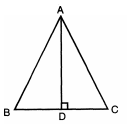
{tex}\Rightarrow{/tex} AB2 = AD2 + BD2
{tex}\Rightarrow{/tex} BC2 = AD2 + BD2, (as AB = BC = CA)
{tex}\Rightarrow{/tex} (2 BD)2 = AD2 + BD2, (perpendicular is the median in an equilateral triangle)
{tex}\Rightarrow{/tex} 4BD2 - BD2 = AD2
{tex}\therefore{/tex} 3BD2 = AD2
Posted by Bharat Singh 7 years, 4 months ago
- 3 answers
Elsa B 7 years, 4 months ago
Bharat Singh 7 years, 4 months ago
Posted by Ashish Kumar 6 years, 4 months ago
- 1 answers
Sia ? 6 years, 4 months ago
Let A(6, -1) and B(2,3) be the given point and P(x,y) be the required point.
Since point P is equidistant from points A and B,therefore,
PA = PB {tex}\Rightarrow{/tex} (PA)2 = (PB)2
{tex}\Rightarrow{/tex}(x - 6)2 + (y + 1)2 = (2 - x)2 + (3 - y)2
{tex}\Rightarrow{/tex} 36 + x2 - 12x + y2 + 1 +2y = 4 + x2 - 4x + 9 + y2 - 6y
{tex}\Rightarrow{/tex} -12x + 4x + 2y + 6y = 4 + 9 - 1 - 36
{tex}\Rightarrow{/tex} -8x + 8y = -24
-8 (x - y)=-24
{tex}\Rightarrow{/tex} x - y = 3
Hence, x - y = 3
Posted by Ankit Raj 6 years, 5 months ago
- 1 answers
Sia ? 6 years, 5 months ago
Given:-In fig., {tex}\Delta{/tex}ABC D is the mid-point of BC and E is the mid-point of AD.
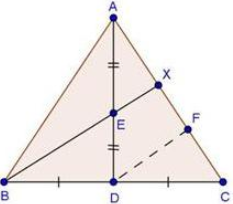
To prove:- BE : EX = 3 : 1
Construction: Through D, draw DF parallel to BX.
Proof:- In {tex}\Delta{/tex}AEX and {tex}\Delta{/tex}ADF
{tex}\angle EAX = \angle DAF{/tex} [Common]
{tex}\angle AXE = \angle AFD{/tex} [Corresponding angles]
Then, {tex}\Delta{/tex}AEX ~ {tex}\Delta{/tex}ADF [By AA similarity]
{tex}\therefore \frac{{EX}}{{DF}} = \frac{{AE}}{{AD}}{/tex} [Corresponding parts of similar {tex}Triangle{/tex}are proportional]
{tex}\Rightarrow \frac{{EX}}{{DF}} = \frac{{AE}}{{2AE}}{/tex} [AE = ED given]
{tex}\Rightarrow{/tex} DF = 2EX ....(i)
In {tex}\Delta{/tex}CDF ~ {tex}\Delta{/tex}CBX
{tex}\angle C = \angle C{/tex} [Common]
{tex}\angle CDF = \angle CBX{/tex} [Corresponding angles]
Then, {tex}\Delta{/tex}CDF ~ {tex}\Delta{/tex}CBX [By AA similarity]
Therefore ,{tex} \frac{{CD}}{{CB}} = \frac{{DF}}{{BX}}{/tex} [Corresponding parts of similar {tex}\Delta{/tex}are proportional]
{tex}\Rightarrow \frac{1}{2} = \frac{{DF}}{{BE + EX}}{/tex} [BD = DC given]
{tex}\Rightarrow{/tex} BE + EX = 2DF
{tex}\Rightarrow{/tex} BE + EX = 4EX [By using (i)]
{tex}\Rightarrow{/tex} BE = 4EX - EX
{tex}\Rightarrow{/tex} BE = 3EX{tex}{/tex}
{tex}\Rightarrow \frac{{BE}}{{EX}} = \frac{3}{1}.{/tex}
Posted by Sahad Bava 7 years, 4 months ago
- 1 answers
Posted by Harshita Vinod 6 years, 5 months ago
- 1 answers
Sia ? 6 years, 5 months ago
Let n be an arbitrary positive integer.
On dividing n by 3, let q be the quotient and r be the remainder.
Then, by Euclid's division lemma, we have
n = 3q + r, where {tex}0 \leq r < 3{/tex}.
The possibilities of remainder = 0,1 or 2
n2 = (3q + r)2 [∵ (a + b) 2 = a2 + 2ab + b2]
{tex}\therefore{/tex} n2 = 9q2 + r2 + 6qr ... ....(i), where {tex}0 \leq r < 3{/tex}.
Case I When r = 0.
Putting r = 0 in (i), we get
n2 = 9q2
= 3(3q2)
n2 = 3m, where m = 3q2 is an integer.
Case II When r = 1.
Putting r = 1 in (i), we get
n2 = (9q2 + 1 + 6 q)
= 3(3q2 + 2q) + 1
n2= 3 m + 1, where m = (3q2 + 2q) is an integer.
Case lll When r = 2.
Putting r = 2 in (i), we get
n2 = (9q2 + 4 + 12q)
= 3(3q2 + 4q + 1) + 1
n2= 3m + 1, where m = (3q2 + 4q + 1) is an integer.
From all the above cases it is clear that the square of any positive integer is of the form 3m or (3m + 1) for some integer m.
Posted by Aryan Rajput 5 years, 8 months ago
- 2 answers
Posted by Muskan Divakar 7 years, 4 months ago
- 4 answers
Muskan Divakar 7 years, 4 months ago
Posted by Raghav Agrawal 7 years, 4 months ago
- 3 answers
Posted by Shibatul Hamd Hamd 7 years, 4 months ago
- 1 answers
Posted by Yuvraj Sevda 7 years, 4 months ago
- 0 answers
Posted by Sumit Rawat 7 years, 4 months ago
- 1 answers
Posted by Aman Jot 6 years, 4 months ago
- 1 answers
Sia ? 6 years, 4 months ago
Let A(-2, -3) and B(5, 6) be the given points.
- Suppose x-axis divides AB in the ratio k:1 at point P
Then, the coordinates of the point of division are
{tex}P \left[ \frac { 5 k - 2 } { k + 1 } , \frac { 6 k - 3 } { k + 1 } \right]{/tex}
Since P lies on x-axis, and y-coordinates of every point on x-axis is zero.
{tex}\therefore \quad \frac { 6 k - 3 } { k + 1 } = 0{/tex}
{tex}\Rightarrow{/tex} 6k - 3=0
{tex}\Rightarrow{/tex} 6k = 3
{tex}\Rightarrow{/tex} {tex}k = \frac { 3 } { 6 } \Rightarrow k = \frac { 1 } { 2 }{/tex}
Hence, the required ratio is 1:2.
Putting {tex}K = \frac { 1 } { 2 }{/tex}in the coordinates of P.
We find that its coordinates are {tex}\left( \frac { 1 } { 3 } , 0 \right).{/tex} - Suppose y-axis divides AB in the ratio k:1 at point Q.
Then, the coordinates of the point of division are
{tex}Q \left[ \frac { 5 k - 2 } { k + 1 } , \frac { 6 k - 3 } { k + 1 } \right]{/tex}
Since, Q lies on y-axis, and x-coordinates of every point on y-axis is zero.
{tex}\therefore \quad \frac { 5 k - 2 } { k + 1 } = 0{/tex}
{tex}\Rightarrow{/tex} 5k - 2 = 0
{tex}\Rightarrow \quad k = \frac { 2 } { 5 }{/tex}
Hence, the required ratio is {tex}\frac { 2 } { 5 } : 1 = 2 : 5{/tex}
Putting {tex}K = \frac { 2 } { 5 }{/tex}in the coordinates of Q.
We find that the coordinates are {tex}\left( 0 , \frac { - 3 } { 7 } \right){/tex}

myCBSEguide
Trusted by 1 Crore+ Students

Test Generator
Create papers online. It's FREE.

CUET Mock Tests
75,000+ questions to practice only on myCBSEguide app

Lovely Boy 7 years, 4 months ago
1Thank You