
Ask questions which are clear, concise and easy to understand.
Ask QuestionPosted by Harshith K V 6 years, 5 months ago
- 1 answers
Posted by Amardeep Kaur 6 years, 5 months ago
- 6 answers
Posted by Tanveer Fatima 6 years, 5 months ago
- 1 answers
Posted by Justin Thomas 6 years, 5 months ago
- 4 answers
Anjali Chandra 6 years, 5 months ago
Shashwanth Shashwanth 6 years, 5 months ago
Sia ? 6 years, 5 months ago
Posted by Parineeta Tyagi 6 years, 5 months ago
- 1 answers
Tanu Singh 6 years, 5 months ago
Posted by Yadav Dinesh 6 years, 5 months ago
- 3 answers
Kritika Singh 6 years, 5 months ago
Hariom Dalal 6 years, 5 months ago
Posted by Chhotu Sahu Sahu 6 years, 5 months ago
- 1 answers
Sia ? 6 years, 5 months ago
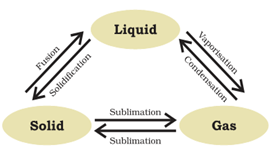
Three states of matter are inter-convertible.
- Solid can be changed into liquid by boiling and liquid can be changed to solid by cooling it i.e. by solidification.
- Liquid can be changed to gas by vaporization by heating it and gas can be changed to liquid by condensation i.e. subjecting it to low temperature.
- Solid can be changed to gaseous form/state by sublimation and gas can be changed to solid by condensation.
Posted by Chhotu Sahu Sahu 6 years, 5 months ago
- 1 answers
Sia ? 6 years, 5 months ago
Posted by Varsha Raj 6 years, 5 months ago
- 2 answers
Power P 6 years, 5 months ago
Sia ? 6 years, 5 months ago
Posted by Geeta Gill 6 years, 5 months ago
- 3 answers
Posted by Tanya Thakur 6 years, 5 months ago
- 2 answers
Yogita Ingle 6 years, 5 months ago
The pressure exerted by a gas uniformly across the surface of a container can be described by simple kinetic theory. The particles of a gas are constantly moving in random directions and frequently collide with the walls of the container and/or each other. The sum of all the normal components of force exerted by the particles impacting the walls of the container divided by the area of the wall is defined to be the pressure.
Posted by Aniket Soni 6 years, 5 months ago
- 2 answers
Yogita Ingle 6 years, 5 months ago
All living organisms - plants, animals and human beings are made of small structures called cells.
Structure and Support:You know a house is made of bricks. Similarly, an organism is made up of cells. Though there are certain cells such as collenchyma and sclerenchyma are present for offering structural support however in general too, all cells generally provide the structural basis of all organisms.
<p3>Growth: In complex organisms such as humans, the tissues grow by simple multiplication of cells. Hence, cells are responsible for the growth of the organism. The entire thing takes place via a process of mitosis.Transport: Cells import the nutrients that are used in the different chemical process which take place inside them. As a result of these processes, a waste product is produced. Cells then work to get rid of this waste. In this manner, the small molecules like the such as oxygen, carbon dioxide, and ethanol pass through the cell membrane by diffusion. This method is known as passive transport. On the other hand, the larger molecules like the proteins and polysaccharides, go in and out of the cell via active transport.
Energy Production:Organisms need energy to perform different chemical reactions. In plants, the energy comes from the process of photosynthesis while in the animals the energy comes via respiration.
Metabolism: Cell is responsible for metabolism that includes all the chemical reactions that take place inside an organism to keep it alive.
Reproduction: A cell helps in reproduction by the processes of mitosis (in more evolved organisms) and meiosis.
</p3>Posted by Avni Sharma 6 years, 5 months ago
- 1 answers
Gaurav Seth 6 years, 5 months ago
- It protects and supports the body.
- The cells are loosely spaced and embedded in an intercellular matrix.
- The matrix may be jelly like, fluid, dense or rigid.
- The nature of matrix differs in concordance with the function of the particular connective tissue.
Posted by Ankita Kushwaha 6 years, 5 months ago
- 4 answers
Varsha Raj 6 years, 5 months ago
Gaurav Seth 6 years, 5 months ago
- Newton's First Law of Motion: Any object remains in the state of rest or in uniform motion along a straight line, until it is compelled to change the state by applying external force.
Riya Kumari 6 years, 5 months ago
Posted by Saurabh Kumar 6 years, 5 months ago
- 2 answers
Palak Arora 6 years, 5 months ago
Posted by Akash Shinde 6 years, 5 months ago
- 1 answers
Posted by Fatima Zubair 6 years, 5 months ago
- 3 answers
Pragya Sinha Thanks 6 years, 5 months ago
Ningappa N 6 years, 5 months ago
Palak Arora 6 years, 5 months ago
Posted by Aniket Das 6 years, 5 months ago
- 2 answers
Ankita Kushwaha 6 years, 5 months ago
Posted by Raji Skeerthy 6 years, 5 months ago
- 3 answers
Raj Ranjan 6 years, 5 months ago
45516111? 46 6 years, 5 months ago
Posted by Anjali Chandra 6 years, 5 months ago
- 3 answers
45516111? 46 6 years, 5 months ago
Posted by Bharath Bharath 6 years, 5 months ago
- 1 answers
Posted by Tanishka Swamy 6 years, 5 months ago
- 3 answers
Aditya Kaushik 6 years, 5 months ago
Posted by Bharath Bharath 6 years, 5 months ago
- 2 answers
Posted by Yashasvi Misra 6 years, 5 months ago
- 2 answers
Sia ? 6 years, 5 months ago
Posted by Lovish Kalyan 6 years, 5 months ago
- 10 answers
Posted by Stanis Kamsuan 6 years, 5 months ago
- 5 answers
45516111? 46 6 years, 5 months ago
Govind Bhatt Bhatt Govind 6 years, 5 months ago
Palak Arora 6 years, 5 months ago
Manisa Ghosh 6 years, 5 months ago
Sia ? 6 years, 5 months ago
Posted by Vaiahali Monani 6 years, 5 months ago
- 1 answers
Sia ? 6 years, 5 months ago
Posted by Geeta Gill 6 years, 5 months ago
- 2 answers
Sia ? 6 years, 5 months ago

myCBSEguide
Trusted by 1 Crore+ Students

Test Generator
Create papers online. It's FREE.

CUET Mock Tests
75,000+ questions to practice only on myCBSEguide app

Aditya Sehal 6 years, 5 months ago
0Thank You