
Ask questions which are clear, concise and easy to understand.
Ask QuestionPosted by Aditya Kumar 5 years, 2 months ago
- 2 answers
Deepanshi Antil 5 years, 2 months ago
Posted by Muskan Singh 5 years, 2 months ago
- 2 answers
Yogita Ingle 5 years, 2 months ago
When fireman directs a large amount of water at a high velocity on fire from a hose pipe, they have to hold the hose pipe strongly because of its tendency to go backwards. The backward movement of the hose pipe is due to the backward reaction force of water rushing out through it in the forward direction at a high speed as per the Newton's third law of motion.
Ananya K 5 years, 2 months ago
Posted by Ananya K 5 years, 2 months ago
- 2 answers
Yogita Ingle 5 years, 2 months ago
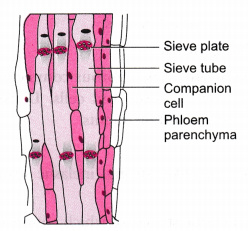
Sieve tubes, companion cells, phloem fibres and phloem parenchyma are the different elements of phloem.
Posted by Ananya K 5 years, 2 months ago
- 3 answers
Rohit Gupta 5 years, 2 months ago
Yogita Ingle 5 years, 2 months ago
Parenchyma cells have thin cellulosic cell walls. Collenchyma cells have thicker cellulosic walls and also may have pectin deposition on corners. Sclerenchyma cells have thick lignified cell walls and are dead at maturity and provide protection to the different parts of the body. Epithelial cells are thin-walled and living.
Posted by Charming Princess? 5 years, 2 months ago
- 2 answers
Ananya K 5 years, 2 months ago
Posted by Kanika Kanika 5 years, 2 months ago
- 1 answers
Ananya K 5 years, 2 months ago
Posted by Charming Princess? 5 years, 2 months ago
- 1 answers
Meghna Thapar 5 years, 2 months ago
- Infectious and non-infectious causes:
One of the causes of diseases is the infectious agents, mostly called microbes or micro-organisms. Diseases where microbes are the immediate causes are called infectious diseases. This is because they spread the diseases in the community.
Some diseases are not caused by infectious agents. Their causes vary, but they are not external causes like microbes that can spread in the community. Instead, these are mostly internal, non-infectious causes. Such diseases are called non-infectious diseases. For example, cancer is caused by genetic abnormalities. High blood pressure can be caused by excessive weight and lack of exercise. Different diseases spread by different means and can be treated and prevented at community level.
- Infectious diseases:
- Infectious agents:
Organisms that can cause disease are found in a wide range of such categories. Some of them are viruses, bacteria, fungi, protozoans or multicellular organisms, such as worms.
|
Category of Infectious Agent |
Examples of Diseases Caused |
|
Virus |
Common cold, influenza, Dengue fever, AIDS |
|
Bacteria |
Typhoid, cholera, tuberculosis, anthrax |
|
Fungi |
Skin infections |
|
Protozoans |
Malaria, kala-azar |
|
Worms |
Intestinal worm infections, elephantiasis |
Posted by Charming Princess? 5 years, 2 months ago
- 1 answers
Meghna Thapar 5 years, 2 months ago
An infectious disease can be spread and is caused by a pathogen. A noninfectious disease cannot be spread and is caused different factors.
Infectious causes: They include the agents like microbes or micro-organisms as the immediate causes which spread the disease from an infected person to a healthy person.
Non-infectious causes: The disease which does not spread by contact between infected and healthy person through air and water, is called non-infectious disease.
Infectious Diseases: The diseases which spread due to infection by micro-organisms are called infectious diseases.
When a disease causing organism enters our body it causes infection, it multiplies and grows in the body called host and micro-organisms multiplies in the host body.
For example: Tuberculosis, tetanus, Common cold, AIDS, etc.
Non-infectious Diseases: The disease which does not spread by contact between infected and healthy person through air and water, is called non-infectious disease.
For example: Cancer, genetic abnormalities, high blood pressure, etc.
Posted by Charming Princess? 5 years, 2 months ago
- 1 answers
Meghna Thapar 5 years, 2 months ago
- Acute and chronic diseases:
Some diseases last for only very short periods of time and their symptoms are quickly visible, they are called acute diseases. Example – common cold, cough, typhoid, etc. They do not cause long term bad effects on the body.
The ailments which can last for a long time, even as much as a lifetime, and their symptoms lasts for months or years, are called chronic diseases. Example – tuberculosis, cancer, diabetes, etc. They cause drastic long term effects on human body.
Posted by Luis Fonsi 5 years, 2 months ago
- 2 answers
Ananya K 5 years, 2 months ago
Meghna Thapar 5 years, 2 months ago
Signs and symptoms are abnormalities that can indicate a potential medical condition. Whereas a symptom is subjective, that is, apparent only to the patient (for example back pain or fatigue), a sign is any objective evidence of a disease that can be observed by others (for example a skin rash or lump). A fever is a temporary increase in your body temperature, often due to an illness. Having a fever is a sign that something out of the ordinary is going on in your body. For an adult, a fever may be uncomfortable, but usually isn't a cause for concern unless it reaches 103 F (39.4 C) or higher.
Posted by Rishita Soni 5 years, 2 months ago
- 3 answers
Muthu Dainy 5 years, 2 months ago
Posted by Rishita Soni 5 years, 2 months ago
- 0 answers
Posted by Rishita Soni 5 years, 2 months ago
- 0 answers
Posted by Seema Sing 5 years, 2 months ago
- 1 answers
Fatima Zehra Khan 5 years, 2 months ago
Posted by Harveen Kaur 5 years, 2 months ago
- 1 answers
Lavishka Choudhary 5 years, 2 months ago
Posted by Mahes Kumar 5 years, 2 months ago
- 1 answers
Posted by Ayush Kumar 5 years, 2 months ago
- 2 answers
Yogita Ingle 5 years, 2 months ago
The types of simple tissues are parenchyma, collenchyma, sclerenchyma and aerenchyma.
Ayush Kumar 5 years, 2 months ago
Posted by Pratibha Pratibha 5 years, 2 months ago
- 1 answers
Ananya K 5 years, 2 months ago
Posted by Madhwi ? 5 years, 2 months ago
- 4 answers
Ananya K 5 years, 2 months ago
Yogita Ingle 5 years, 2 months ago
- In case of uniform composition, the molecules of all the components are arranged uniformly throughout the mixture.
- It is not possible to recognize them individually as the mixture gets a uniform texture.
Posted by Divyahb Divya 5 years, 2 months ago
- 0 answers
Posted by Gourav Bajaj 5 years, 2 months ago
- 5 answers
Bhumika Sharma ✓ 5 years, 2 months ago
Madhu 433576 5 years, 2 months ago
Yogita Ingle 5 years, 2 months ago
Cells are the structural, functional, and biological units of all living beings. A cell can replicate itself independently. Hence, they are known as the building blocks of life.
Posted by Divya Singh 5 years, 2 months ago
- 3 answers
Yogita Ingle 5 years, 2 months ago
1 mole of nitrogen atoms is equivalent to the gram atomic mass of nitrogen. Therefore, 1 mole of nitrogen atoms contains 14 g.
Ananya K 5 years, 2 months ago
Posted by Tiger$ Praful Jawale 5 years, 2 months ago
- 3 answers
Posted by Muskan Singh 5 years, 2 months ago
- 2 answers
Yogita Ingle 5 years, 2 months ago
The drawback of Rutherford model is:
It can't explain the stability of an atom. As per the model, the orbital revolution of electrons around the nucleus is not stable as the revolving electrons in orbits will undergo acceleration and emit energy. This will result in loss of energy of electrons and they will ultimately fall into the nucleus.
Tiger$ Praful Jawale 5 years, 2 months ago
Posted by Abhishek Kumar Sinha 5 years, 2 months ago
- 1 answers
Yogita Ingle 5 years, 2 months ago
In unicellular organisms, the cell is capable of performing the different life processes with the help of the different cellular organelles. The division of labour in multicellular organisms refers to the presence of different organ systems that are incharge of taking care of a particular life process. For example, the respiratory system, helps the body in obtaining oxygen from the air and supplying it to the rest of the body.
Posted by Jay Kushwaha 5 years, 2 months ago
- 2 answers
Bhumika Sharma ✓ 5 years, 2 months ago
Kalpana Singh 5 years, 2 months ago
Posted by Simon Chauhan 5 years, 2 months ago
- 1 answers
Lavishka Choudhary 5 years, 2 months ago
Posted by Simon Chauhan 5 years, 2 months ago
- 2 answers
Zoya . 5 years, 2 months ago
Sujita N B 5 years, 2 months ago
Posted by Sharanpreet Singh Lubana 5 years, 3 months ago
- 3 answers
Samruddhi Fukat 5 years, 2 months ago
Kartikey Pandey 5 years, 2 months ago
Ananya K 5 years, 3 months ago
Posted by Roshani Pal 5 years, 3 months ago
- 1 answers
Satakshi Mishra 5 years, 3 months ago

myCBSEguide
Trusted by 1 Crore+ Students

Test Generator
Create papers online. It's FREE.

CUET Mock Tests
75,000+ questions to practice only on myCBSEguide app

Abhishek Chaudhary 5 years, 2 months ago
2Thank You