
Ask questions which are clear, concise and easy to understand.
Ask QuestionPosted by R K 4 years, 4 months ago
- 2 answers
Posted by Raghav Garg 4 years, 4 months ago
- 2 answers
Posted by Tamkin Banu 4 years, 4 months ago
- 0 answers
Posted by Abhishek Pandey 4 years, 4 months ago
- 2 answers
Posted by Akshita Tomar 4 years, 4 months ago
- 0 answers
Posted by Shubham Kumar 4 years, 4 months ago
- 2 answers
Himanshi Goyal 4 years, 3 months ago
Posted by Fatima Fatima 4 years, 4 months ago
- 1 answers
Posted by Amulya Sahu 4 years, 4 months ago
- 0 answers
Posted by Charu Damor 4 years, 4 months ago
- 0 answers
Posted by Prathibha. D 4 years, 4 months ago
- 3 answers
Posted by Sofia Das 4 years, 4 months ago
- 1 answers
Posted by Vrinda Sharma 4 years, 4 months ago
- 3 answers
Sujeet Roy 4 years, 4 months ago
Posted by Sohani Khatun 4 years, 4 months ago
- 2 answers
Vanshika Agarwal 4 years, 4 months ago
Posted by Shivang Shakya 4 years, 4 months ago
- 3 answers
Mahi Sharma 4 years, 3 months ago
Posted by Mukes Akash 4 years, 4 months ago
- 2 answers
Posted by Mariyam Shahid 4 years, 4 months ago
- 4 answers
Vandana Yashu 4 years, 4 months ago
Vandana Yashu 4 years, 4 months ago
Posted by Sahil Kumar 4 years, 4 months ago
- 4 answers
Utkarsh Agarwal 4 years, 4 months ago
Posted by Anil Jaithalia 4 years, 4 months ago
- 3 answers
Posted by Laksh Manorkar 4 years, 4 months ago
- 0 answers
Posted by Khushi Dhillon 4 years, 4 months ago
- 1 answers
Sia ? 4 years, 4 months ago
Given: A square ABCD.
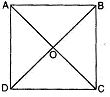
To Prove : (i) AC = BD and (ii) Diagonals bisect each other at right angles.
Proof :
- In {tex}\triangle{/tex}ADB and {tex}\triangle{/tex}BCA, we have
AD = BC ...[As sides of a square are equal]
{tex}\angle{/tex}BAD = {tex}\angle{/tex}ABC ...[All interior angles are of 90o]
AB = BA ...[Common]
{tex}\triangle{/tex}ADB {tex}\cong{/tex} {tex}\triangle{/tex}BCA ...[By SAS rule]
AC = BD ...[c.p.c.t.] - Now in {tex}\triangle{/tex}AOB and {tex}\triangle{/tex}COD, we have
AB = CD ...[Sides of a square]
{tex}\angle{/tex}AOB = {tex}\angle{/tex}COD ...[Vertically opp. angles]
{tex}\angle{/tex}OBA = {tex}\angle{/tex}ODC ...[Alternate interior angles are equal]
{tex}\triangle{/tex}AOB {tex}\cong{/tex} {tex}\triangle{/tex}COD ...[By ASA rule]
OA = OC and OB = OD ...[c.p.c.t.] ...(1)
Now consider {tex}\triangle{/tex}s AOD and COD.
AD = CD ...[Sides of square]
OA = OC ...[As proved above]
OD = OD ...[Common]
{tex}\triangle{/tex}AOD {tex}\cong{/tex} {tex}\triangle{/tex}COD ...[By SSS rule]
{tex}\angle{/tex}AOD = {tex}\angle{/tex}COD ...[c.p.c.t.]
But {tex}\angle{/tex}AOD + {tex}\angle{/tex}COD = 180° ...[linear pair]
or {tex}\angle{/tex}AOD + {tex}\angle{/tex}AOD = 180° ...[As {tex}\angle{/tex}AOD = {tex}\angle{/tex}COD]
or 2{tex}\angle{/tex}AOD = 180° {tex}\therefore{/tex} {tex}\angle{/tex}AOD = 90° ...(2)
From equation (1) and (2) it is clear that diagonals of a square bisect each other at right angles.
Posted by Ajeet Singh 4 years, 4 months ago
- 1 answers
Sia ? 4 years, 4 months ago
To find the area of a rectangle, multiply its height by its width. For a square you only need to find the length of one of the sides (as each side is the same length) and then multiply this by itself to find the area. This is the same as saying length2 or length squared.
Posted by Aarzoo Preet Kaur 4 years, 4 months ago
- 1 answers
Posted by Hamsa J Buddiyavar 4 years, 4 months ago
- 2 answers
Posted by Siya Siya 4 years, 4 months ago
- 2 answers
Sia ? 4 years, 4 months ago
The expression is given to be : 2√3 + √3
We need to simplify this given expression and find the value of this expression.
The expression is : 2√3 + √3
Since, √3 is common factor in both the terms so taking √3 common we have,
⇒ √3 × (2 + 1)
Now using BODMAS rule we will simplify the bracket first
⇒ √3 × 3
⇒ 3√3
The approximate value of √3 correct to three places of decimal is 1.732
So, the value of the given expression is : 3 × 1.732 = 5.196

myCBSEguide
Trusted by 1 Crore+ Students

Test Generator
Create papers online. It's FREE.

CUET Mock Tests
75,000+ questions to practice only on myCBSEguide app

Maneesh R.K 4 years, 4 months ago
0Thank You