
Ask questions which are clear, concise and easy to understand.
Ask QuestionPosted by Mohammad Kaif 2 years, 10 months ago
- 1 answers
Posted by Priyanshi Pandey 2 years, 10 months ago
- 1 answers
Mrunali Salunke 2 years, 10 months ago
Posted by Saransh Kumar 2 years, 10 months ago
- 2 answers
Posted by Monster Gamer 2 years, 10 months ago
- 0 answers
Posted by Ritu Kumari 2 years, 10 months ago
- 0 answers
Posted by Aditya Thombare 2 years, 10 months ago
- 2 answers

Posted by K Mitrajit 2 years, 10 months ago
- 0 answers
Posted by Gamer Boy 2 years, 11 months ago
- 1 answers
Posted by Priyanshu Yadav 2 years, 11 months ago
- 3 answers
Learn With Aastha Pandey ❤️ 2 years, 10 months ago
Posted by Dhanush R 2 years, 10 months ago
- 1 answers
Preeti Dabral 2 years, 10 months ago
Let the radius of base of hemisphere and cone, each be r cm. Let the height of the cone be h cm.
Volume of the cone = {tex}{1\over3}\pi r^2{/tex} hcm3
Volume of the hemisphere = {tex}{2\over3}\pi{/tex}r3 cm3
According to the question, {tex}{1\over3}\pi r^2h={2\over3}\pi r^3{/tex}
{tex}\Rightarrow{/tex} h = 2r
{tex}\Rightarrow{/tex} Height of the cone = 2r cm.
Height of the hemisphere = r cm
{tex}\therefore{/tex} Ratio of their heights = 2r : r = 2 : 1
Posted by Ayesha Saifi 2 years, 11 months ago
- 5 answers
Posted by Manshi Yadav 2 years, 11 months ago
- 1 answers
Vidhya Bhushan 2 years, 10 months ago
Few rules to keep homework help section safe, clean and informative.
- Don't post personal information, mobile numbers and other details.
- Don't use this platform for chatting, social networking and making friends. This platform is meant only for asking subject specific and study related questions.
- Be nice and polite and avoid rude and abusive language. Avoid inappropriate language and attention, vulgar terms and anything sexually suggestive. Avoid harassment and bullying.
- Ask specific question which are clear and concise.
Remember the goal of this website is to share knowledge and learn from each other. Ask questions and help others by answering questions.
Posted by Gulam Mustafa Qadri 2 years, 11 months ago
- 3 answers
Posted by Sai Lekha 2 years, 11 months ago
- 1 answers
Rishu Raj 2 years, 11 months ago
Posted by Prince Sahni 2 years, 11 months ago
- 5 answers
Posted by Nayan Ganesh Kale Kale 2 years, 11 months ago
- 1 answers
Aditya Maurya 2 years, 10 months ago
Posted by Jagan Mann 2 years, 10 months ago
- 1 answers
Preeti Dabral 2 years, 10 months ago
Given: ABCD is a rhombus
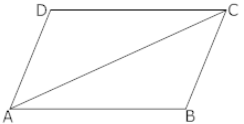
In {tex}\triangle{/tex}ABC and {tex}\triangle{/tex}ADC,
AB = CD [Sides of a rhombus]
BC = DA [Sides of a rhombus]
AC = AC [Common]
{tex}\therefore{/tex} {tex}\triangle{/tex}ABC {tex}\cong{/tex} {tex}\triangle{/tex}ADC [By SSS Congruency]
{tex}\therefore{/tex} {tex}\angle {/tex}CAB = {tex}\angle {/tex}CAD And {tex}\angle {/tex}ACB = {tex}\angle {/tex}ACD
Hence AC bisects {tex}\angle {/tex}A as well as {tex}\angle {/tex}C
Similarly, by joining B to D, we can prove that {tex}\triangle{/tex}ABD {tex}\cong{/tex} {tex}\triangle{/tex}CBD
Hence BD bisects {tex}\angle {/tex}B as well as {tex}\angle {/tex}D
Posted by Nikhil Tekam 9 2 years, 11 months ago
- 2 answers
Posted by Sahil Paul 2 years, 11 months ago
- 1 answers
Posted by Sameer Ray 2 years, 11 months ago
- 1 answers
Posted by Ashish Malik 2 years, 11 months ago
- 1 answers
Posted by Mansi Kalyan 2 years, 11 months ago
- 1 answers
Posted by Ritik Singh 2 years, 11 months ago
- 1 answers
Posted by Rashmi Mirchandani 2 years, 11 months ago
- 3 answers
Aditya Maurya 2 years, 10 months ago
Few rules to keep homework help section safe, clean and informative.
- Don't post personal information, mobile numbers and other details.
- Don't use this platform for chatting, social networking and making friends. This platform is meant only for asking subject specific and study related questions.
- Be nice and polite and avoid rude and abusive language. Avoid inappropriate language and attention, vulgar terms and anything sexually suggestive. Avoid harassment and bullying.
- Ask specific question which are clear and concise.
Remember the goal of this website is to share knowledge and learn from each other. Ask questions and help others by answering questions.
Rashmi Mirchandani 2 years, 10 months ago
Few rules to keep homework help section safe, clean and informative.
- Don't post personal information, mobile numbers and other details.
- Don't use this platform for chatting, social networking and making friends. This platform is meant only for asking subject specific and study related questions.
- Be nice and polite and avoid rude and abusive language. Avoid inappropriate language and attention, vulgar terms and anything sexually suggestive. Avoid harassment and bullying.
- Ask specific question which are clear and concise.
Remember the goal of this website is to share knowledge and learn from each other. Ask questions and help others by answering questions.
Hima Sadeeqi 2 years, 11 months ago
Posted by Sri Varshitha 2 years, 11 months ago
- 5 answers
Ashish Malik 2 years, 11 months ago
Rashmi Mirchandani 2 years, 11 months ago

myCBSEguide
Trusted by 1 Crore+ Students

Test Generator
Create papers online. It's FREE.

CUET Mock Tests
75,000+ questions to practice only on myCBSEguide app

Nasima Praveen 2 years, 10 months ago
0Thank You