
Ask questions which are clear, concise and easy to understand.
Ask QuestionPosted by Harshit Tyagi 6 years, 4 months ago
- 5 answers
Salma Khatun 6 years, 4 months ago
Posted by Ankit Sangwan 6 years, 4 months ago
- 0 answers
Posted by Raksha Mishra 6 years, 4 months ago
- 1 answers
Posted by Srishti Sharma 6 years, 4 months ago
- 1 answers
Sia ? 6 years, 4 months ago
In order to get the result we have to find the HCF of 2002 and 2618. which is given by
2002 = 2 {tex}\times{/tex} 7 {tex}\times{/tex} 11 {tex}\times{/tex} 13 and
2618 = 2 {tex}\times{/tex} 7 {tex}\times{/tex} 11 {tex}\times{/tex} 17
Hence HCF = 2 {tex}\times{/tex} 7 {tex}\times{/tex} 11 = 154
Posted by Raj ? Singh 6 years, 4 months ago
- 0 answers
Posted by Sanju Thrived 6 years, 4 months ago
- 0 answers
Posted by Manoj Gupta 6 years, 4 months ago
- 1 answers
Posted by Priya Seth 6 years, 4 months ago
- 1 answers
Sia ? 6 years, 4 months ago
According to the question, given equation is {tex} 2x + 3y + 15 = 0.{/tex}
So, putting x = 2k - 3 and y = k + 2 in equation, we get
{tex}\Rightarrow{/tex} {tex}2(2k - 3) + 3(k + 2) +15 = 0{/tex}
{tex}\Rightarrow{/tex} {tex}4k - 6+ 3k + 6 + 15 = 0{/tex}
{tex}\Rightarrow{/tex} {tex}7k + 15 = 0{/tex}
{tex} \Rightarrow 7 k=-15 \\ \Rightarrow \ k=-\frac{15}{7}{/tex}
Posted by Saroja Kolkur 6 years, 4 months ago
- 1 answers
Sia ? 6 years, 4 months ago
We need to prove that every line segment has one and only one mid-point. Let us consider the given below line segment AB and assume that C and D are the mid-points of the line segment AB

If C is the mid-point of line segment AB, then
AC = CB.
An axiom of the Euclid says that “If equals are added to equals, the wholes are equal.”
AC + AC = CB + AC....(i)
From the figure, we can conclude that CB + AC will coincide with AB.
An axiom of the Euclid says that “Things which coincide with one another are equal to one another.” AC + AC = AB....(ii)
An axiom of the Euclid says that “Things which are equal to the same thing are equal to one another.”
Let us compare equations (i) and (ii), to get
AC + AC = AB, or 2AC = AB.(iii)
If D is the mid-point of line segment AB, then
AD = DB.
An axiom of the Euclid says that “If equals are added to equals, the wholes are equal.”
AD + AD = DB + AD....(iv)
From the figure, we can conclude that DB + AD will coincide with AB.
An axiom of the Euclid says that “Things which coincide with one another are equal to one another.”
AD + AD = AB....(v)
An axiom of the Euclid says that “Things which are equal to the same thing are equal to one another.”
Let us compare equations (iv) and (v), to get
AD + AD = AB, or
2AD = AB....(vi)
An axiom of the Euclid says that “Things which are equal to the same thing are equal to one another.” Let us compare equations (iii) and (vi), to get
2AC = 2AD.
An axiom of the Euclid says that “Things which are halves of the same things are equal to one another.” AC = AD.
Therefore, we can conclude that the assumption that we made previously is false and a line segment has one and only one mid-point.
Posted by Saroja Kolkur 6 years, 4 months ago
- 1 answers
Sia ? 6 years, 4 months ago

Given, AC = BC
AC + AC = BC + AC . . . . [AC are added to both the side]
2AC = AB . . . . [BC + AC coincides with AB]
{tex}\therefore{/tex} AC = {tex}\frac{1}{2}{/tex}AB
Posted by Dhananjay Singh 6 years, 4 months ago
- 2 answers
Shakti Sarkar 6 years, 4 months ago
Posted by Dhananjay Singh 6 years, 4 months ago
- 1 answers
Sia ? 6 years, 4 months ago
{tex}95 \times 96{/tex}
{tex}95 \times 96{\text{ can also be written as}}\left( {100 - 5} \right)\left( {100 - 4} \right){/tex} We can observe that we can apply the identity {tex}\left( {x + a} \right)\left( {x + b} \right) = {x^2} + \left( {a + b} \right)x + ab{/tex}
Here a = -5 and b = -4
{tex}\left( {100 - 5} \right)\left( {100 - 4} \right) = {\left( {100} \right)^2} + \left[ {\left( { - 5} \right) + \left( { - 4} \right)} \right]\left( {100} \right) + \left( { - 5} \right) \times \left( { - 4} \right){/tex}
{tex}= 10000 - 900 + 20{/tex}
= 9120 Therefore, we conclude that the value of the product {tex}95 \times 96{/tex} is 9120
Posted by शारदा सिंह 6 years, 4 months ago
- 1 answers
Sia ? 6 years, 4 months ago
You can check NCERT Solutions here : https://mycbseguide.com/ncert-solutions.html
Posted by Dhananjay Singh 6 years, 4 months ago
- 0 answers
Posted by Shilpi Kukdeja 6 years, 4 months ago
- 2 answers
Posted by Anshpreet Kaur 6 years, 4 months ago
- 1 answers
Rakesh Kumar 6 years, 4 months ago
Posted by Mayank Sawalkar 6 years, 4 months ago
- 1 answers
Deepak Bisht 6 years, 4 months ago
Posted by Ramkumar Gupta 6 years, 4 months ago
- 0 answers
Posted by Praveen Praveen 6 years, 4 months ago
- 0 answers
Posted by Deepak Kumar Das 6 years, 4 months ago
- 1 answers
Sia ? 6 years, 4 months ago
Given: A ray OA.
Required: To construct an angle of 1350 at O.
Steps of construction :
- Produce AO to A' to form OA'.
- Taking O as centre and some radius, draw an arc of a circle, which intersects OA at a point B and OA' at a point B'.
- Taking B as centre and with the same radius as before, draw an arc intersecting the previously drawn arc at a point C.
- Taking C as centre and with the same radius as before, draw an arc intersecting the arc drawn in step 1, say at D.
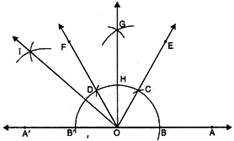
- Draw the ray OE passing through C.
Then {tex}\angle{/tex}EOA = 60o. - Draw the ray OF passing through D.
Then {tex}\angle{/tex}FOE = 60o. - Taking C and D as centres and with the radius more than {tex}1 \over2{/tex}CD, draw arcs to intersect each other, say at G.
- Draw the ray OG intersecting the arc drawn in step 1 at H. This ray OG is the bisector of the angle FOE, i.e. {tex}\angle{/tex}FOG = {tex}\angle{/tex}EOG = {tex}1 \over2{/tex}{tex}\angle{/tex}FOE = {tex}1 \over2{/tex}(60o) = 30o.
Thus {tex}\angle{/tex}GOA = {tex}\angle{/tex}GOE + {tex}\angle{/tex}EOA = 30o + 60o = 90o
{tex}\angle{/tex}B'OH = 90o - Taking B' and H as centres and with the radius more than {tex}1 \over2{/tex}B'H, draw arcs to intersect each other, say at I.
- Draw the ray OI. This ray OI is the bisector of the angle B'OG i.e. {tex}\angle{/tex}B'OI = {tex}\angle{/tex}GOI = {tex}1 \over2{/tex}{tex}\angle{/tex}B'OG = {tex}1 \over2{/tex}(90o) = 45o
{tex}\angle{/tex}IOA = {tex}\angle{/tex}IOG + {tex}\angle{/tex}GOA
= 45o + 90o = 135o
On measuring the {tex}\angle{/tex}IOA by protractor, find that {tex}\angle{/tex}IOA = 135o.
Posted by Ankush Tiwari 6 years, 4 months ago
- 0 answers
Posted by Ankit Goyal 6 years, 4 months ago
- 1 answers
Yogita Ingle 6 years, 4 months ago
(7+ 5 +x+ 8 + 17 + 12)/5 =10
49 + x = 50
X = 50 - 49 = 1
Posted by Sanju Thrived 6 years, 4 months ago
- 1 answers
Yogita Ingle 6 years, 4 months ago
2x2 + px - 14 = 0
Put x = 2
2(2)2 + p(2) - 14 = 0
2 (4) + 2p - 14 = 0
8 + 2p - 14 = 0
2p - 6 = 0
2p = 6
p = 6/2
p = 3
Posted by Anu Mitha 6 years, 4 months ago
- 1 answers
Yogita Ingle 6 years, 4 months ago
{tex}x^6−y^6=(x−y)(x+y)(x^4+y^4+x^2y^2){/tex}
Explanation:
{tex}x^6−y^6{/tex}
<mathjax>={tex}(x^2)^3−(y^2)^3{/tex}</mathjax>
<mathjax>={tex}(x^2−y^2)((x^2)^2+(y^2)^2+(x^2)(y^2)){/tex}</mathjax>
<mathjax>={tex}(x^2−y^2)(x^4+y^4+x^2y^2){/tex}</mathjax>
<mathjax>={tex}(x−y)(x+y)(x^4+y^4+x^2y^2){/tex}</mathjax>
Posted by Khushi Dhakad 6 years, 4 months ago
- 1 answers

myCBSEguide
Trusted by 1 Crore+ Students

Test Generator
Create papers online. It's FREE.

CUET Mock Tests
75,000+ questions to practice only on myCBSEguide app

45516111? 46 6 years, 4 months ago
0Thank You