
Ask questions which are clear, concise and easy to understand.
Ask QuestionPosted by Gurjeet Singh 6 years, 3 months ago
- 3 answers
Posted by Sarthak Yadav 6 years, 3 months ago
- 2 answers
Posted by Rohit Reliano 6 years, 3 months ago
- 1 answers
Posted by Priyanka Rani 6 years, 3 months ago
- 0 answers
Posted by Ratna Verma 6 years, 3 months ago
- 1 answers
Shreya Raj 6 years, 3 months ago
Posted by Firoj Khan 6 years, 3 months ago
- 1 answers
Sia ? 6 years, 3 months ago
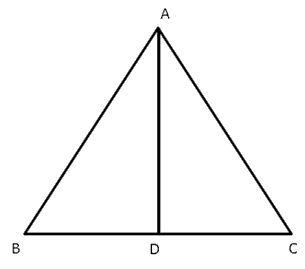
Let {tex}\triangle{/tex}ABC be an equilateral triangle.
We know that in an equilateral triangle the altitude is same as the median.
So, BD=DC=a cm
By Pythagoras theorem,
AC2=AD2+DC2
{tex}\Rightarrow{/tex} AD2=AC2-DC2
{tex}\Rightarrow{/tex} AD2=(2a)2 -a2
{tex}\Rightarrow{/tex} AD2= 4a2 - a2
{tex}\Rightarrow{/tex} AD2=3a2
{tex}\Rightarrow{/tex} AD={tex}\sqrt 3 {/tex} a cm
So, length of the altitude is {tex}\sqrt 3 {/tex} a cm.
Posted by Kashish Kashish 6 years, 3 months ago
- 1 answers
Posted by Samiksha Joshi 6 years, 3 months ago
- 2 answers
Mr Mady 6 years, 3 months ago
Posted by Mohd Asif 6 years, 3 months ago
- 5 answers
Posted by Mohd Asif 6 years, 3 months ago
- 2 answers
Gaurav Seth 6 years, 3 months ago
Let us take 4 rational number between 1/9 and 2/9
So, 4+1=5
1/9 and 2/9
1/9x5/5=5/45
2/9x5/5=10/45
Hence, The rational number between 1/9 and 2/9 are
6/45,7/45,8/45,9/45
OR
Rational number between
Are
Posted by Jitesh Prajapati 6 years, 3 months ago
- 0 answers
Posted by Naveendeep G N 6 years, 3 months ago
- 1 answers
Shreya Raj 6 years, 3 months ago
Posted by Shameema Salam11 6 years, 3 months ago
- 2 answers
Mr Mady 6 years, 3 months ago
Posted by Anshit Tardeja 6 years, 3 months ago
- 2 answers
Posted by Sree Kala 6 years, 3 months ago
- 1 answers
Sia ? 6 years, 3 months ago
)
Given: A quadrilateral ABCD
To prove: The sum of all the sides is greater than the sum of its diagonals.
i.e. AB + BC + CD + DA > AC + BD
Construction: Join AC and BD.
Proof: Since sum of any two sides of a triangle is greater than the third side.
Therefore,
In {tex}\triangle{/tex}ABC
AB + BC > AC ...(i)
In {tex}\triangle{/tex}ACD
AD + DC > AC ...(ii)
In {tex}\triangle{/tex}ABD
AB + AD > BD ...(iii)
and in {tex}\triangle{/tex}BCD
BC + CD > BD ...(iv)
adding (i), (ii), (iii) and (iv) we get
2AD + 2DC + 2AB + 2BC > 2AC + 2BD
{tex}\Rightarrow{/tex} AB + BC + CD + DA > AC + BD
Hence proved.
Posted by Kavita Bhola 6 years, 3 months ago
- 2 answers
Posted by Daksh Tiwari 6 years, 3 months ago
- 2 answers
Posted by Darshika Pandey 6 years, 3 months ago
- 1 answers
Posted by Shameema Salam11 6 years, 3 months ago
- 3 answers
Arti Singh 6 years, 3 months ago
Pankaj Singh 6 years, 3 months ago
Posted by Noorain Warsi 6 years, 3 months ago
- 2 answers
Posted by Thyagraj Javali 6 years, 3 months ago
- 1 answers
Posted by Shashi Raj 6 years, 3 months ago
- 1 answers
Posted by Muskan Agrawal 6 years, 3 months ago
- 0 answers
Posted by Muskan Agrawal 6 years, 3 months ago
- 1 answers
Posted by Amresh Yadav 6 years, 3 months ago
- 3 answers
Posted by Sonia Dhillon 6 years, 3 months ago
- 1 answers
Satyabrat Sahu 6 years, 3 months ago
Posted by Balaraju Goud 6 years, 3 months ago
- 2 answers

myCBSEguide
Trusted by 1 Crore+ Students

Test Generator
Create papers online. It's FREE.

CUET Mock Tests
75,000+ questions to practice only on myCBSEguide app

Rudrani Kumari 6 years, 3 months ago
1Thank You