
Ask questions which are clear, concise and easy to understand.
Ask QuestionPosted by Amit Raj 5 years, 4 months ago
- 2 answers
Posted by Ariba Bano Class 10 5 years, 4 months ago
- 1 answers
Yogita Ingle 5 years, 4 months ago
Given, side of an equilateral triangle is 4√3 cm.
Area of an equilateral triangle = √3/4 (Side)2
= √3/4 (4√3)2 = (√3/4) x 16 x 3
= 3√3 x 4 = 12 x 1.732 = 20.784 cm2
Hence, the area of an equilateral triangle is 20.784 cm2.
Posted by Nishant Kumar 5 years, 4 months ago
- 5 answers
Posted by Muskan Singh 5 years, 4 months ago
- 1 answers
Gaurav Seth 5 years, 3 months ago
Diameter of Copper Sphere = 18 cm
Radius = 9 cm [Radius = Diameter / 2]
Length of cylindrical wire = 108 m or 10800 cm [ 1 m = 100 cm]
Let radius of cylindrical wire be R
Since wire is made by melting the sphere
∴ Volume of Cylindrical wire = Volume of Copper Sphere
[Volume of Cylinder = π × Radius² × height and
Volume of Sphere = (4/3)×π×Radius³]
∴ π × R² × 10800 = (4/3) × π × (9)³
Dividing both sides by π
R² × 10800 = (4/3) × (9)³
Taking Square Root of both sides
R = 0.30 cm
Radius of wire = 0.3 cm or 3 mm
[∵ Diameter = 2×Radius]
∴Diameter of wire = 0.6 cm or 6 mm
Posted by Satyam Kumar 5 years, 4 months ago
- 0 answers
Posted by Satyam Kumar 5 years, 4 months ago
- 2 answers
Gaurav Seth 5 years, 4 months ago
bac = y as they are corresponding angles since ac is parallel to de
then,
cda=90 (as my assumption) cdg+y+25=90
cdg+20+25=90; cdg=45
cdg+20 i mean 45 +20 =65=acd (alternate angles)
x+acd=180 (linear pair)
x+65=180
x=115
Posted by Rajani Naik 5 years, 4 months ago
- 1 answers
Gaurav Seth 5 years, 4 months ago
Draw the graph of the equation represented by the straight line which is parallel to the x-axis and is 4 units above it. Solution : Any straight line parallel to x-axis is given by y = k, where k is the distance of the line from the x-axis. Here k = 4. Therefore, the equation of the line is y = 4. To draw the graph of this equation, plot the points (1, 4) and (2, 4) and join them. This is the required graph
Click the given link:
<a href="https://ncert.nic.in/ncerts/l/ieep204.pdf" ping="/url?sa=t&source=web&rct=j&url=https://ncert.nic.in/ncerts/l/ieep204.pdf&ved=2ahUKEwjniObt45XsAhWTj-YKHQ-zAuwQFjAZegQICxAC" rel="noopener" target="_blank">linear equations in two variables - ncert</a>
Go to page no. 38
and see Sample Question 4
Posted by Santosh Ram 5 years, 4 months ago
- 2 answers
Gaurav Seth 5 years, 4 months ago
|
The length and breadth of a cuboid are in the ratio 4 : 5. The height and total surface area |
|
Answer:
|

Posted by Sourav Singh 5 years, 4 months ago
- 1 answers
Gaurav Seth 5 years, 3 months ago
Here,
1 metric ton = 1000 kg
So, 90 metric ton = 90×103 kg
m = 9×10⁴ kg
h = 200 m
g = 9.8 ms-2
Time taken = 1 hr = 3600 s
The potential energy of a mass m raised to a height h = mgh
Now to raise a mass 9×10⁴ kg to a height 200 m we must do work equal to the potential energy of the mass at 200 m.
Potential energy of mass at 200 m = mgh= 9×104×9.8×200 Joule
So, work done must be = 9×104×9.8×200 Joule
Again we know power P = work done / time taken
P = 9×104×9.8×200/3600 = 49000 watt. or 49 kW
Posted by Tanmay Lende 5 years, 4 months ago
- 1 answers
Gaurav Seth 5 years, 4 months ago
(5a+3b)³ - (5a-3b)³
= (5a)³+3*(5a)²*3b+3*5a*(3b)²+(3b)³- [(5a)³-3*(5a)²*3b+3*5a*(3b)²-(3b)³]
=(5a)³+3*(5a)²*3b+3*5a*(3b)²+(3b)³-(5a)³+3*(5a)²*3b-3*5a*(3b)²+(3b)³
=2*3*(5a)²*3b+2*(3b)³
=450a²b+54b³
Posted by Ankit Raj 5 years, 4 months ago
- 0 answers
Posted by Manish Jevaliya 5 years, 4 months ago
- 0 answers
Posted by Harpreet Kaur 5 years, 4 months ago
- 1 answers
Posted by Shubham Chopra 5 years, 4 months ago
- 0 answers
Posted by Aditya Kumar 5 years, 1 month ago
- 5 answers
Posted by Panu Sahu 5 years, 4 months ago
- 2 answers
Gaurav Seth 5 years, 4 months ago
Radius of circle = 50/2 = 25 cm
perpendicular distance = 24 cm
Therefore, By Pythagoras theorem:
Hypotenuse² = Base² + Perpendicular ²
25² = Base² + 24²
Base² = 625 - 576
Base² = 49
Base = 7
Chord = 2 × Base
Chord = 2 × 7
Answer: 14 cm
Posted by Jashanpreet Singh 5 years, 4 months ago
- 1 answers
Tamanna Yadav 5 years, 4 months ago
Posted by Sujal Tushir 5 years, 4 months ago
- 1 answers
Posted by Mangaiha Zongaihawma 5 years, 4 months ago
- 0 answers
Posted by Krishnan Singh 5 years, 4 months ago
- 0 answers
Posted by Pragati Kesarwani 5 years, 4 months ago
- 5 answers
Posted by Manya Manjunatha 5 years, 4 months ago
- 2 answers
Devashish Kumar 5 years, 4 months ago
Posted by Manthan Patel 5 years, 4 months ago
- 2 answers
Posted by Aliya Irshad 5 years, 4 months ago
- 1 answers
Posted by Arun Jii 5 years, 4 months ago
- 5 answers
Posted by Aryan Raheja 5 years, 4 months ago
- 1 answers
Sakshi Sharma 5 years, 4 months ago
Posted by Kishan Kishan 5 years, 4 months ago
- 4 answers
Posted by Dhanush M 5 years, 4 months ago
- 3 answers
Yogita Ingle 5 years, 4 months ago
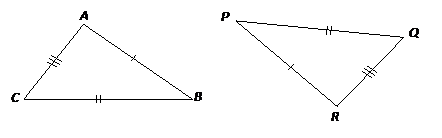
SSS (Side-Side-Side)
If all the three sides of one triangle are equivalent to the corresponding three sides of the second triangle, then the two triangles are said to be congruent by SSS rule.
In the diagrams below, if AB = RP, BC = PQ and CA = QR, then triangle ABC is congruent to triangle RPQ.
M K Tobaiy 5 years, 4 months ago

myCBSEguide
Trusted by 1 Crore+ Students

Test Generator
Create papers online. It's FREE.

CUET Mock Tests
75,000+ questions to practice only on myCBSEguide app

Gaurav Seth 5 years, 4 months ago
(i) Given:
Diameter of the spherical ball (d)= 28 cm
Radius =d/2= 28/2 cm = 14 cm
Amount of water displaced by a solid spherical ball = Volume of spherical ball = 4/3πr³
= (4/3 × 22/7 × 14 × 14 × 14)
= 34496/3 = 11498.67 cm³
Amount of water displaced by a solid spherical ball= 11498.67 cm³
(ii) Diameter of the spherical ball (d)= 0.21 m
Radius (r) = d/2= 0.21/2 m = 0.105 m
Amount of water displaced by a solid spherical ball = Volume of spherical ball= 4/3πr³
=(4/3×22/7×0.105×0.105×0.105)
= 0.004851 m³
Amount of water displaced by a solid spherical ball =0.004851 m³
1Thank You