
Ask questions which are clear, concise and easy to understand.
Ask QuestionPosted by Rani ? 5 years, 4 months ago
- 1 answers
Posted by Krishna Sharma 5 years, 4 months ago
- 1 answers
Posted by Varun Dharne 5 years, 4 months ago
- 2 answers
Aliza Taufiq 5 years, 4 months ago
Gaurav Seth 5 years, 4 months ago
1. The angles of quadrilateral are in the ratio 3 : 5 : 9 : 13. Find all the angles of the quadrilateral.
Solution:
Let the common ratio between the angles be = x.
We know that the sum of the interior angles of the quadrilateral = 360°
Now,
3x+5x+9x+13x = 360°
⇒ 30x = 360°
⇒ x = 12°
, Angles of the quadrilateral are:
3x = 3×12° = 36°
5x = 5×12° = 60°
9x = 9×12° = 108°
13x = 13×12° = 156°
Posted by M U 5 years, 4 months ago
- 4 answers
Posted by M U 5 years, 4 months ago
- 2 answers
Gaurav Seth 5 years, 4 months ago
Let us convert 5/7 and 9/11 into decimal form, to get
5/7 = 0.714285... and 9/1 = 0.818181.... .
Three irrational numbers that lie between 0.714285.... and 0.818181.... are:
0.73073007300073….
0.74074007400074….
0.76076007600076….
Posted by Shreyansh Sutariya 5 years, 4 months ago
- 4 answers
Kashak Jadav 5 years, 4 months ago
M U 5 years, 4 months ago
Posted by Shreyansh Sutariya 5 years, 4 months ago
- 5 answers
Posted by Ayush Singh 5 years, 4 months ago
- 3 answers
Posted by Sanjana Bharti 5 years, 4 months ago
- 2 answers
M U 5 years, 4 months ago
Gaurav Seth 5 years, 4 months ago
Suppose we have two rational numbers a and b, then the irrational numbers between those two will be, √ab. Now let us find two irrational numbers between two given rational numbers.
1. Find an irrational number between two rational numbers 2 – √3 and 5 – √3
Let x be the irrational number between two rational numbers 2 – √3 and 5 – √3. Then we get,
2 – √3 < x < 5 – √3
⇒ 2 < x + < √3 < 5
We see that x + √3 is an irrational number between 2 – √3 and 5 – √3 where 2 – √3 < x < 5 – √3.
2. Find two irrational numbers between two given rational numbers.
Now let us take any two numbers, say a and b. Let x be any number between a and b. Then,
We have a < x < b….. let this be equation (1)
Now, subtract √2 from both the sides of equation (1)
So, a – √2 < x < b – √2……equation (2)
= a < x + √2 < b
Addition of irrational number with any number results into an irrational number. So, x + √2 is an irrational number which exists between two rational numbers a and b.
Posted by Tisha Rajour 5 years, 4 months ago
- 3 answers
M U 5 years, 4 months ago
Yogita Ingle 5 years, 4 months ago
Constant Polynomials : An expression consisting of only constants is called as constant polynomial.
For Example: 7, -27, 3, etc. are some constant polynomials.
Tisha Rajour 5 years, 4 months ago
Posted by Shashank Aryan 5 years, 4 months ago
- 1 answers
Gaurav Seth 5 years, 4 months ago
Question 5. In Fig. 6.32, if AB || CD, ∠ APQ = 50° and ∠ PRD = 127°, find x and y.
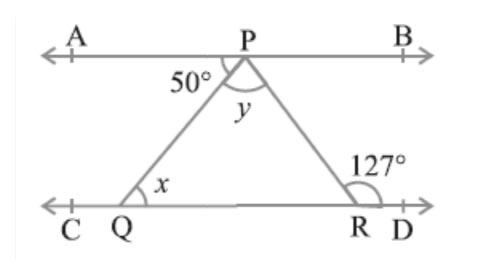
Solution: Use property of Alternate interior angles
∠APR = ∠PRD
50° + y = 127°
y = 127° − 50°
y = 77°
use same property of Alternate interior angles
∠APQ = ∠PQR
50° = x
∠ x = 50° and y = 77°
Posted by Chandn Singh 5 years, 4 months ago
- 3 answers
Agnes Jimmy 5 years, 4 months ago
Posted by Anfal Pananghat 5 years, 4 months ago
- 1 answers
Posted by Abhinandan Dubey 5 years, 4 months ago
- 3 answers
Shubham Singh 5 years, 4 months ago
Gaurav Seth 5 years, 4 months ago
Answer
Bepin Babu said that he spent the Durga Puja of October 1958 in Kanpur and he didn’t go to Ranchi at all.
He went to Kanpur at his friend's Place in October '58'.
Posted by Karuna Mishra 5 years, 4 months ago
- 0 answers
Posted by Ashmit Sharma 5 years, 4 months ago
- 1 answers
Gaurav Seth 5 years, 4 months ago
Answer:
Sides of the triangle are 20 cm, 16 cm, 12 cm
Step-by-step explanation:
Formula used:
If a, b, c are sides of triangle then
s=(a+b+c)/2
Given:
s-a=4 cm
s-b=8 cm
s-c=12 cm
Adding these we get
s+s+s-a-b-c = 24
3s-(a+b+c) =24
3s-2s = 24
s = 24
Now,
s-a=4
24 - a =4
a = 24 - 4 = 20 cm
s-b=8
24 - b = 8
b = 24 - 8 = 16 cm
s - c = 12
24 - c = 12
c = 24 -12 = 12 cm
Posted by Samruddhi Khonde 5 years, 4 months ago
- 5 answers
Aarushi Erande 5 years, 4 months ago
Posted by Vandana Bari 5 years, 4 months ago
- 5 answers
Khushi Sawanliya 5 years, 4 months ago
Abhinandan Dubey 5 years, 4 months ago
Abhinandan Dubey 5 years, 4 months ago
Aarushi Erande 5 years, 4 months ago
Samruddhi Khonde 5 years, 4 months ago
Posted by Vivek Vallyapur 5 years, 4 months ago
- 1 answers
Vivek Vallyapur 5 years, 4 months ago
Posted by Ananya Sharma 5 years, 4 months ago
- 1 answers
Posted by Shravani Walke 5 years, 4 months ago
- 2 answers
Arpit Agnihotri 5 years, 4 months ago
Gaurav Seth 5 years, 4 months ago
A n s w e r:
By Herons formula,
Area of equilateral triangle=√3a²/4
Given,
a= 2cm
Therefore,
Area of the triangle
= (√3a²/4) cm²
= (√3 × 2²/4) cm²
= (4√3 /4) cm²
= √3 cm²
Posted by Himanshi Arora 5 years, 4 months ago
- 0 answers
Posted by Rakibul Shaikh 5 years, 4 months ago
- 0 answers
Posted by Anjali Pathania 5 years, 4 months ago
- 0 answers
Posted by Krishna Chouhan 5 years, 4 months ago
- 2 answers
M U 5 years, 4 months ago
Gaurav Seth 5 years, 4 months ago
The steps of constructions are:

(a) Draw a line PQ and take a point O on it.
(b) Taking O as the centre and convenient radius, mark an arc, which intersects PQ at A and B.
(c) Taking A and B as centres and radius more than half of AB, draw two arcs intersecting each other at R.
(d) Join OR. Thus, ∠QOR = ∠POQ = 90 .
(e) Draw OD the bisector of ∠POR. Thus, ∠QOD is the required angle of 135.
(f) Now, draw OE as the bisector of ∠QOD=1/2 of 135=67.5
Posted by Angel Koddikar 5 years, 4 months ago
- 1 answers
Gaurav Seth 5 years, 4 months ago
AD and BC are equal perpendiculars to a line segment AB (see figure). Show that CD bisects AB.
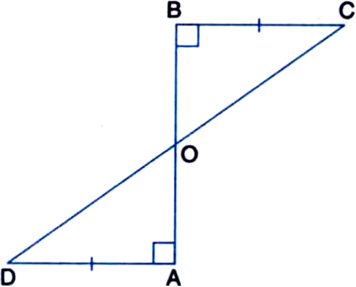
Given: AD and BC are equal perpendiculars to a line segment AB.
To Prove: CD bisects AB.
Proof: In ∆O AD and ∆OBC
AD = BC | Given
∠OAD = ∠OBC | Each = 90°
∠AOD = ∠BOC
| Vertically Opposite Angles
∴ ∠OAD ≅ ∆OBC | AAS Rule
∴ OA = OB | C.P.C.T.
∴ CD bisects AB.

myCBSEguide
Trusted by 1 Crore+ Students

Test Generator
Create papers online. It's FREE.

CUET Mock Tests
75,000+ questions to practice only on myCBSEguide app

Pratibha Kushwah 5 years, 4 months ago
8Thank You