
Ask questions which are clear, concise and easy to understand.
Ask QuestionPosted by Sanjana Venkatesh 5 years, 1 month ago
- 2 answers
Yogita Ingle 5 years, 1 month ago
Given a number 0.2353535…….
We need to prove 0.2353535… = 0.235‾ can be expressed in the form of p/q, where p and q are integers and q ≠zero
Proof:
Let us assume that
x = 0.2353535…
x = 0.235 ——————(i)
On Multiplying both sides by 100 of equation (i) we get,
100x = 100 × 0.2353535…
100x = 23.53535————–(ii)
Subtracting equation (i) from equation (ii) we get,
100x – x = 23.53535 – 0.2353535…
99x = 23.2999965
x = 23.2999965/99
x = 233/990
x = 0.2353535
Hence, x = 0.2353535…= 0.235‾ can be expressed in the form of p/q as 233/ 990 and here q=990 (q≠zero)
Hence proved.
Posted by Hitesh Chandora 5 years, 1 month ago
- 2 answers
Nandini 18 5 years, 1 month ago
Yogita Ingle 5 years, 1 month ago
In triangle PQC and triangle PRC,
Given - QC= PR
PQ=CR
To prove:- angle PCQ= angle CPR
Proof:- In triangle PQCand triangle PRC:-
QC=PR [GIVEN]
PQ=CR [GIVEN]
andPC=PC [COMMON]
by SAS similarly criterion, triangle PQC is congruent to triangle PRC.
therefore by C.P.C.T
angle PCQ =angle CPR
Posted by Gaurav Kumar 5 years, 1 month ago
- 2 answers
Yogita Ingle 5 years, 1 month ago
Non Euclidean Geometry:
All the attempts to prove Euclid’s fifth postulate using the first 4 postulates failed. But they led to the discovery of several other geometries, called non-Euclidean geometries. Now the geometry of the universe we live in has been shown to be a non-Euclidean geometry. In fact, it is called spherical geometry. In spherical geometry, lines are not straight. They are parts of great circles (i.e., circles obtained by the intersection of a sphere and planes passing through the centre of the sphere). As per fist postulate of Euclid, lines AN & BN should not meet, but in the image below, these lines meet at point N. It has been proved that Euclidean geometry is valid only for the figures in the plane. On the curved surfaces, it fails.
Posted by Arun Kushwah 5 years, 1 month ago
- 1 answers
Gaurav Kumar 5 years, 1 month ago
Posted by Arun Kushwah 5 years, 1 month ago
- 1 answers
Yogita Ingle 5 years, 1 month ago
Given: In the isosceles ∆XYZ, XY = XZ.
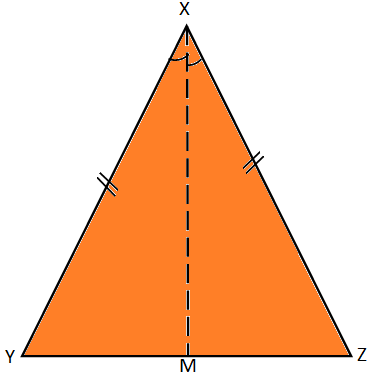
To prove ∠XYZ = ∠XZY.
Construction: Draw a line XM such that it bisects ∠YXZ and meets the side YZ at M.
Proof:
|
Statement 1. In ∆XYM and ∆XZM, (i) XY = XZ (ii) XM = XM (iii) ∠YXM = ∠ZXM
2. ∆XYM ≅ ∆XZM 3. ∠XYZ = ∠XZY. (Proved) |
Reason 1. (i) Given. (ii) Common side. (iii) XM bisects ∠YXZ.
2. By SAS criterion. 3. CPCTC. |
Posted by Arun Kushwah 5 years, 1 month ago
- 2 answers
Yogita Ingle 5 years, 1 month ago

In ΔABE and ΔACF,
∠BAE=∠CAF (Common angle)
∠AEB=∠AFC ....(∵BE⊥AC and CF⊥AB)
BE=CF (Given that altitudes are equal)
By AAS criterion of congruence,
ΔABE≅ΔACF
Hence,
AB=AC (by CPCT)
Posted by Arun Kushwah 5 years, 1 month ago
- 1 answers
Yogita Ingle 5 years, 1 month ago
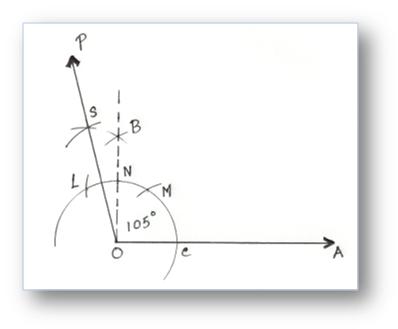
<i>Step of Construction:</i>
(i) After making 90° angle take L and N as centre and draw two arcs cutting each other at S.
(ii) Join SO.
Then, ∠SOA = 105°.
Posted by Arun Kushwah 5 years, 1 month ago
- 1 answers
Yogita Ingle 5 years, 1 month ago
since , AB is a line segment,
L is drawn perpendicular to AB,
A point 'p' lies on line L.
( as shown in the diagram in the attachment )
To prove : P is equidistant from A and B.
Prove :- In ∆AOP and ∆BOP ,
OP = OP ( common side )
POA =
POB
AO = OB
∆AOP
∆BOP (By S.A.S.)
=> AP = BP ( By C.P.C.T. )
Hence , "P" is equidistant from A and B .
Posted by Arun Kushwah 5 years, 1 month ago
- 2 answers
Yogita Ingle 5 years, 1 month ago
In △AOB and △DOC
∠BAO=∠CDO (alternate angles as AB∥CD and BC is the transversal)
∠AOB=∠DOC(vertically opposite angles)
OA=OD(given)
∴△AOB≅△DOC by ASA rule.

Meenkashi Singh 5 years, 1 month ago
Posted by Arun Kushwah 5 years, 1 month ago
- 2 answers
Yogita Ingle 5 years, 1 month ago
In triangle PQC and triangle PRC,
Given - QC= PR
PQ=CR
To prove:- angle PCQ= angle CPR
Proof:- In triangle PQCand triangle PRC:-
QC=PR [GIVEN]
PQ=CR [GIVEN]
andPC=PC [COMMON]
by SAS similarly criterion, triangle PQC is congruent to triangle PRC.
therefore by C.P.C.T
angle PCQ =angle CPR
Meenkashi Singh 5 years, 1 month ago
Posted by Arun Kushwah 5 years, 1 month ago
- 1 answers
Yogita Ingle 5 years, 1 month ago
It is given that ∠BAD=∠EAC
∠BAD+∠DAC=∠EAC+∠DAC [add ∠DAC on both sides]
∴∠BAC=∠DAE
In △BAC and △DAE
AB=AD (Given)
∠BAC=∠DAE (Proved above)
AC=AE (Given)
∴△BAC≅△DAE (By SAS congruence rule)
∴BC=DE (By CPCT)
Posted by Vandana Kapoor 5 years, 1 month ago
- 0 answers
Posted by Riya Kumari 5 years, 1 month ago
- 1 answers
Yogita Ingle 5 years, 1 month ago
Given that:- ABCD is a parallelogram and EFCD is a rectangle.
To prove:- ar(ABCD)=DC×AL
Proof:-
∴AB∥CD.....(1)[∵Opposite sides of parallelogram are equal]
As given that EFCD is a rectangle and we know that rectangle is also a parallelogram.
∴EF∥CD.....(2)
From eqn(1)&(2), we hahve
AB∥EF
Now, ABCD and EFCD are two parallelograms with same base CD and between tha same parallels EB and CD.
As we know that parallelogram with same base and in between same parallels are equal in area.
∴ar(ABCD)=ar(EFCD)
As from the fig.
ar(EFCD)=DC×FC
⇒ar(ABCD)=DC×FC.....(3)
AL⊥CD[Given]
∴AFCL is a also a rectangle.
∴AL=FC.....(4)
From eqn(3)&(4), we get
ar(ABCD)=DC×AL
Hence proved that ar(ABCD)=DC×AL.

Posted by Nisha Murali 5 years, 1 month ago
- 3 answers
Abhay Singh 5 years, 1 month ago
Yogita Ingle 5 years, 1 month ago
Let us rewrite (102)3 as (100+2)3
Now using the identity (a+b)3=a3+b3+3ab(a+b), we get
(100+2)3=1003+23+[(3×100×2)(100+2)]
=1000000+8+(600×102)
=1000000+8+61200
=1061208
Hence, (102)3=1061208
Posted by Arun Kushwah 5 years, 1 month ago
- 2 answers
Yogita Ingle 5 years, 1 month ago
Given: In ΔPQR,
∠R >∠Q
⇒ PQ > PR (side opposite to greater angle is greater)
Hence, B is correct.
Posted by Arun Kushwah 5 years, 1 month ago
- 3 answers
Yogita Ingle 5 years, 1 month ago
Which of the following can be construed using ruler and pair of compasses only (A). 35° (B). 40° (C). 37.5° (D). 47.5°
Ans c
Posted by Arun Kushwah 5 years, 1 month ago
- 2 answers
Yogita Ingle 5 years, 1 month ago
Given E and F are mid point of equal sides AB and AC of triangle ABC
In ΔABF and ΔACE
AB=AC (given )
∠A=∠A (common angle )
AF=AE (halves of equal sides)
∴ΔABF≅ΔACE (SAS rule)
∴BF=CF (CPCT)

Posted by Aryan Maran 5 years, 1 month ago
- 2 answers
Chandana M Patil 5 years, 1 month ago
Posted by Pakhi Saxena 5 years, 1 month ago
- 1 answers
Posted by Vandana Bari 5 years, 1 month ago
- 5 answers
Posted by Ishika Sharma 5 years, 1 month ago
- 5 answers
Posted by Ishika Sharma 5 years, 1 month ago
- 1 answers
Posted by Gcm Tamizhan 5 years, 1 month ago
- 5 answers
Posted by Vikash Singh 5 years, 1 month ago
- 1 answers
Posted by Aditya Satwar 5 years, 1 month ago
- 1 answers
Posted by Likhitha N 5 years, 1 month ago
- 1 answers
Gaurav Seth 5 years, 1 month ago

We can do it by using Pythagoras Theorem.
We can write √10 = √(9 + 1)
=> √10 = √(32 + 1)
Construction
1. Take a line segment AO = 3 unit on the x-axis. (consider 1 unit = 2cm)
2. Draw a perpendicular on O and draw a line OC = 1 unit
3. Now join AC with √10.
4. Take A as center and AC as radius, draw an arc which cuts the x-axis at point E.
5. The line segment AC represents √10 units.

myCBSEguide
Trusted by 1 Crore+ Students

Test Generator
Create papers online. It's FREE.

CUET Mock Tests
75,000+ questions to practice only on myCBSEguide app

Nandini 18 5 years, 1 month ago
0Thank You