
Ask questions which are clear, concise and easy to understand.
Ask QuestionPosted by Anchal Singh 7 years, 1 month ago
- 1 answers
Posted by Koti Korikana 7 years, 1 month ago
- 0 answers
Posted by Sampath Gynapanaver 7 years, 1 month ago
- 3 answers
Posted by Krish Kataria 6 years, 8 months ago
- 1 answers
Sia ? 6 years, 8 months ago
- Perimeter of the semicircle + Diameter of the circle
= {tex}\pi (\frac{2.8}{2}){/tex} cm + 2.8 cm
= {tex}\frac{22}{7} \times{/tex} 1.4 cm + 2.8 cm
= 4.4 cm + 2.8 cm
= 7.2 cm - Perimeter of the 3 sides of rectangle + Perimeter of semicircle
= 2.8 cm + 1.5 cm + 1.5 cm + {tex}\pi (\frac{2.8}{2}){/tex} cm
= 5.8 cm + {tex}\frac{22}{7} \times{/tex} 1.4 cm
= 5.8 cm + 4.4 cm
= 10.2 cm - Perimeter of semicircle + Perimeter of 2 sides of the triangle
= 2 cm + 2 cm + {tex}\pi (\frac{2.8}{2}){/tex} cm
= 4 cm + {tex}\frac{22}{7} \times{/tex} 1.4 cm
= 4 cm + 4.4 cm
= 8.4 cm
Therefore, the ant would have to take a longer round for food pieces (b).
Posted by Lanson Dsouza 7 years, 1 month ago
- 3 answers
Posted by Lanson Dsouza 7 years, 1 month ago
- 0 answers
Posted by Lanson Dsouza 7 years, 1 month ago
- 1 answers
Posted by Tamanna Yasmin 7 years, 1 month ago
- 0 answers
Posted by Vijay Shanker Srivastava 5 years, 11 months ago
- 0 answers
Posted by Sampath Gynapanaver 7 years, 1 month ago
- 3 answers
Posted by Vikash Kumar 7 years, 1 month ago
- 2 answers
Pranav Warninge 7 years, 1 month ago
Posted by Gajjala Kalpana 7 years, 1 month ago
- 3 answers
Posted by Shri Shanmuha Tharshini 7 years, 1 month ago
- 1 answers
Sarthak Narang 7 years, 1 month ago
Posted by Inayat Shaikh 7 years, 1 month ago
- 2 answers
Vardaan Lohia 7 years, 1 month ago
Samaira Khan 7 years, 1 month ago
Posted by Mohammed Sithik Abshal 7 years, 1 month ago
- 1 answers
Sarthak Narang 7 years, 1 month ago
Posted by Golden Darkness 7 years, 1 month ago
- 1 answers
Suneha S 7 years, 1 month ago
Posted by Ramesh N 7 years, 1 month ago
- 1 answers
Ram Kushwah 7 years, 1 month ago
Mensuration is the branch of mathematics which deals with the study of Geometric shapes, their area, volume and related parameters.
Some important mensuration formulas are:
1. Area of rectangle (A) = length(l) × Breath(b)

2. Perimeter of a rectangle (P) = 2 × (Length(l) + Breath(b))

3. Area of a square (A) = Length (l) × Length (l)

4. Perimeter of a square (P) = 4 × Length (l)

5. Area of a parallelogram(A) = Length(l) × Height(h)


6. Perimeter of a parallelogram (P) = 2 × (length(l) + Breadth(b))

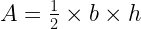
7. Area of a triangle (A) = (Base(b) × Height(b)) / 2

And for a triangle with sides measuring “a” , “b” and “c” , Perimeter = a+b+c
and s = semi perimeter = perimeter / 2 = (a+b+c)/2
And also: Area of triangle =

This formulas is also knows as “Heron’s formula”.
8. Area of triangle(A) =

Where A, B and C are the vertex and angle A , B , C are respective angles of triangles and a , b , c are the respective opposite sides of the angles as shown in figure below:

area of triangle - mensuration
9. Area of isosceles triangle =

Where a = length of two equal side , b= length of base of isosceles triangle.
10. Area of trapezium (A) =

Where “a” and “b” are the length of parallel sides and “h” is the perpendicular distance between “a” and “b” .

11. Perimeter of a trapezium (P) = sum of all sides
12. Area of rhombus (A) = Product of diagonals / 2
13. Perimeter of a rhombus (P) = 4 × l
where l = length of a side
14. Area of quadrilateral (A) = 1/2 × Diagonal × (Sum of offsets)

15. Area of a Kite (A) = 1/2 × product of it’s diagonals
16. Perimeter of a Kite (A) = 2 × Sum on non-adjacent sides
17. Area of a Circle (A) =

Where r = radius of the circle and d = diameter of the circle.
18. Circumference of a Circle =

r= radius of circle
d= diameter of circle
19. Total surface area of cuboid =

where l= length , b=breadth , h=height
20. Total surface area of cuboid =

where l= length
21. length of diagonal of cuboid =

22. length of diagonal of cube =

23. Volume of cuboid = l × b × h
24. Volume of cube = l × l × l
25. Area of base of a cone =

26. Curved surface area of a cone = C =

Where r = radius of base , l = slanting height of cone
27. Total surface area of a cone =

28. Volume of right circular cone =

Where r = radius of base of cone , h= height of the cone (perpendicular to base)
29. Surface area of triangular prism = (P × height) + (2 × area of triangle)
Where p = perimeter of base
30. Surface area of polygonal prism = (Perimeter of base × height ) + (Area of polygonal base × 2)
31. Lateral surface area of prism = Perimeter of base × height
32. Volume of Triangular prism = Area of the triangular base × height
33. Curved surface area of a cylinder =

Where r = radius of base, h = height of cylinder
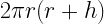
34. Total surface area of a cylinder =
35. Volume of a cylinder =

36. Surface area of sphere =

where r= radius of sphere, d= diameter of sphere
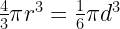
37. Volume of a sphere =
38. Volume of hollow cylinder =

where , R = radius of cylinder , r= radius of hollow , h = height of cylinder
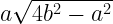
39. Right Square Pyramid:
If a = length of base , b= length of equal side ; of the isosceles triangle forming the slanting face , as shown in figure:

net diagram of right square pyramid
39.a Surface area of a right square pyramid =
39.b Volume of a right square pyramid =

40. Square Pyramid:
40.a. Johnson Pyramid:
<dl id="attachment_6719"> <dt> </dt>
<dd>net diagram of johnson pyramid</dd>
</dl>
</dt>
<dd>net diagram of johnson pyramid</dd>
</dl>
Volume =
Total Surface Area:


40.b. Normal Square pyramid:
If a = length of square base and h = height of the pyramid then:
Volume =
Total Surface Area =


41. Area of a regular hexagon =

42. area of equilateral triangle =

43. Curved surface area of a Frustums =

44. Total surface area of a Frustums =

45. Curved surface area of a Hemisphere =

46. Total surface area of a Hemisphere =

47. Volume of a Hemisphere =

48. Area of sector of a circle =

where 
Posted by Muniraju Raju 7 years, 1 month ago
- 1 answers
Posted by Mia Sis 7 years, 1 month ago
- 0 answers
Posted by Gamer 550 Yadav 7 years, 1 month ago
- 0 answers
Posted by Ashutosh Kushwaha 7 years, 1 month ago
- 2 answers
Posted by Samruddhi Dalavi 7 years, 1 month ago
- 2 answers
#Joel Wilson 7 years, 1 month ago
Posted by Samruddhi Dalavi 7 years, 1 month ago
- 2 answers
Ram Kushwah 7 years, 1 month ago
{tex}\begin{array}{l}x^2+5x+6\\=x^2+3x+2x+6\\=x(x+3)+2(x+3)\\=(x+3)(x+2)\end{array}{/tex}
Posted by Ashwani Pandey 7 years, 1 month ago
- 1 answers
Sarthak Narang 7 years, 1 month ago
Posted by Maya Popondiya 7 years, 1 month ago
- 1 answers
Gamer 550 Yadav 7 years, 1 month ago

myCBSEguide
Trusted by 1 Crore+ Students

Test Generator
Create papers online. It's FREE.

CUET Mock Tests
75,000+ questions to practice only on myCBSEguide app

Mayank Chaudhary 7 years, 1 month ago
0Thank You