
Ask questions which are clear, concise and easy to understand.
Ask QuestionPosted by Tripatjot Kaur 6 years, 8 months ago
- 2 answers
Posted by Aarav Chauhan 6 years, 8 months ago
- 1 answers
Reenu Kumari Reenu Khatri 6 years, 8 months ago
Posted by Aarav Chauhan 6 years, 8 months ago
- 4 answers
Anas Khan 6 years, 7 months ago
Balaji Reddy 6 years, 8 months ago
Posted by Arsh Savaliya 6 years, 8 months ago
- 0 answers
Posted by Pratibha Salunke 6 years, 8 months ago
- 1 answers
Aastha ? 6 years, 8 months ago
Posted by Pratyush Agarwal 6 years, 8 months ago
- 0 answers
Posted by Vinay Dengi 6 years, 8 months ago
- 2 answers
Lokanath Reddy 6 years, 8 months ago
Posted by Vinay Dengi 6 years, 8 months ago
- 1 answers
Renuka Seiwal 6 years, 8 months ago
Posted by Umesh Tummarmatti 6 years, 8 months ago
- 2 answers
Priyamani Priyamani Raja 6 years, 8 months ago
Posted by Kunal Shrinath 6 years, 8 months ago
- 1 answers
Sia ? 6 years, 8 months ago
Britannia has been used in several different senses, but is best known as a national personification of the United Kingdom.
Posted by Ayush Rai 6 years, 8 months ago
- 1 answers
Sia ? 6 years, 8 months ago
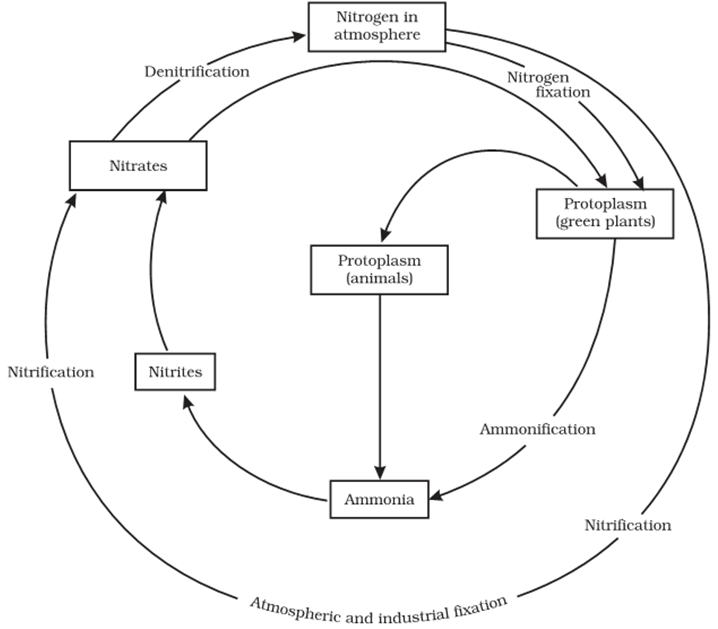
Steps of the Nitrogen cycle:
- Ammonification – The process of conversion of complex organic compounds like proteins into ammonia (NH3) is called ammonification.
- Nitrification – The process of conversion of ammonia into nitrites and nitrates is called nitrification. It occurs in two-steps
- Ammonia {tex}{\xrightarrow[{{\text{Nitrosomonas(Bacteria)}}}]{}}{/tex} Nitrate
- Nitrite {tex}{\xrightarrow[{{\text{Nitrobacter}}}]{}}{/tex} Nitrate
- Denitrification – The process of conversion of nitrate salts in the soil and water to free nitrogen gas. This is done by bacteria pseudomonas.
Posted by Ayush Rai 6 years, 8 months ago
- 1 answers
Sia ? 6 years, 8 months ago
Nitrogen fixation is a process by which nitrogen in the air is converted into ammonia or related nitrogenous compounds.
Posted by Shantanu Prasad 6 years, 8 months ago
- 1 answers
Posted by Aman Maurya 6 years, 8 months ago
- 1 answers
Sia ? 6 years, 8 months ago
The metallic minerals are subclassified as :
- ferrous (iron, manganese, nickel, and cobalt)
- nonferrous (copper, zinc, lead, tin, and bauxite),
- precious (gold, silver, and platinum).
Posted by Vinay Dengi 6 years, 8 months ago
- 3 answers
Sia ? 6 years, 8 months ago
If an Indian ruler died without a male heir his kingdom would become the part of company territory.
Lokanath Reddy 6 years, 8 months ago
Posted by Vinay Dengi 6 years, 8 months ago
- 1 answers
Aman Maurya 6 years, 8 months ago
Posted by Vinay Dengi 6 years, 8 months ago
- 1 answers
Sia ? 6 years, 8 months ago
In May 1857, the East India Company faced a massive rebellion that threatened the company’s very presence in India. Sepoy’s mutinied in several places beginning from Meerut and people from different sections of society rose up in rebellion.
Posted by Ajinkya Pawar 6 years, 8 months ago
- 1 answers
Yogita Ingle 6 years, 7 months ago
|
Conventional Sources |
Non-conventional Sources |
|
Conventional sources of energy (e.g. coal, petroleum and natural gas) are non-renewable sources of energy. |
Non-conventional sources of energy (e.g. solar and wind energy) are renewable sources of energy. |
|
They have been in use since a long time. For example, firewood and coal have been in use since a long time. |
These sources have recently developed and are still developing. For example, the technology of producing electricity from solar panels has recently developed. |
|
Most of these energy sources (e.g. coal and firewood) cause pollution when used. |
They do not cause any pollution (e.g. solar energy, geothermal energy etc.) |
|
They are common and widely used sources (e.g. thermal power). |
They are comparatively new sources of energy and hence are not widely used. For example, solar panels and wind mills are not widely used. |
Posted by Hitesh Kumar 6 years, 8 months ago
- 0 answers
Posted by Ipsita Mohanty 6 years, 8 months ago
- 5 answers
Posted by Neyma Mallick 6 years, 8 months ago
- 1 answers
Sia ? 6 years, 8 months ago
Following are the objectives of the Constitution given in the Preamble:
- Justice-Social, political and economic.
- Liberty of thought, expression, belief, faith, and worship.
- Equality of status and opportunity.
- Fraternity assuring the dignity of the individual and the unity of the nation.
Posted by Shubh Kushwaha 6 years, 8 months ago
- 3 answers
Posted by Harsh Lokhande 6 years, 8 months ago
- 1 answers
Yogita Ingle 6 years, 7 months ago
Chandragupta II was Son of Samudragupta and his queen Dattadevi. Chandragupta II was also known as ‘Vikramaditya’.
Posted by Harsh Lokhande 6 years, 8 months ago
- 0 answers
Posted by Akash Dvrma 6 years, 8 months ago
- 5 answers
Prinshu Patel 6 years, 8 months ago
Yogita Ingle 6 years, 8 months ago
Sound can not travel through vacuum. Sound requires a medium to travel. This medium can be solid, liquid or gas.
Posted by Mudit Tiwari 6 years, 8 months ago
- 2 answers
Posted by Sarvesh Kumar 6 years, 8 months ago
- 1 answers
Posted by Vishakha Singh 6 years, 8 months ago
- 0 answers

myCBSEguide
Trusted by 1 Crore+ Students

Test Generator
Create papers online. It's FREE.

CUET Mock Tests
75,000+ questions to practice only on myCBSEguide app

Yogita Ingle 6 years, 8 months ago
All organisms are made up of cells. The way a building is made up of bricks, an organism is made up of cells. Many cells group together to make a tissue, many tissues come together to make an organ, many organs come together to make an organ system and many organ systems make an organism. Thus, it is clear that cells are the basic structural units of living organisms.
1Thank You