
Ask questions which are clear, concise and easy to understand.
Ask QuestionPosted by Ayush Rai 6 years, 8 months ago
- 1 answers
Posted by Ayush Rai 6 years, 8 months ago
- 1 answers
Sia ? 6 years, 8 months ago
Nitrogen fixation is a process by which nitrogen in the air is converted into ammonia or related nitrogenous compounds.
Posted by Ajinkya Pawar 6 years, 8 months ago
- 1 answers
Yogita Ingle 6 years, 7 months ago
|
Conventional Sources |
Non-conventional Sources |
|
Conventional sources of energy (e.g. coal, petroleum and natural gas) are non-renewable sources of energy. |
Non-conventional sources of energy (e.g. solar and wind energy) are renewable sources of energy. |
|
They have been in use since a long time. For example, firewood and coal have been in use since a long time. |
These sources have recently developed and are still developing. For example, the technology of producing electricity from solar panels has recently developed. |
|
Most of these energy sources (e.g. coal and firewood) cause pollution when used. |
They do not cause any pollution (e.g. solar energy, geothermal energy etc.) |
|
They are common and widely used sources (e.g. thermal power). |
They are comparatively new sources of energy and hence are not widely used. For example, solar panels and wind mills are not widely used. |
Posted by Ipsita Mohanty 6 years, 8 months ago
- 5 answers
Posted by Akash Dvrma 6 years, 8 months ago
- 5 answers
Prinshu Patel 6 years, 8 months ago
Yogita Ingle 6 years, 8 months ago
Sound can not travel through vacuum. Sound requires a medium to travel. This medium can be solid, liquid or gas.
Posted by Mudit Tiwari 6 years, 8 months ago
- 2 answers
Posted by Ritesh Pandey 6 years, 8 months ago
- 2 answers
Aastha ? 6 years, 8 months ago
Posted by Anshika Verma 6 years, 8 months ago
- 1 answers
Sia ? 6 years, 8 months ago
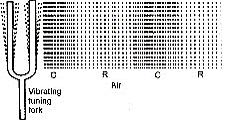
Air is the commonest material through which sound propagates. When a vibrating object, like prongs of tuning fork, move forward, they push the molecules of the air in front of them. This is turn compresses the air, thus creating a region of high pressure and high density called compression. This compression in the air travels forward. When the prongs of the tuning fork move backward, they create a region of low pressure in the air, commonly called rarefaction. This region has low-pressure low density and more volume. As the tuning fork continues to vibrate, the regions of compression in the air alternate with the regions of rarefaction. These regions alternate at the same place. The energy of vibrating tuning fork travels outward. This energy which reaches the ears makes the eardrums to vibrate and thus we hear the sound.
Posted by Jadav Hardeep Jadav 6 years, 8 months ago
- 3 answers
Posted by Jadav Hardeep Jadav 6 years, 8 months ago
- 5 answers
Posted by Jadav Hardeep Jadav 6 years, 8 months ago
- 0 answers
Posted by Asha Bhati 6 years, 8 months ago
- 2 answers
Niharika Kandari 6 years, 8 months ago
Yogita Ingle 6 years, 8 months ago
The biotic factors are referred to the living components of an ecosystem .Their presence or their materials affect the composition of an ecosystem. These materials include all living organisms, like animals, humans, plants, fungi, and bacteria All the interactions will make the difference in survival and reproduction of each species.
Biotic Examples
All living components of an ecosystem, including the producers, consumers, and decomposers or detritivores are considered as the biotic examples.
Posted by Aman Maurya 6 years, 8 months ago
- 1 answers
Yogita Ingle 6 years, 8 months ago
Hydrogen is the lightest element in the periodic table. Its atomic number is 1. It was discovered by Henry Cavendish in the 18th century.
Posted by Shivam Kumar 6 years, 8 months ago
- 4 answers
Posted by Khushboo Kurrey 6 years, 8 months ago
- 1 answers
Yogita Ingle 6 years, 8 months ago
Types of Viruses In Biology
Based on the type of host, three types of viruses have been identified:
- Animal viruses: These viruses infect by invading the cells of animals, including humans. Prominent examples of animal viruses include the influenza virus, mumps virus, rabies virus, poliovirus etc.
- Plant viruses: These viruses infect plants by invading the plant cells. Well-known examples of plant virus include potato virus, tobacco mosaic virus, beet yellow virus and turnip yellow virus etc.
- Bacteriophage: The virus which infects bacterial cells is known as bacteriophage. There are many varieties of bacteriophages, such as DNA virus, RNA virus, etc.
Posted by Bhumi Jain 6 years, 8 months ago
- 0 answers
Posted by Madan Reddiar 6 years, 8 months ago
- 1 answers
Posted by Khilander Kumar 6 years, 8 months ago
- 2 answers
Yogita Ingle 6 years, 8 months ago
| Traditional Method | Seed drill |
| Sowing mostly with the help of human hands. | Seed drill is used for sowing with the help of tractors. |
| May not be sown uniformly at a proper distance and depth. | This tool sows the seeds uniformly at a proper distance and depth. |
| Cheaper Method | Costly Method |
| Slow Process | Quick Process |
Nainika Chugh 6 years, 8 months ago
Posted by Krishna Rai 6 years, 8 months ago
- 3 answers
Sia ? 6 years, 8 months ago
Alcohol is a colourless volatile flammable liquid which is produced by the natural fermentation of sugars.
Niharika Kandari 6 years, 8 months ago
Aarshi Lodh 6 years, 8 months ago
Posted by Vardhmaan Ratan Bhardwaj 6 years, 8 months ago
- 1 answers
Sia ? 6 years, 8 months ago
Sound is produced due to vibration. The vibration makes the air around vibrate and the air vibrations enter the ear. When an object vibrates, it disturbs the air around it. The molecules of air in contact with vibrating objects also start to vibrate. The vibrating air molecules in turn, make more air, it makes a long chain of sound waves. Sound waves travel in all direction through a material medium like air, water or solids, called propagation of sound. Sound cannot travel in absence of medium because in empty space there is no molecules which help the sound to travel.
Posted by Abhijeet Deshmukh 6 years, 8 months ago
- 1 answers
Sia ? 6 years, 8 months ago
The atomic number of chlorine is 17. The electronic configuration is 2, 8, 7.
So the number of valence electrons for chlorine is 7 and it needs 1 more electron to complete its octet (8 electrons in its outermost shell).
Therefore, its valency is one (8 - 7).
Posted by Sai Harshavardhan 6 years, 8 months ago
- 1 answers
Kalyani Jaybhaye 6 years, 7 months ago
Posted by Jonathan Christopher 6 years, 8 months ago
- 1 answers
Meghna Thapar 6 years, 1 month ago
Lactobacillus bacterium present in milk promotes the formation of curd. It multiplies in milk and converts it into curd. Bacteria are also involved in the making of cheese, pickles and many other food items.
Posted by Nikita Maurya 6 years, 8 months ago
- 1 answers
Sia ? 6 years, 8 months ago
Brownian motion is the random motion of particles suspended in a fluid resulting from their collision with the fast-moving molecules in the fluid.
Posted by Anu Panda 6 years, 8 months ago
- 2 answers
Yogita Ingle 6 years, 8 months ago
Advantages of preparation of soil
(i) Loose soil has a lot of air trapped in it, which is used by the roots to breathe easily.
(ii) Loose soil helps the growth of earthworms and microbes in the soil. They provide nutrients to the soil and aid in further loosening of the soil.
(iii) Turning and loosening of soil brings nutrient-rich soil to the top. Plants can then absorb these nutrients more efficiently. The process of loosening and turning the soil is called tilling or ploughing. It is carried out by using a wooden or iron plough which is pulled either by animals or by tractor.
Rahul Bohara 6 years, 8 months ago
Posted by Betting Neeraj 6 years, 8 months ago
- 0 answers
Posted by Vandana Patel 6 years, 8 months ago
- 1 answers
Meghna Thapar 5 years, 9 months ago
Atmospheric levels of carbon dioxide—the most dangerous and prevalent greenhouse gas—are at the highest levels ever recorded. Greenhouse gas levels are so high primarily because humans have released them into the air by burning fossil fuels. For more than a century air pollution has affected agriculture. Burning coal and petroleum produce sulfur oxides. Fluorides result from smelting and glass and ceramic manufacture. Damage to crops by air pollution, of course, brings economic loss as well.
Posted by Vishnu Verma 6 years, 8 months ago
- 1 answers
Posted by Jakkuva Mahesh Mahesh 6 years, 8 months ago
- 1 answers
Yogita Ingle 6 years, 8 months ago
Loudness of sound is proportional to the square of the amplitude of vibrations producing the sound. For example, if the amplitude becomes twice the loudness increases by a factor of 4.
Posted by Nisha Tomar 6 years, 8 months ago
- 1 answers
Sia ? 6 years, 8 months ago
Flora is the plant life occurring in a particular region or time, generally the naturally occurring or indigenous—native plant life.

myCBSEguide
Trusted by 1 Crore+ Students

Test Generator
Create papers online. It's FREE.

CUET Mock Tests
75,000+ questions to practice only on myCBSEguide app

Sia ? 6 years, 8 months ago
Steps of the Nitrogen cycle:
2Thank You