
Ask questions which are clear, concise and easy to understand.
Ask QuestionPosted by M Anju Naidus M 4 years, 9 months ago
- 2 answers
Posted by Chanpreet Kaur 4 years, 9 months ago
- 0 answers
Posted by Bharati Das 4 years, 9 months ago
- 5 answers
Posted by Yogesh Yogesh 4 years, 9 months ago
- 4 answers
Aboli Kadu 4 years, 9 months ago
Posted by Smarth Surya 4 years, 9 months ago
- 3 answers
Posted by Adwita Abilash 4 years, 9 months ago
- 2 answers
Posted by Nandan Kerai 4 years, 9 months ago
- 3 answers
Deekshu ? 4 years, 9 months ago
Deekshu ? 4 years, 9 months ago
Posted by D S 4 years, 9 months ago
- 0 answers
Posted by Spm Msv 4 years, 9 months ago
- 1 answers
Preeti Dabral 4 years, 9 months ago
Let ABCD is a convex quadrilateral, then we draw a diagonal AC which divides the quadrilateral in two triangles.
{tex}\angle \mathrm{A}+\mathrm{B}+\angle \mathrm{C}+\angle \mathrm{D}{/tex}
= {tex}\angle 1+\angle 6+\angle 5+\angle 4+\angle 3+\angle 2{/tex}
= {tex}(\angle 1+\angle 2+\angle 3)+(\angle 4+\angle 5+\angle 6){/tex}
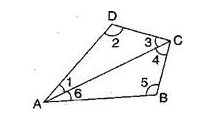
= {tex}180^{\circ}+180^{\circ}{/tex} [By Angle sum property of triangle]
= {tex}360^{\circ}{/tex}
Hence, the sum of measures of the triangles of a convex quadrilateral is {tex}360^{\circ}{/tex}.
Yes, if quadrilateral is not convex then, this property will also be applied.
Posted by Ankit Verma 4 years, 9 months ago
- 1 answers
Preeti Dabral 4 years, 9 months ago
Let the number to be divided be x
According to question
{tex}\left( { - \frac{{33}}{{16}}} \right) \div x = - \frac{{11}}{4}{/tex}
{tex}x=\;\left(-\frac{33}{16}\right)\div\left(-\frac{11}4\right)=\left(-\frac{33}{16}\right)\times\left(-\frac4{11}\right){/tex}
{tex}x = \frac{3}{4}{/tex}
Posted by Sana Verma 4 years, 9 months ago
- 2 answers
Tejas Kumar 4 years, 9 months ago
Ankit Verma 4 years, 9 months ago
Posted by Vishwam Pareek 4 years, 9 months ago
- 0 answers
Posted by Harsh Vardhan 4 years, 9 months ago
- 5 answers
Preeti Dabral 4 years, 9 months ago
Rearrange terms
?=30+7?
?=7?+30
Subtract 7? from both sides of the equation
?=7?+30
?−7?=7?+30−7?
−6?=30
x-=-5
Posted by 😇 Krishna😇 God Of Destruction 4 years, 9 months ago
- 3 answers
Posted by Meenal Kakadwar 4 years, 9 months ago
- 1 answers
Preeti Dabral 4 years, 9 months ago
Boy cover distance in 2 1/2 hours
he covers by foot = 5km/hr
In 1 hour he complete 5km
he covers distance by bicycle = 10km /hr
In 1 hour he complete = 10 km
total distance 20 km
x/5 + (20-x ) /10 = 5/2
x +20 =25
x = 25-20
x = 5
Hence, the distance covered by foot is 5 km
Posted by Tahrim Fatima 4 years, 9 months ago
- 2 answers
Preeti Dabral 4 years, 9 months ago
See, if all 18 birds together make 1nest in 1 day like same way they all will make per day 1nest then 18 birds will make 18 nest in 18 days . Therefore for 1 bird it will take 18 days.
Posted by Dilshad Khatri 4 years, 9 months ago
- 0 answers
Posted by Lokesh Raikwar 4 years, 9 months ago
- 5 answers
Preeti Dabral 4 years, 9 months ago
Multiply 2/3 with reciprocal of 3/5
2/3 multiplied by 5/3
2/3 *5/3=10/15
So simplify it
10/15=2/3( using 5 table)
Therefore answer =2/3
Posted by Sanjana Sanjana 4 years, 9 months ago
- 0 answers
Posted by Pankaj Kumar 4 years, 9 months ago
- 2 answers
Preeti Dabral 4 years, 9 months ago
Zero's origins most likely date back to the “fertile crescent” of ancient Mesopotamia. Sumerian scribes used spaces to denote absences in number columns as early as 4,000 years ago, but the first recorded use of a zero-like symbol dates to sometime around the third century B.C. in ancient Babylon.
Deekshu ? 4 years, 9 months ago
Posted by Kanugula Karthikeya 4 years, 9 months ago
- 0 answers
Posted by Adithiyakrishnan S 4 years, 9 months ago
- 2 answers
Anjali Yadav 4 years, 9 months ago
Akshra Khokhar 4 years, 9 months ago
Posted by Bhuvaneshwari.R Bhuvaneshwari.R 4 years, 9 months ago
- 1 answers
Posted by Praseeda Jaya Prakash 4 years, 9 months ago
- 0 answers
Posted by Rayna Khurana 4 years, 9 months ago
- 1 answers
Preeti Dabral 4 years, 9 months ago
There are all 10 outcomes of the event. Getting a number less than 6 has five outcomes as there are five numbers (1, 2, 3, 4, and 5 ) less than 6.
So the probability of getting a number less than {tex}6 = \frac{5}{{10}} = \frac{1}{2}{/tex}

myCBSEguide
Trusted by 1 Crore+ Students

Test Generator
Create papers online. It's FREE.

CUET Mock Tests
75,000+ questions to practice only on myCBSEguide app

Anjali Yadav 4 years, 9 months ago
1Thank You