
Ask questions which are clear, concise and easy to understand.
Ask QuestionPosted by Sonam Agrawal 7 years, 1 month ago
- 0 answers
Posted by Shashank Panwar 7 years, 1 month ago
- 4 answers
R.P Qureshi 7 years, 1 month ago
Yogita Ingle 7 years, 1 month ago
- A quadrilateral is a four sides Polygon. It has four angles .
- Sum of angles of the Quadrilaterals =3600
- Sum of exterior angles of the Quadrilaterals =3600
Posted by Bhawani Singh 7 years, 1 month ago
- 1 answers
Posted by Ashwini Choudhary 7 years, 1 month ago
- 2 answers
Pratibha Singh 7 years, 1 month ago
Sahana V B 7 years, 1 month ago
Posted by Anurag Kumar 7 years, 1 month ago
- 1 answers
Posted by Rohit Sable 7 years, 1 month ago
- 1 answers
Posted by Dayaraj Aheibam 6 years, 5 months ago
- 1 answers
Sia ? 6 years, 5 months ago
Let the number of sugar crystals in 5 kg of sugar be x.
The given information in the form of a table is as follows.
|
Amount of sugar (in kg) |
2 |
5 |
|
Number of crystals |
9 × 10⁶ |
x |
The amount of sugar and the number of crystals it contains are directly proportional to each other. Therefore, we obtain
{tex}\frac{2}{{9 \times {{10}^6}}} = \frac{5}{x}{/tex}
{tex}x = \frac{{5 \times 9 \times {{10}^6}}}{2} = 2.25 \times {10^7}{/tex}
Hence, the number of sugar crystals is 2.25 × 10⁷.
Posted by Vasanth Kumar 7 years, 1 month ago
- 1 answers
Anu S 7 years, 1 month ago
Posted by Vasanth Kumar 7 years, 1 month ago
- 2 answers
Kiti Sharma 7 years, 1 month ago
Posted by Rishi Rb 7 years, 1 month ago
- 3 answers
Posted by Yash Satpute 7 years, 1 month ago
- 0 answers
Posted by Ravneet Dhanda 7 years, 1 month ago
- 0 answers
Posted by Sanjana Sanju 7 years, 1 month ago
- 1 answers
Kiti Sharma 7 years, 1 month ago
Posted by Ayush Gupta 7 years, 1 month ago
- 3 answers
Vasanth Kumar 7 years, 1 month ago
Gauri Patil 7 years, 1 month ago
Posted by Mayank Singh 7 years, 1 month ago
- 0 answers
Posted by Adithya Prasanth 7 years, 1 month ago
- 2 answers
Ayush Gupta 7 years, 1 month ago
Posted by Abhijit And Abhiraj Dash 7 years, 1 month ago
- 0 answers
Posted by Sweety Vaswani 7 years, 1 month ago
- 3 answers
Posted by Shubhi Rajoliya 7 years, 1 month ago
- 0 answers
Posted by Vipul Tirpude 5 years, 8 months ago
- 0 answers
Posted by Sanaur Rehman 7 years, 1 month ago
- 2 answers
Posted by Chakshu Ranka 7 years, 1 month ago
- 0 answers
Posted by Sonal Singh 7 years, 1 month ago
- 1 answers
Posted by Nidhiya Naseer S 7 years, 1 month ago
- 0 answers
Posted by Basanti Devi 7 years, 1 month ago
- 2 answers
Posted by Sakshi Singh 6 years, 5 months ago
- 1 answers
Posted by Krishna Tiwari 7 years, 1 month ago
- 1 answers
Joshua Joseph 7 years, 1 month ago
Posted by Krishna Tiwari 6 years, 5 months ago
- 1 answers
Sia ? 6 years, 5 months ago
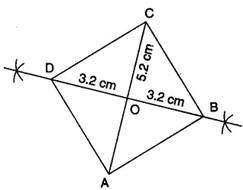
Steps of construction.
- Draw AC = 5.2 cm.
- Construct its perpendicular bisector. Let them meet at O.
- Cut off {tex}\frac{{6.4}}{2} = 3.2cm{/tex} lengths on either side of the drawn bisector, we get B and D.
- Join AB, BC, CD and DA.
Then, ABCD is the required rectangle.
Posted by Ritwik Sinha 7 years, 1 month ago
- 0 answers
Posted by Piyush Borude 7 years, 1 month ago
- 0 answers

myCBSEguide
Trusted by 1 Crore+ Students

Test Generator
Create papers online. It's FREE.

CUET Mock Tests
75,000+ questions to practice only on myCBSEguide app
