
Ask questions which are clear, concise and easy to understand.
Ask QuestionPosted by Reshmi Mani 7 years, 1 month ago
- 2 answers
Utkarsh Kumar 7 years, 1 month ago
Posted by Bhuwan Durgapal 7 years, 1 month ago
- 1 answers
Posted by Varunroy Varun 7 years, 1 month ago
- 4 answers
Posted by Pinki Datta 7 years, 1 month ago
- 0 answers
Posted by Harshit Panjwani 7 years, 1 month ago
- 1 answers
Abhay Chhillar 7 years, 1 month ago
Posted by Hema Oraon 7 years, 1 month ago
- 0 answers
Posted by Krish Kataria 6 years, 8 months ago
- 1 answers
Sia ? 6 years, 8 months ago
- Perimeter of the semicircle + Diameter of the circle
= {tex}\pi (\frac{2.8}{2}){/tex} cm + 2.8 cm
= {tex}\frac{22}{7} \times{/tex} 1.4 cm + 2.8 cm
= 4.4 cm + 2.8 cm
= 7.2 cm - Perimeter of the 3 sides of rectangle + Perimeter of semicircle
= 2.8 cm + 1.5 cm + 1.5 cm + {tex}\pi (\frac{2.8}{2}){/tex} cm
= 5.8 cm + {tex}\frac{22}{7} \times{/tex} 1.4 cm
= 5.8 cm + 4.4 cm
= 10.2 cm - Perimeter of semicircle + Perimeter of 2 sides of the triangle
= 2 cm + 2 cm + {tex}\pi (\frac{2.8}{2}){/tex} cm
= 4 cm + {tex}\frac{22}{7} \times{/tex} 1.4 cm
= 4 cm + 4.4 cm
= 8.4 cm
Therefore, the ant would have to take a longer round for food pieces (b).
Posted by Tamanna Yasmin 7 years, 1 month ago
- 0 answers
Posted by Ramesh N 7 years, 1 month ago
- 1 answers
Ram Kushwah 7 years, 1 month ago
Mensuration is the branch of mathematics which deals with the study of Geometric shapes, their area, volume and related parameters.
Some important mensuration formulas are:
1. Area of rectangle (A) = length(l) × Breath(b)

2. Perimeter of a rectangle (P) = 2 × (Length(l) + Breath(b))

3. Area of a square (A) = Length (l) × Length (l)

4. Perimeter of a square (P) = 4 × Length (l)

5. Area of a parallelogram(A) = Length(l) × Height(h)


6. Perimeter of a parallelogram (P) = 2 × (length(l) + Breadth(b))

7. Area of a triangle (A) = (Base(b) × Height(b)) / 2
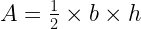

And for a triangle with sides measuring “a” , “b” and “c” , Perimeter = a+b+c
and s = semi perimeter = perimeter / 2 = (a+b+c)/2
And also: Area of triangle =

This formulas is also knows as “Heron’s formula”.
8. Area of triangle(A) =

Where A, B and C are the vertex and angle A , B , C are respective angles of triangles and a , b , c are the respective opposite sides of the angles as shown in figure below:

area of triangle - mensuration
9. Area of isosceles triangle =

Where a = length of two equal side , b= length of base of isosceles triangle.
10. Area of trapezium (A) =

Where “a” and “b” are the length of parallel sides and “h” is the perpendicular distance between “a” and “b” .

11. Perimeter of a trapezium (P) = sum of all sides
12. Area of rhombus (A) = Product of diagonals / 2
13. Perimeter of a rhombus (P) = 4 × l
where l = length of a side
14. Area of quadrilateral (A) = 1/2 × Diagonal × (Sum of offsets)

15. Area of a Kite (A) = 1/2 × product of it’s diagonals
16. Perimeter of a Kite (A) = 2 × Sum on non-adjacent sides
17. Area of a Circle (A) =

Where r = radius of the circle and d = diameter of the circle.
18. Circumference of a Circle =

r= radius of circle
d= diameter of circle
19. Total surface area of cuboid =

where l= length , b=breadth , h=height
20. Total surface area of cuboid =

where l= length
21. length of diagonal of cuboid =

22. length of diagonal of cube =

23. Volume of cuboid = l × b × h
24. Volume of cube = l × l × l
25. Area of base of a cone =

26. Curved surface area of a cone = C =

Where r = radius of base , l = slanting height of cone
27. Total surface area of a cone =

28. Volume of right circular cone =

Where r = radius of base of cone , h= height of the cone (perpendicular to base)
29. Surface area of triangular prism = (P × height) + (2 × area of triangle)
Where p = perimeter of base
30. Surface area of polygonal prism = (Perimeter of base × height ) + (Area of polygonal base × 2)
31. Lateral surface area of prism = Perimeter of base × height
32. Volume of Triangular prism = Area of the triangular base × height
33. Curved surface area of a cylinder =

Where r = radius of base, h = height of cylinder
34. Total surface area of a cylinder =
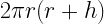
35. Volume of a cylinder =

36. Surface area of sphere =

where r= radius of sphere, d= diameter of sphere
37. Volume of a sphere =
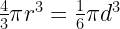
38. Volume of hollow cylinder =

where , R = radius of cylinder , r= radius of hollow , h = height of cylinder
39. Right Square Pyramid:
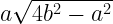
If a = length of base , b= length of equal side ; of the isosceles triangle forming the slanting face , as shown in figure:

net diagram of right square pyramid
39.a Surface area of a right square pyramid =
39.b Volume of a right square pyramid =

40. Square Pyramid:
40.a. Johnson Pyramid:
<dl id="attachment_6719"> <dt> </dt>
<dd>net diagram of johnson pyramid</dd>
</dl>
</dt>
<dd>net diagram of johnson pyramid</dd>
</dl>
Volume =
Total Surface Area:


40.b. Normal Square pyramid:
If a = length of square base and h = height of the pyramid then:
Volume =
Total Surface Area =


41. Area of a regular hexagon =

42. area of equilateral triangle =

43. Curved surface area of a Frustums =

44. Total surface area of a Frustums =

45. Curved surface area of a Hemisphere =

46. Total surface area of a Hemisphere =

47. Volume of a Hemisphere =

48. Area of sector of a circle =

where 
Posted by Muniraju Raju 7 years, 1 month ago
- 1 answers
Posted by Ashutosh Kushwaha 7 years, 1 month ago
- 2 answers
Posted by Samruddhi Dalavi 7 years, 1 month ago
- 2 answers
#Joel Wilson 7 years, 1 month ago
Posted by Samruddhi Dalavi 7 years, 1 month ago
- 2 answers
Ram Kushwah 7 years, 1 month ago
{tex}\begin{array}{l}x^2+5x+6\\=x^2+3x+2x+6\\=x(x+3)+2(x+3)\\=(x+3)(x+2)\end{array}{/tex}
Posted by Ashwani Pandey 7 years, 1 month ago
- 1 answers
Sarthak Narang 7 years, 1 month ago
Posted by Om Vhanmane 6 years, 8 months ago
- 1 answers
Sia ? 6 years, 8 months ago
Suppose the actual speed of the train be x km/hr and the actual time taken be y hours. Then,
Distance covered =(xy) km ...........(i) [{tex}\therefore{/tex} Distance = Speed {tex}\times{/tex}Time]
If the speed is increased by {tex}6km/hr{/tex}, then time of journey is reduced by 4 hours i.e., when speed is {tex}(x + 6)km/hr{/tex}, time of journey is {tex}(y-4)hours.{/tex}
{tex}\therefore{/tex} Distance covered = {tex}(x + 6) (y - 4){/tex}
{tex}\Rightarrow{/tex}{tex}xy = (x + 6) (y - 4){/tex} [Using (i)]
{tex}\Rightarrow{/tex}{tex}-4x + 6y -24=0{/tex}
{tex}\Rightarrow{/tex}{tex}-2x + 3y -12=0{/tex} ..........(ii)
when the speed is reduced by 6 km/hr, then the time of journey is increased by 6 hours i.e.,
when speed is {tex}(x-6)km/hr{/tex}, time of journey is {tex}(y - 6)hours.{/tex}
{tex}\therefore{/tex} Distance covered ={tex}(x -6) (y + 6){/tex}
{tex}\Rightarrow{/tex} {tex}xy = (x - 6) (y + 6){/tex} [Using (i)]
{tex}\Rightarrow{/tex} {tex}6x - 6y -36 =0{/tex}
{tex}\Rightarrow{/tex} {tex}x - y -6=0 {/tex}...........(iii)
Thus, we obtain the following system of equations:
{tex}-2x + 3y -12 =0{/tex}
{tex}x - y - 6=0{/tex}
By using cross-multiplication, we have
{tex}\frac { x } { 3 \times - 6 - ( - 1 ) \times - 12 } = \frac { - y } { - 2 \times - 6 - 1 \times - 12 } = \frac { 1 } { - 2 \times - 1 - 1 \times 3 }{/tex}
{tex}\Rightarrow \quad \frac { x } { - 30 } = \frac { - y } { 24 } = \frac { 1 } { - 1 }{/tex}
{tex}\Rightarrow{/tex} {tex}x =30\ and\ y=24.{/tex}
Putting the values of x and y in equation (i), we obtain
Distance= {tex}(30\times24)km =720km.{/tex}
Hence, the length of the journey is {tex}720 km{/tex}.
Posted by Nayan Shah 7 years, 1 month ago
- 1 answers
Krishna Gaud 7 years, 1 month ago
Posted by Rushil Patel 7 years, 1 month ago
- 3 answers
Posted by Jagdish Farswan 7 years, 1 month ago
- 1 answers
Renu Kumari Yadav 7 years, 1 month ago
Posted by Shristi Tiwari 7 years, 1 month ago
- 1 answers
Ram Kushwah 7 years, 1 month ago
When a circle is evenly divided into four sections by two perpendicular lines,
each of the four areas is a quadrant
Posted by Hinanshi Sankla 7 years, 1 month ago
- 1 answers
Pratyush Raj 7 years, 1 month ago
Posted by Shreevidya Chakravarty 7 years, 1 month ago
- 1 answers
Posted by Shreevidya Chakravarty 6 years, 8 months ago
- 1 answers
Sia ? 6 years, 8 months ago
Average {tex} = \frac{{sum\;of\;all\;observations}}{{total\;number\;of\;observations}}{/tex}
Posted by Yash Agrawal 7 years, 1 month ago
- 3 answers
Somveer Singh 7 years, 1 month ago
Posted by Hardik Srivastava 7 years, 1 month ago
- 0 answers
Posted by Imam Khan 7 years, 1 month ago
- 1 answers
Gaurav Seth 7 years, 1 month ago
divide
p4+p3-p2+1 by p-1
refer to the attachment given below:
Explanation:

Posted by Account Deleted 7 years, 1 month ago
- 2 answers

myCBSEguide
Trusted by 1 Crore+ Students

Test Generator
Create papers online. It's FREE.

CUET Mock Tests
75,000+ questions to practice only on myCBSEguide app

Pushp Raj 7 years, 1 month ago
3Thank You