
Ask questions which are clear, concise and easy to understand.
Ask QuestionPosted by Twisha Poojary 7 years ago
- 1 answers
Yogita Ingle 7 years ago
Volume of the cylinder = 1.54m³
Diametre of the base = 140cm
Radius of the base = 140/2
= 70cm
= 0.7m
Volume of cylinder = πr²h
1.54 = 22/7×0.7²×h
1.54×7/22×0.7×0.7 = h
h = 1
Height = 1m
Posted by Rohit Agarwal 7 years ago
- 1 answers
Posted by Darshan Mohta 7 years ago
- 2 answers
Posted by Tanisha Sen 7 years ago
- 0 answers
Posted by Lakshan Vijay 7 years ago
- 0 answers
Posted by Lakshan Vijay 7 years ago
- 1 answers
Saloni Pant 7 years ago
Posted by Sumit Shukla 7 years ago
- 4 answers
Jateen Karwasra 7 years ago
Posted by Sachin Gupta 7 years ago
- 4 answers
Posted by Neha Krishnan 7 years ago
- 1 answers
Posted by Ranjeet Chhillar 7 years ago
- 4 answers
Uznaib Fatima Khan 7 years ago
Posted by Mukesh Patel 7 years ago
- 0 answers
Posted by Selvaraj Smith 7 years ago
- 4 answers
Posted by Sanamjot Kour 7 years ago
- 1 answers
Yogita Ingle 7 years ago
A parallelogram is a quadrilateral with two pairs of parallel sides. The opposite sides of a parallelogram are equal in length & opposite angles are equal in measures. Each diagonal divides the parallelogram into two equal triangles.
Posted by Devraj Parmar 7 years ago
- 2 answers
Posted by Koushik Sarmag 7 years ago
- 2 answers
Posted by Akshata Gite 7 years ago
- 5 answers
Posted by Abcd Abcd 4 years, 9 months ago
- 1 answers
Sia ? 4 years, 9 months ago
Posted by Sneha Surjal 7 years ago
- 2 answers
Posted by Aishwarya Lakshmi 6 years, 8 months ago
- 1 answers
Sia ? 6 years, 8 months ago
Diameter of the road roller = 84 cm
{tex}\therefore{/tex} Radius (r) of the road roller {tex} = \frac{{84}}{2}{/tex}cm = 42 cm
Length (h) of the road roller = 1m = 100 cm
{tex}\therefore{/tex} Lateral surface area of the road roller {tex} = 2\pi rh{/tex}
{tex} = 2 \times \frac{{22}}{7} \times 42 \times 100{/tex}
= 26400 cm2
{tex}\therefore{/tex} Area of the road covered in 1 complete revolution = 26400 cm2
{tex}\therefore{/tex} Area of the road covered in 750 complete revolutions
= 26400 cm2 {tex}\times{/tex} 750 cm2
= 19800000 cm2
{tex} = \frac{{19800000}}{{100 \times 100}}{m^2}{/tex}
= 1980 m2
Posted by Aishwarya Lakshmi 7 years ago
- 3 answers
Posted by Sahil Verma 6 years, 8 months ago
- 1 answers
Sia ? 6 years, 8 months ago
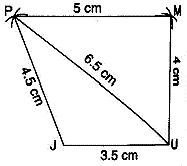
Steps of Construction :
- Draw JU = 3.5 cm.
- With J as centre and radius JP = 4.5 cm, draw an arc.
- With U as centre and radius UP = 6.5 cm, draw another arc to intersect the arc of step 2 at P.
- With U as centre and radius UM = 4 cm, draw an arc on the side of PU opposite to that of J.
- With P as centre and radius PM = 4 cm, draw another arc to intersect the arc of step 4 at M.
- Join UM, MP, PJ and UP.
Then, JUMP is the required quadrilateral.
Posted by Shereeya Patial 7 years ago
- 1 answers
Yogita Ingle 7 years ago
Divisibility Rule of 3=The sum of the digits should be divisible with 3.
There are many possible answers but here's one.
34x = 7x
So 7 must be added to 2 to make 9 which is divisible by 3.
x = 2
Posted by Sachin Gupta 7 years ago
- 2 answers
?☺???Hrishi Khapekar???☺? 7 years ago
Posted by Amrit Kaur 7 years ago
- 2 answers
Prince Verma 7 years ago

myCBSEguide
Trusted by 1 Crore+ Students

Test Generator
Create papers online. It's FREE.

CUET Mock Tests
75,000+ questions to practice only on myCBSEguide app

Akshata Gite 7 years ago
0Thank You