
Ask questions which are clear, concise and easy to understand.
Ask QuestionPosted by Purvi Rawat 5 years, 7 months ago
- 2 answers
Yogita Ingle 5 years, 7 months ago
n/5+3=-7/2
n/5 = -7/2 - 3
n/5 = (-7 - 6)/2
n/5 = -13/2
2n = - 65
n = -65/2
Posted by Muhammed Saffan . A 5 years, 7 months ago
- 1 answers
Yogita Ingle 5 years, 7 months ago
From the given, Let Ravi’s present age is taken as "a" years.
After 15 years, his age = (a+15) years.
By the given, it is identified that the age of Ravi after 15 years is equal to the 4 times of his present age.
Given,
a + 15 = 4a
4a - a = 15
3a = 15
a = 15/3
a= 5
Then, it has been found that the present age of Ravi is 5 when his age after 15 years will be 4 times of his present age.
Posted by Sadhana Swathi 5 years, 7 months ago
- 0 answers
Posted by Rajesh Palathitta 5 years, 7 months ago
- 1 answers
Yogita Ingle 5 years, 7 months ago
3x/4 - 2x + 5/3 = 5/2
3x /4 - 2x = 5/2 - 5/3
(3x - 8x)/4 = (15 - 10)/6
-5x/4 = 5/6
- 30x = 20
x = -20/30
x = -2/3
Posted by Sowjanya Lekisha 5 years, 7 months ago
- 1 answers
Yogita Ingle 5 years, 7 months ago
Given : ||gm ABCD in which diagonals AC and BD bisect each other.
To Prove : OA = OC and OB = OD
Proof : AB || CD (Given)
∠1 = ∠2 (alternate ∠s)
∠3 = ∠4 = (alternate ∠s)
and AB = CD (opposite sides of //gm)
∆COD = ∆AOB (A.S.A. rule)
OA = OC and OB = OD
Hence the result.
Posted by Tarunakumar Dalai 5 years, 7 months ago
- 1 answers
Posted by Suravi Roy 5 years, 7 months ago
- 2 answers
Posted by Namita Biju Nair 5 years, 7 months ago
- 0 answers
Posted by Vaibhav Anil 5 years, 7 months ago
- 0 answers
Posted by Bhole Kaa Deewana 5 years, 7 months ago
- 3 answers
Piyush Kumar Kumar 5 years, 7 months ago
Gaurav Seth 5 years, 7 months ago
The Range is the difference between the lowest and highest values.
Example: In {4, 6, 9, 3, 7} the lowest value is 3, and the highest is 9.
So the range is 9 − 3 = 6.
In the given sum the highest number is 18 and the lowest number is is 9
Hence Range = highest minus lowest
= 18 - 9
= 9
Yogita Ingle 5 years, 7 months ago
Highest value = 18
Least value = 9
Range = Highest value - Least value
= 18 - 9
Range = 9
Posted by Masum Patel 5 years, 7 months ago
- 1 answers
Sajal Choudhary 5 years, 7 months ago
Posted by Sakhavala Dhrumil Shailebhai 5 years, 7 months ago
- 3 answers
Aditi Mondkar 5 years, 7 months ago
Posted by Subhashree Mohanta 5 years, 7 months ago
- 1 answers
Sajal Choudhary 5 years, 7 months ago
Posted by Vaishnavi Padshetty ....... 5 years, 7 months ago
- 2 answers
Vaishnavi Padshetty ....... 5 years, 5 months ago
Ashwin Nair 5 years, 5 months ago
Posted by Megha Santhosh 5 years, 7 months ago
- 1 answers
Posted by Swati Shinde 5 years, 7 months ago
- 1 answers
Sajal Choudhary 5 years, 7 months ago
Posted by Rajesh Palathitta 5 years, 7 months ago
- 5 answers
Sajal Choudhary 5 years, 7 months ago
Posted by Anande Anande 5 years, 7 months ago
- 5 answers
Posted by Santosh Dwivedi 5 years, 7 months ago
- 3 answers
Gaurav Seth 5 years, 7 months ago
1. 5832=3×3×3×3×3×3×2×2×2
=3×3×2
=18
2. 262144
The prime factors are: 2 x 2 x 2 x 2 x 2 x 2 x 2 x 2 x 2 x 2 x 2 x 2 x 2 x 2 x 2 x 2 x 2 x 2
= 2 x 2 x 2 x 2 x 2 x 2
= 64
Posted by Vani Bhatia 5 years, 7 months ago
- 2 answers
Lucky Somra 5 years, 7 months ago
Yogita Ingle 5 years, 7 months ago
-2/5×3/7+3/10-3/5×1/7
= -15/35 + 3/10 + 3/35
= (-30 + 21 + 6)/70
= -3/70
Posted by Hameera Sadaf 5 years, 7 months ago
- 1 answers
Yogita Ingle 5 years, 7 months ago
(3p-2)-5(6p-1)=2(p-8)-6(7p-4)
3p - 2 - 5(6p) - 5 (-1) = 2p - 2 (8) - 6(7p) - 6 (-4)
3p - 2 - 30p + 5 = 2p - 16 - 42p + 24
-27p + 3 = -40p +8
-27p + 40p = 8 - 3
13p = 5
p = 5/13
Posted by Kaushik Agarwal 5 years, 7 months ago
- 2 answers
Yogita Ingle 5 years, 7 months ago
Prime Factors of 110592 =2, 2, 2, 2, 2, 2, 2, 2, 2, 2, 2, 2, 3, 3, 3
Which is the same as = 212 x 33
Prime Factors Tree of 110592
| 110592
<div>/ \ 2 <a href="https://www.2dtx.com/prime/prime55296.html">55296 </a></div> <div> <div>/ \ 2 <a href="https://www.2dtx.com/prime/prime27648.html">27648 </a></div> </div> <div> <div>/ \ 2 <a href="https://www.2dtx.com/prime/prime13824.html">13824 </a></div> </div> <div> <div>/ \ 2 <a href="https://www.2dtx.com/prime/prime6912.html">6912 </a></div> </div> <div> <div>/ \ 2 <a href="https://www.2dtx.com/prime/prime3456.html">3456 </a></div> </div> <div> <div>/ \ 2 <a href="https://www.2dtx.com/prime/prime1728.html">1728 </a></div> </div> <div> <div>/ \ 2 <a href="https://www.2dtx.com/prime/prime864.html">864 </a></div> </div> <div> <div>/ \ 2 <a href="https://www.2dtx.com/prime/prime432.html">432 </a></div> </div> <div> <div>/ \ 2 <a href="https://www.2dtx.com/prime/prime216.html">216 </a></div> </div> <div> <div>/ \ 2 <a href="https://www.2dtx.com/prime/prime108.html">108 </a></div> </div> <div> <div>/ \ 2 <a href="https://www.2dtx.com/prime/prime54.html">54 </a></div> </div> <div> <div>/ \ 2 <a href="https://www.2dtx.com/prime/prime27.html">27 </a></div> </div> <div> <div>/ \ 3 <a href="https://www.2dtx.com/prime/prime9.html">9 </a></div> </div> <div> <div>/ \ 3 <a href="https://www.2dtx.com/prime/prime3.html">3 </a></div> </div> <div> <div>/ \ 3 <a href="https://www.2dtx.com/prime/prime1.html">1 </a></div> </div> |
Posted by Nishant Dahiya 5 years, 7 months ago
- 1 answers
Yogita Ingle 5 years, 7 months ago
Pythagorean triplets:
For any natural number m > 1, we have (2m) ² + (m2 – 1)²= (m2 + 1)² . So, 2m, m² – 1 and m² + 1 forms a Pythagorean triplet.
I) Let 2m = 6
m = 3
m²+ 1 = 3² + 1= 9 + 1 = 10
m²- 1 = 3 2 - 1 = 9 - 1 = 8
check:
6 ² + 8² = 36 + 64 = 100 = 10²
Hence, the triplet is 6, 8 & 10
ii)
Let 2 m = 14
m = 7
m² + 1 = 7²+ 1 = 49 + 1 = 50
m²- 1 = 7² - 1 = 49 - 1 = 48
check:
14² + 48² = 196 + 1304 = 2500 = 50²
Hence, the triplet is 14, 48, and 50
Posted by Nilkamal Ahima 5 years, 7 months ago
- 1 answers
Gaurav Seth 5 years, 7 months ago
Consider a polygon with n vertices. Each vertex can be connected to the n-1 other vertices but two of those connections (to the two adjacent vertices) form sides of the polygon, not diagonals. So there are n-3 diagonals emanating from each of the n vertices giving n(n-3) diagonals. This formula overcounts because it counts each diagonal twice: once for each vertex on the diagonal. Divide by two to compensate for the overcounting giving n(n-3)/2 diagonals.
You can set n(n-3)/2 = 20, expand and solve the quadratic equation by factorization but this is time consuming and inefficient. Way faster is to simply plug in the answer choices for n and see which one satisfies the equation: n(n-3) = 40. Ans: n=8.
20=(n^2-3n)/2
40=n^2-3n
n^2-3n-40= 0
Splitting the middle term,
n^2-8n+5n-40=0
n(n-8)+5(n-8)=0
(n-8)(n+5)= 0
So there are two values for n
n-8=0 or n+5=0
n = 8 or n = -5
n can’t be negative
So n = 8
Posted by Adarsh Dubey 5 years, 7 months ago
- 2 answers
Yogita Ingle 5 years, 7 months ago
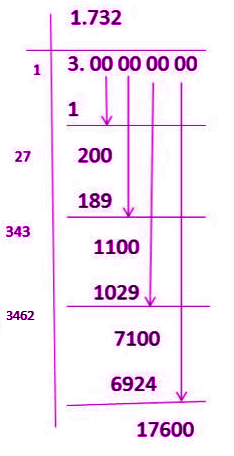
Value of root 3, √3 =1.732
Since 3 is a non-perfect square number, we will find the value of root 3 using long division method as follows
Posted by Harini Poornima 5 years, 7 months ago
- 3 answers
Sonal Ramteke 5 years, 7 months ago
Yogita Ingle 5 years, 7 months ago
Multiply (-5a²b²)by(-6ab) = (-5a²b²) × (-6ab)
= 30a3b3

myCBSEguide
Trusted by 1 Crore+ Students

Test Generator
Create papers online. It's FREE.

CUET Mock Tests
75,000+ questions to practice only on myCBSEguide app

Purvi Rawat 5 years, 7 months ago
0Thank You