
Ask questions which are clear, concise and easy to understand.
Ask QuestionPosted by S Sai Avinash 5 years, 7 months ago
- 1 answers
Posted by Srushti Arote 5 years, 7 months ago
- 2 answers
Posted by Aditya Thakur 5 years, 7 months ago
- 1 answers
Sajal Choudhary 5 years, 7 months ago
Posted by Komal Sharma 5 years, 7 months ago
- 1 answers
Gaurav Seth 5 years, 7 months ago
How many non-square numbers lie between the following pairs of numbers:
(i) 1002 and 1012 (ii) 902 and 912
(iii) 10002 and 10012
Answer:
i) Between 1002 and 1012
Here, n=100 ∴ n x2 = 100 x 2 = 200
∴ 200 non-square numbers lie between 1002 and 1012 .
(ii) Between 902 and 912
Here, n=90 ∴ 2 x n = 2 x 90 or 180
∴ 180 non-square numbers lie between 90 and 91.
(iii) Between 10002 and 10012
Here, n = 1000 ∴ 2 x n = 2 x 1000 or 2000
∴ 2000 non-square lie between 10002 and 10012.
Posted by Manish Goswami 5 years, 7 months ago
- 1 answers
Posted by Manish Goswami 5 years, 7 months ago
- 1 answers
Posted by Aditya Thakur 5 years, 7 months ago
- 0 answers
Posted by Niharika Sathwika 5 years, 7 months ago
- 1 answers
Posted by Viral Choudhary 5 years, 7 months ago
- 1 answers
Posted by Nildip De 5 years, 7 months ago
- 2 answers
Gaurav Seth 5 years, 7 months ago
Given, Total number participants = 63
Total prize money distributed =
Rs 3000Winner gets a prize of Rs 100
Who does not win gets a prize of Rs 25
Number of winners = ?
Let the number of winners = m
Since,Number of winners + Number of losers = Total number of participants
Or, m + Number of losers = 63
By transposing ‘m’ to RHS, we getNumber of losers = 63 – m
Now,Total Prize money distributed to winners=
Number of winners X prize money distributed to each winner = m X 100 = 100m
Total prize money distributed to losers
= Number of losers X prize money distributed to each loser= (63 – m) X 25 = (63 x 25) – 25 m = 1575 – 25 m
Now,Total Prize money of winners + Total Prize money of losers =
Total prize money
By substituting the total prize money distributed to winners and total prize money distributed to losers, we get100 m + 1575 – 25 m = 3000
⇒ 100 m – 25 m + 1575 = 3000By transposing 1575 to RHS, we get100 m – 25 m = 3000 – 1575⇒75 m = 1425
After dividing both sides by 75, we get the answer.
Thus, number of winners = 19 Answer
Gaurav Seth 5 years, 7 months ago
Let the number of winners =x
∴ Number of participants who are not winners = (63 - x)
∴ Prize money given to: Winners = x Rs 100 = Rs 100 x
Non-winner participants = Rs 25  (63-x)
= Rs 25  63 - Rs 25x
= Rs 1575 - Rs 25x
According to the condition, we have
100x + 1575 - 25x = 3000
or 75x = 3000 - 1575 [Transposing 1575 to RHS]
or 75x = 1425
or x = 1425  75 = 19
Thus, the number of winners = 19
Posted by Vaman Mayache 5 years, 7 months ago
- 2 answers
Posted by Sakshi Singh 5 years, 7 months ago
- 2 answers
Gaurav Seth 5 years, 7 months ago
Find selling price (SP) if a profit of 5% is made on
(a) a cycle of Rs 700 with Rs 50 as overhead charges.
(b) a lawn mower bought at Rs 1150 with Rs 50 as transportation charges.
(c) a fan bought for Rs 560 and expenses of Rs 40 made on its repairs.
<hr />
Posted by Rahul Kumar 5 years, 7 months ago
- 1 answers
Posted by Adarsh Dubey 5 years, 7 months ago
- 0 answers
Posted by Aditya Thakur 5 years, 7 months ago
- 4 answers
Gaurav Seth 5 years, 7 months ago
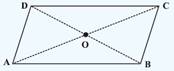
- Parallelogram: A quadrilateral with each pair of opposite sides parallel.
(1) Opposite sides are equal.
(2) Opposite angles are equal.
(3) Diagonals bisect one another.
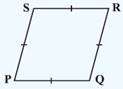
- Rhombus: A parallelogram with sides of equal length.
(1) All the properties of a parallelogram.
(2) Diagonals are perpendicular to each other.
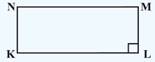
- Rectangle: A parallelogram with a right angle.
(1) All the properties of a parallelogram.
(2) Each of the angles is a right angle.
(3) Diagonals are equal. -
- Square: A rectangle with sides of equal length.
(1) All the properties of a parallelogram, rhombus and a rectangle.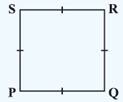
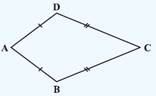
- Kite: A quadrilateral with exactly two pairs of equal consecutive sides
(1) The diagonals are perpendicular to one another
(2) One of the diagonals bisects the other.
(3) In the figure but
but  .
.
- Trapezium: A quadrilateral having exactly one pair of parallel sides.

- Diagonal: A simple closed curve made up of only line segments. A line segment connecting two non-consecutive vertices of a polygon is called diagonal.

- Convex: The measure of each angle is less than
 .
. - Concave: The measure of at least one angle is more than
- Quadrilateral: Polygon having four sides.
- Element of quadrilateral:
(i) Sides: Line segments joining the points.
(ii) Vertices: Point of intersection of two consecutive sides.
(iii) Opposite sides: Two sides of a quadrilateral having no common endpoint.
(iv) Opposite Angles: Two angles of a quadrilateral not having a common arm.
(v) Diagonals: Line segment obtained by joining the opposite vertices.
(vi) Adjacent Angles: Two angles of a quadrilateral having a common arm.
(vii) Adjacent Sides: Two sides of a quadrilateral having a common endpoint.
For ncert exercise copy the given link:
https://mycbseguide.com/blog/ncert-solutions-for-class-8-mathematics/
Posted by Aditya Thakur 5 years, 7 months ago
- 1 answers
Posted by Vidhi Gulgulia 5 years, 7 months ago
- 1 answers
Yogita Ingle 5 years, 7 months ago
Let ones place = x
Tens place = y
number will be = 10y +x
Number after reversing the digits = 10y +x
According to question:
x+y = 12 ⇒ x= 12- y ------(i)
(10y+x) -36 = 10x+y
⇒ 10y +x -10x-y =36 ⇒ 9y - 9x=36 ⇒ y-x=4 ----(ii)
Put the value of (i) in (ii)
y-(12-y)= 4 ⇒ y-12+y = 4 ⇒ 2y= 16 ⇒ y= 8 x= 4
Given number is 10y+x = 10 x 8+4 = 84
Hence, the number is 84
Posted by Mahak♥️ Gupta 5 years, 7 months ago
- 1 answers
Posted by Manoj Edvani 5 years, 7 months ago
- 1 answers
Yogita Ingle 5 years, 7 months ago
Which among these is not a perfect square? a. 225/729 b. 1.96 c. 624 d. 1600
624 is not a perfect square.
Posted by Aditya Thakur 5 years, 7 months ago
- 1 answers
Yogita Ingle 5 years, 7 months ago
- Opposite sides are parallel and congruent
- Opposite angles are congruent
- Consecutive angles are supplementary
- Diagonals bisect each other
Posted by Amrita M Nambiar 5 years, 7 months ago
- 0 answers
Posted by Prince Sarkar 5 years, 7 months ago
- 2 answers
Abhi Yuki 5 years, 7 months ago
Posted by Azath Shariff 5 years, 7 months ago
- 0 answers
Posted by Ganesh Srinivasan 5 years, 7 months ago
- 1 answers
Posted by Øm Kümãr 5 years, 7 months ago
- 2 answers
Yogita Ingle 5 years, 7 months ago
8x –4+11x+(–14)
= 8x - 4 + 11x - 14
=8x + 11x - 4 - 14
= 19x - 18
Posted by Av Vashisht 5 years, 7 months ago
- 1 answers
Gaurav Seth 5 years, 7 months ago
Probability:
Probability is defined as the numerical method of measuring uncertainty involved in a situation.
It is widely used in the study of mathematics, statistics, gambling, physical science, biological science, weather forecasting, finance etc. to draw conclusions.
Posted by Avneet Chouhan 5 years, 7 months ago
- 5 answers

myCBSEguide
Trusted by 1 Crore+ Students

Test Generator
Create papers online. It's FREE.

CUET Mock Tests
75,000+ questions to practice only on myCBSEguide app

Yogita Ingle 5 years, 7 months ago
X+34(20+13)=5(5x+5)
x + 34(33) = 5 (5x) + 5 (5)
x + 1122 = 25x + 25
x - 25x = 25 - 1122
- 24x = - 1097
x = 1097/24
x = 45.71
1Thank You