
Ask questions which are clear, concise and easy to understand.
Ask QuestionPosted by Md Owais Ashraf 6 years, 7 months ago
- 0 answers
Posted by Drone Singh 6 years, 7 months ago
- 1 answers
Posted by Surakha Rangani 6 years, 7 months ago
- 1 answers
Gaurav Seth 6 years, 7 months ago
Question 3: There are ten tubewells in a lane of fifty houses. What could be the long term impact on the water table?
Answer: Ten tube-wells in a lane of fifty houses can lead people to mindlessly exploit the groundwater. This can lead to depletion of the water table in the long run.
Posted by Dadaji Bharre 6 years, 7 months ago
- 1 answers
Divya Prajapati 6 years, 7 months ago
Posted by Amita Patel 6 years, 7 months ago
- 1 answers
Posted by Aryan Nigam 6 years, 7 months ago
- 3 answers
Sreelakshmi Puthiyottil 6 years, 7 months ago
Hanish Singla 6 years, 7 months ago
Adheena Mathews 6 years, 7 months ago
Posted by Tanushree Prakash 6 years, 7 months ago
- 1 answers
Meghna Thapar 6 years, 1 month ago
Iron and sulphur is a mixture so iron and sulphur have retained their properties. However, a compound formed by mixing iron and sulphur, FeS, do not retain the properties of iron and sulphur separately and cannot be separated from the compound only by moving over it.
Posted by Mamata Thakur 6 years, 7 months ago
- 1 answers
Sia ? 6 years, 7 months ago
Stamina is the ability to sustain prolonged physical or mental effort.
Posted by Anishka Kishore 6 years, 7 months ago
- 3 answers
Posted by Ben Stoke 6 years, 7 months ago
- 1 answers
Posted by Khushi Kumari 6 years, 7 months ago
- 0 answers
Posted by Vivek Kumar Koli 6 years, 7 months ago
- 3 answers
Chetali Malviya 6 years, 7 months ago
Adheena Mathews 6 years, 7 months ago
Suman Mishra 6 years, 7 months ago
Posted by Khushi Kumari 6 years, 7 months ago
- 1 answers
Sia ? 6 years, 7 months ago
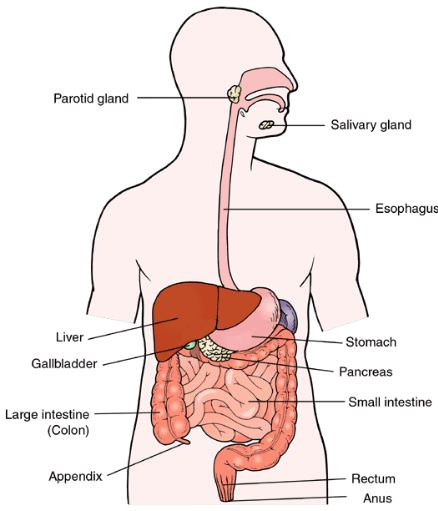
When we ingest food in our mouth, salivary glands of the mouth secrete saliva which moistens the food. It also converts the starch Into sugar. The tongue helps in chewing by moving the food in various directions. Saliva contains enzyme called salivary amylase which converts starch into sugar.Oesophagus Eh From mouth food goes into foodpipe called oesophagus. As food enters into the foodpipe, muscles of its wall start contraction and relexation movement. This movement is called peristaltic movement that pushes the food into the stomach. The peristaltic movement occurs throughout the alimentary canal. The oesophagus leads the food a sac like structure called stomach. The food is churned and partly digested in the stomach. The semi-solid food passes from the stomach to much coiled tube-like structure called the small intestine. The small intestine. serves two purposes—digestion and absorption of the digested food. It is about 20 feet long. The inner surface of the small intestine has a large number of fingerlike projections called villi. The Villi increase the surface area for the absorption of digested food. The absorbed food enters into the blood stream and carried away to various parts of the body for assimilation. The undigested food moves from the small intestine to the large intestine where mainly absorption of water from the undigested food takes place. From the large intestine the undigested food passes to the rectum which pushes it out of the body through the opening called the **** as faeces.
Posted by Khushi Kumari 6 years, 7 months ago
- 1 answers
Yogita Ingle 6 years, 7 months ago
Change in which only physical properties of a substance change and no new substance is formed is called Physical Change.
Examples of Physical changes:
1. Ice melting involves a change from a solid to a liquid and the substances maintain the properties of water because the molecules never change.
2. Water boiling is a physical change as water molecules vibrate faster, they enter the gas phase and become water vapor.
3. Rubbing alcohol left uncovered will evaporate quickly into the air. It turns to a gas but maintains the properties of alcohol.
4. Hot molten iron is a liquid and when left to cool will from solid steel and can take many forms.
5. Dissolving sugar in water is a physical change. The solid sugar never loses its properties, the molecules become separated by water and the sugar can easily be recovered by evaporating the water.
Posted by Nidhi Talokar 6 years, 7 months ago
- 1 answers
Posted by Shashibhushan Prasad 6 years, 7 months ago
- 1 answers
Meghna Thapar 6 years, 1 month ago
The uppermost layer of earth’s crust is called soil. Soil is one of the most important natural resources. It supports the growth of plants by holding the roots firmly and supplying water and nutrients. Soil contains air, water and countless living organisms like bacteria, fungi, insects, worms, rodents, moles, and plant roots. Soil is existence of life on the earth.
Posted by Vansh Bhatia 6 years, 7 months ago
- 1 answers
Yogita Ingle 6 years, 7 months ago
Rainwater which falls on roofs and terraces of buildings can be collected through pipes and stored in underground tanks or can be allowed to percolate into the soil and used to recharge the groundwater table. This is called water harvesting or rainwater harvesting. The main aim of rainwater harvesting is to check the runoff water.
The benefits of rainwater harvesting system are listed below.
- Less of cost
- Helps in reducing the water bill
- Decreases the demand for water
- Reduces the need for imported water
- Promotes both water and energy conservation
- Improves the quality and quantity of groundwater
- Does not require a filtration system for landscape irrigation
- This technology is relatively simple, easy to install and operate
- It reduces soil erosion, stormwater runoff, flooding, and pollution of surface water with fertilizers, pesticides, metals and other sediments.
Posted by Dharmendra Kumar 6 years, 7 months ago
- 2 answers
Yogita Ingle 6 years, 7 months ago
Cotton clothes are thin and do not have space in which air can be trapped. Thus, cotton clothes do not prevent heat coming out of our body. Woollen clothes keep us warm during winter because wool is a poor conductor of heat and it has air trapped in between the fibres.
Posted by Dharmendra Kumar 6 years, 7 months ago
- 2 answers
Prince Bhatter 6 years, 7 months ago
Posted by Deepak Rathore 6 years, 7 months ago
- 1 answers
Yogita Ingle 6 years, 7 months ago
Physical Change: Change in which only physical properties of a substance change and no new substance is formed is called Physical Change.
Most of the physical changes are reversible, this means we can get the substance back even after the change.
Chemical changes: Changes in which chemical properties of substance change and a new substance is formed are called chemical changes. Some of the chemical changes are irreversible. Even in case of reversible changes in which chemical properties of substance change and a new substance is formed are called chemical changes. Some of the chemical changes are irreversible.
Posted by Laiju Kt 6 years, 7 months ago
- 1 answers
Yogita Ingle 6 years, 7 months ago
Calcium hydroxide, commonly referred to as slaked lime, is described by the chemical formula Ca(OH)2. It is an inorganic compound which has a white, powdery appearance in its solid state. However, Ca(OH)2 has a colorless appearance in its crystalline form.
Posted by Priti Thakur 6 years, 7 months ago
- 1 answers
Yogita Ingle 6 years, 7 months ago
- Fats take longer time to digest than carbohydrates.
- When it comes to fats they cannot be digested so easily since they are quite insoluble in water and are thereby present as large globules.
- The bile juice that gets secreted breaks down the fat from bigger droplets into smaller ones.
Posted by Priyanshu Sharma 6 years, 7 months ago
- 1 answers
Deepak Rathore 6 years, 7 months ago
Posted by Sharanyaa Mandal 6 years, 7 months ago
- 3 answers
Yogita Ingle 6 years, 7 months ago
|
Breathing involves the process of inhaling and exhaling the air in and out of lungs. While breathing, oxygen is inhaled and carbon dioxide is exhaled. |
Respiration is the process of the breaking down the glucose to produce energy which is used by cells to carry out the cellular function. |
|
Breathing takes place in lungs. |
Respiration takes place in cells. |
|
Breathing is a physical voluntary process. |
Respiration is a chemical involuntary process. |
|
No energy is produced during the process. |
Energy is released in the form of ATP. |
|
It is an extracellular process, as it occurs outside cells. |
It is an intracellular process, as it occurs inside cells. |
|
No enzymes are used during the process. |
A large number of enzymes are used during the process. |
Posted by Manish Yadav 6 years, 7 months ago
- 3 answers
Yug Verma 6 years, 7 months ago
Yogita Ingle 6 years, 7 months ago
In small intestines, the intestinal juice contains a number of enzymes which complete the digestion process by converting complex carbohydrates into glucose, proteins into amino acids and fats into fatty acids and glycerol.
Posted by Shivam Kumar 6 years, 7 months ago
- 3 answers
Yug Verma 6 years, 7 months ago
Tulika Kamra 6 years, 7 months ago
Posted by Thatavarthi Jasmitha 6 years, 7 months ago
- 1 answers

myCBSEguide
Trusted by 1 Crore+ Students

Test Generator
Create papers online. It's FREE.

CUET Mock Tests
75,000+ questions to practice only on myCBSEguide app
