
Ask questions which are clear, concise and easy to understand.
Ask QuestionPosted by Anish Sharma 7 years, 11 months ago
- 0 answers
Posted by Sanket De 7 years, 11 months ago
- 0 answers
Posted by Surinder Kumar 7 years, 11 months ago
- 0 answers
Posted by Inaaya Waqar 7 years, 11 months ago
- 0 answers
Posted by Riza Ansari 7 years, 11 months ago
- 1 answers
Yogita Ingle 7 years, 11 months ago
Pinhole Camera: The pinhole camera works on the principle that light travels in a straight line. The image formed by a pinhole camera is real, inverted and diminished in size when compared to the original object. Pinhole cameras are inexpensive and are easy to make. An eclipse can be viewed using a pinhole camera.
Making a Pinhole Camera
• Take two rectangular boxes that fit into one another without leaving any gap.
• Cut open one side of each box.
• Make a small hole in the larger box at the centre of the closed end opposite to the side that has been cut open.
• Cut a square of side five centimetres in the smaller box in the closed end opposite to the side that has been cut open. Cover this square with tracing paper.
• Finally, slide the smaller box into the larger box, ensuring that the pinhole and the tracing paper are in line with one another, but at the opposite ends.
• Slide the smaller box to adjust the focus so that you can capture the image of any object you want.
This is the basic structure of the pinhole camera. However, the developed form of a pinhole camera uses photosensitive film instead of translucent paper to capture images. The film can be developed later to obtain photo prints. Nowadays, of course, we use digital cameras that store images in a computer chip. However, the basic principle of capturing the image remains the same.
Posted by Harmanpreet Kaur 7 years, 11 months ago
- 0 answers
Posted by Sukhmani Hunjan 7 years, 11 months ago
- 1 answers
Posted by Anish Sharma 7 years, 11 months ago
- 1 answers
Yogita Ingle 7 years, 11 months ago
A dry cell is a voltage generating cell in which the electrolyte is in the form of a moist paste. Because of this there is no spilling of electrolyte and hence becomes portable. This is used in torch lights, portable radios, etc. Zinc-Carbon batteries and alkaline batteries are examples of dry cells.
A dry cell consists of a metal electrode or graphite rod surrounded by a moist electrolyte paste enclosed in a metal cylinder as shown here. Different chemicals can be used to create this paste, such as ammonium chloride and manganese dioxide, depending on the type of battery. The cathode and electrolyte paste are wrapped in paper or cardboard and sealed into a metal cylinder called an anode, which is made of zinc.
The anode in the dry cell battery has two terminals, one that is positive and one that is negative. When a load is connected to the battery's terminals, a chemical reaction occurs between the anode and the paste that produces roughly 1.5 volts of electricity. A pin or collector in the middle of the battery conducts this charge out of the battery to an external circuit. This circuit physically connects to the electronic device the battery is in, providing the charge necessary for the device to function.
Posted by Gyandeep Rathore 7 years, 11 months ago
- 1 answers
Yogita Ingle 7 years, 11 months ago
Cell
(i) The single unit device which converts the chemical energy into electrical energy
(ii) Supply power for a short time.
(iii) Applied in clocks, lamp, radio, remote control devices etc.
(iv) It is cheap by cost.
Battery
(i) It is the collection of electrochemical cells which either connects in series or in parallel.
(ii) Supply power for a long time.
(iii) Applied in Automobiles, inverter, emergency light etc.
(iv) It is costly by cost.
Posted by Srihari Reddy 6 years, 7 months ago
- 1 answers
Sia ? 6 years, 7 months ago
If a person’s clothes catch fire, he/she has to be rolled in a blanket so that the oxygen supply cuts off and hence the fire extinguishes. Blanket cuts off the supply of oxygen to the person’s body and as it is the supporter of combustion, the fire puts off.
Posted by Yashvi Tushir 6 years, 7 months ago
- 1 answers
Sia ? 6 years, 7 months ago
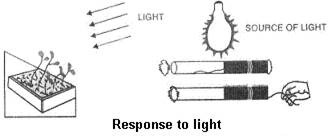
All living things respond to changes in their surroundings. These changes which they respond to, are called stimuli. The living things show response to stimuli such as heat, light, touch, sound, smell and taste etc. The response of living things is usually in the form of some movement of their body part. Plant also perform movement, though at a slow rate. For example, chhui-mui, kachhan flowers of lotus and water lily show such type of activity. So all things (animals and plants) respond to external stimuli.
Posted by Vaishnavi V 7 years, 11 months ago
- 0 answers
Posted by Sampreeth Rock 7 years, 11 months ago
- 0 answers
Posted by Aryan Pathak 6 years, 7 months ago
- 1 answers
Sia ? 6 years, 7 months ago
An atom is the smallest constituent unit of ordinary matter that has the properties of a chemical element.
Posted by Aryan Pathak 7 years, 11 months ago
- 0 answers
Posted by Manya Gupta 7 years, 11 months ago
- 1 answers
Yogita Ingle 7 years, 11 months ago
Difference between Locomotion and Movement
• Locomotion takes place at organism level while movement can take place at any biological level from cellular to organisms.
• Locomotion is usually voluntary while movement could be either voluntary or involuntary.
• Movement essentially requires energy, but locomotion does not essentially require energy when the free-floating organisms are considered.
• Usually plants do not move from place to place, but there are various types of movements take place inside plants.
Posted by Ashutosh Kumar Kumar 7 years, 11 months ago
- 0 answers
Posted by Sandeep Bhujbal 7 years, 11 months ago
- 1 answers
Posted by Khushbu Chouhan 7 years, 11 months ago
- 0 answers
Posted by Prachi Bansal 7 years, 11 months ago
- 1 answers
Khushbu Chouhan 7 years, 11 months ago
Posted by Pooja Aggarwal 7 years, 11 months ago
- 0 answers
Posted by Avantika Tomar 7 years, 11 months ago
- 0 answers
Posted by Humera Singh 7 years, 11 months ago
- 0 answers
Posted by Humera Singh 7 years, 11 months ago
- 1 answers
Posted by Partha Pratim Baishya 7 years, 11 months ago
- 1 answers
Posted by Pratibha Maheshwari 6 years, 7 months ago
- 1 answers
Sia ? 6 years, 7 months ago
The atmosphere of Earth protects life on Earth by creating pressure allowing for liquid water to exist on the Earth's surface, absorbing ultraviolet solar radiation, warming the surface through heat retention (greenhouse effect).
Posted by Sahil Gadadinni 6 years, 7 months ago
- 1 answers
Sia ? 6 years, 7 months ago
A host is an organism that harbors another organism, inside or near their body, in a symbiotic relationship.
Posted by Prachi Gupta 6 years, 7 months ago
- 1 answers
Sia ? 6 years, 7 months ago
When rays of light coming from an object strike the smooth surface of a mirror, they bounce back at the same angle. Your eyes see these reflected photons as a mirror image.

myCBSEguide
Trusted by 1 Crore+ Students

Test Generator
Create papers online. It's FREE.

CUET Mock Tests
75,000+ questions to practice only on myCBSEguide app
